Neither one wins everywhere. Solid wood is the better choice for parts that take hard wear and may need refinishing for decades: frames, legs, doors with raised panels, tabletops you will sand. Veneer over a stable core is often the better choice for large, flat surfaces like cabinet sides, wide panels and long shelves, where solid boards tend to move with the seasons. Most well-built cabinetry uses both, each where it performs best.
Below is how the two differ, where each one fails, how to tell them apart in a showroom or a secondhand piece, and how the choice plays out in a Central Illinois home, where humidity swings hard between January and July.
TL;DR
- Solid wood is natural timber all the way through, so it can be sanded and repaired repeatedly. Veneer is a thin slice of real wood bonded to a core such as plywood or MDF.
- Veneer is often more stable than wide solid panels, which is why it is common on flat surfaces like cabinet sides and tabletops.
- Solid wood suits high-wear, load-bearing parts. Veneer is only as good as its core, glue and edge work.
- Check the edges and end grain to tell them apart: continuous grain means solid, a thin seam or a visible core means veneer.
- The best cabinets usually combine solid frames and doors with veneered or plywood panels.
Table of Contents
- What each material actually is
- Movement: the real difference in a Central Illinois home
- Solid wood vs veneer side by side
- Where solid wood is the better call
- Where veneer is the better call
- How veneer goes wrong
- How to tell solid wood from veneer
- Cabinets, shelves and closets: the questions we hear most
- What this costs
- Our perspective: use each material where it earns its place
- How to choose: a short checklist
- Working with us
- FAQ
- Sources
What each material actually is
Solid wood is a single, continuous piece of natural timber through its whole thickness. Veneer is a thin slice of real wood, typically about 0.6 mm or 1/42 inch thick, bonded to a substrate such as plywood, particleboard or MDF.
That definition matters because “veneer” is not the same as laminate or a printed photograph of wood. Real wood veneer is cut from a log and has the grain, color variation and feel of the species it came from. A veneer overview from a commercial furniture manufacturer separates the three categories: veneer, solid wood and laminate. Laminate is the one that imitates wood rather than being wood.
Penn State Extension notes that hardwood veneer is sliced or peeled from a hardwood log and is made from high-quality logs. So the face you see can be the same species and quality you would pay for in boards.
Movement: the real difference in a Central Illinois home
Wood takes on and gives off moisture as the air around it changes. Purdue Extension explains that wood exposed to 75 percent relative humidity settles at about 14 percent moisture content, and that composites tend to settle at somewhat lower values than solid wood. Solid wood swells and shrinks mostly across the grain, and that is where trouble starts.
In practice:
- A wide solid panel can cup, split or pull out of its frame if it is glued down rigidly or not allowed to move.
- Cross-grain expansion can fracture the frames of raised-panel doors, and joints tend to fail when lumber was not properly dried or acclimated to the home before installation.
- Veneer on an engineered core is often more dimensionally stable, because the core resists the warping, shrinking and expansion that humidity causes. That is why it works well for tabletops and cabinet doors with large flat faces.
Central Illinois has humid summers and dry, heated winters, so every piece of wood in a house gets a full seasonal cycle. We wrote about this in our guide to the best wood for humidity in Central Illinois. The short version is that species alone does not solve movement. Construction does: grain direction, panel design, joinery and acclimation.
If you are weighing plywood as a stable base for any surface, one UK guide to plywood under bathroom floors is a useful read on how a layered sheet behaves compared with a single board. It is written for British homes, so treat its product names and regulations as UK-specific.
Solid wood vs veneer side by side
| Factor | Solid wood | Veneer over a stable core |
|---|---|---|
| Construction | One continuous piece of timber | Thin real-wood face on plywood, MDF or particleboard |
| Stability on wide flat panels | More movement, can cup or crack | Generally more stable |
| Repair and refinishing | Can be sanded and refinished repeatedly | Limited by the thin face layer |
| Scratches and dents | Can be sanded out | Deep damage can break through to the core |
| Load-bearing parts | Preferred | Not ideal for legs, frames, posts |
| Grain matching | Limited by board width | Easy to match across doors and panels |
| Use of rare species | Uses more timber per surface | Spreads one log across more surfaces |
| Quality risk | Poor drying, rigid joinery | Poor glue, thin face, bad edge banding |
Where solid wood is the better call
Industry guidance consistently puts solid wood ahead on high-wear structural parts like table legs, chair frames and bed posts, where the material has to carry load and last. The American Hardwood Information Center makes a similar case that solid hardwood furniture and cabinetry can serve many generations of hard use.
Choose solid wood when:
- The piece will be refinished over its lifetime, such as a dining table or a bar top.
- It takes impact: stair parts, bench seats, drawer fronts that get banged daily.
- You want edges that can be shaped, profiled or repaired with no visible seam.
- It is a frame or stile-and-rail door, where the width of each part is small enough that movement is manageable.
One practical point: solid wood does not fail from age, it fails from design. A narrow, well-dried board in a floating panel will outlast a badly glued wide slab, and that is a joinery question, not a species question.
Where veneer is the better call
Veneer gets an unfair reputation as a cheap stand-in. Craftspeople point out that professional veneering is a deliberate design choice that allows careful grain matching and stable performance in complex cabinetry, especially compared with the unpredictable movement of wide solid panels.
There is also a resource argument. Because one log can yield many thin sheets, veneer makes rare or expensive species go further than milling boards from the same volume of timber.
Choose veneer when:
- The surface is large and flat: cabinet end panels, wall panels, wide shelving, headboards.
- You want continuous grain across several doors or drawers, which book-matching and sequence-matching make possible.
- The species is expensive or scarce and you want its look without the cost of thick boards.
- Flatness matters more than the ability to refinish many times.
How veneer goes wrong
The fear is legitimate when the work is poor. Three failure points to know:
- Moisture at lay-up. Veneer applied at too high a moisture content on a stable core can develop surface checks, which are fine cracks, as it dries in a climate-controlled home. Those are very hard to repair without refinishing the whole surface.
- Thin face, hard hit. A scratch or chip that goes through a 0.6 mm layer shows the core. Veneer can be more susceptible to scratches and chips than solid wood, so sanding out a gouge is not an option.
- Weak edges. Edge banding that lifts or a visible seam is the usual first sign of cheap construction.
How to tell solid wood from veneer
You do not need tools. Look at where the surface ends.
- Edges and end grain. In solid wood, the grain pattern runs consistently through the thickness. A veneered edge shows a thin line of core or a seam where edge tape meets the surface.
- Pattern repeats. If the grain on two drawer fronts looks identical, it is likely veneer or a printed surface. Real boards rarely repeat.
- Underside and inside. Check the back of a panel, the inside of a drawer and any unfinished spot. Particleboard or MDF texture tells you the core.
- Weight. Solid hardwood is heavy for its size, though plywood and MDF can be heavy too, so use this as a hint only.
- The seller’s wording. Be careful with “solid wood” labels. The term is sometimes used loosely for pieces with solid frames and veneered panels, which can be perfectly good construction but is not solid throughout. Ask what is solid and what is not.
Cabinets, shelves and closets: the questions we hear most
Most homeowners in our area ask about this in the context of a kitchen or a built-in, not a coffee table. Here is how the same logic applies.
Stock, RTA and custom cabinets
The material question and the buying route are separate. Stock and ready-to-assemble (RTA) cabinets come in fixed sizes and usually have a particleboard or MDF box with a laminate, thermofoil or veneer finish. Custom work is built to your walls, so it avoids filler strips and awkward gaps, and you choose the materials: a solid hardwood face frame and doors, with plywood or veneered panels for the box where flatness matters. A big-box brand’s flat-pack line can be a fair fit for a rental or a short-term space. For a kitchen you plan to live with for twenty years, a cabinet built to your room and made from the right material in each place tends to be the better value.
Plywood, MDF and melamine for shelves and closets
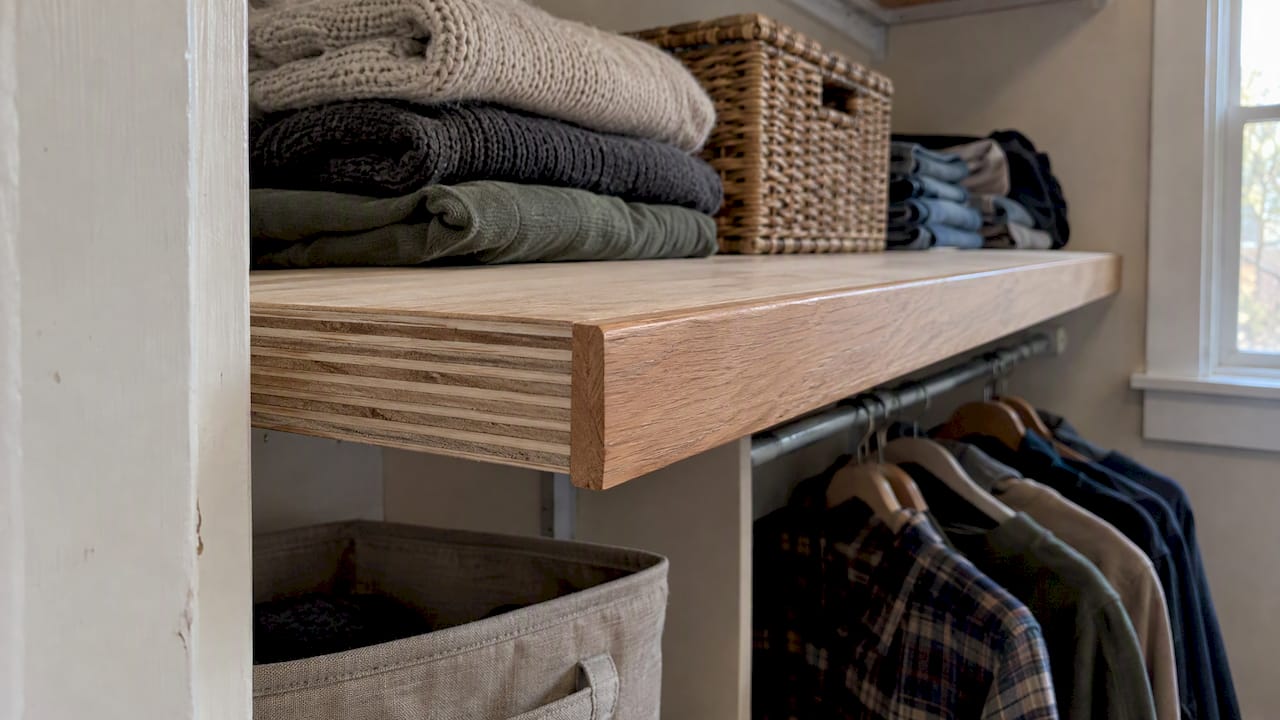
For long shelves, the issue is sag and flatness. Plywood holds screws well and is lighter; MDF is very flat and smooth for painted or veneered faces but heavier and weaker at the edges. Melamine, a resin-coated particleboard, gives a tough, wipeable surface that is common in closets, with edges that need banding. For a heavily loaded span, a solid hardwood front edge on a plywood shelf adds stiffness and hides the layers.
Formaldehyde and composite cores
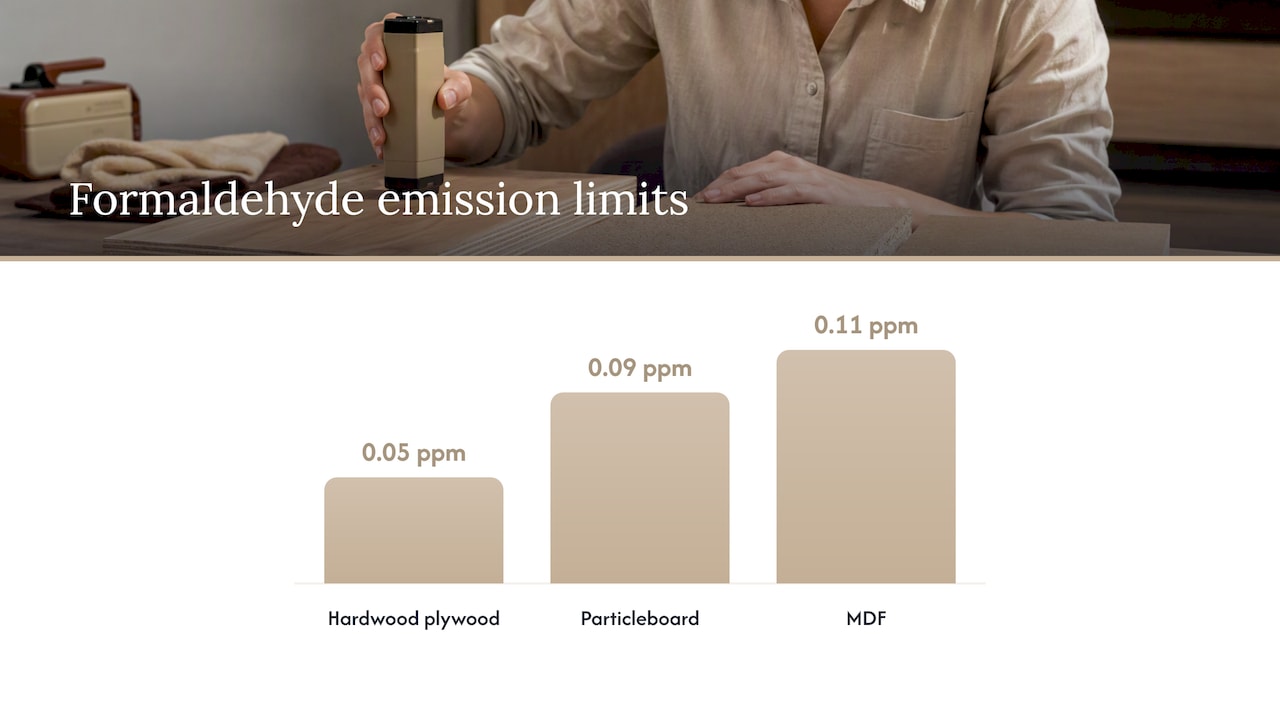
Veneer is usually glued to a composite or plywood core, so emissions are worth a question. Under EPA’s TSCA Title VI rule, hardwood plywood must meet a 0.05 ppm formaldehyde emission limit, particleboard 0.09 ppm and MDF 0.11 ppm. Ask any supplier or builder for the compliance labeling on the panels they use. If anyone in your household has asthma or chemical sensitivities, raise it with your doctor and tell your carpenter before materials are ordered.
What this costs
Veneer is not automatically cheaper. A premium veneer on a good plywood core, matched across a whole kitchen, takes skilled labor. Solid wood costs more per board foot but needs less engineering for small parts. The honest answer is that price follows species, thickness, finish and labor more than the solid-versus-veneer label. Judge a quote by what it specifies: species, core type, edge treatment and how panels are allowed to move.
Our perspective: use each material where it earns its place
We build for Central Illinois homes and small businesses, and our team has more than 100 years of combined carpentry experience. What that experience teaches is that the question “solid or veneer” is usually the wrong one. The better one is “what is this part asked to do?”
A face frame, a stile, a door rail or a bar top is asked to take wear and be repaired. We make those from solid wood. A wide cabinet side or a long built-in panel is asked to stay flat through a humid July and a dry January. There, a stable core with a well-matched face often outperforms a wide board, and we say so even when a client arrives asking for solid everything.
We also think of finish as the skin and the material beneath as the bones. A beautiful face over a poorly chosen core will disappoint, and so will a thick board used without room to move. Maintenance and material choice are a marathon, not a sprint.
Our advice for a budget-conscious project: spend on solid wood where hands, knees and cleaning cloths touch it every day, and let veneered or plywood panels do quiet structural work elsewhere. That is also how we keep custom work cost-effective without leaning on thin or unknown materials.
— Wood
How to choose: a short checklist
- List the parts. Frames, doors, sides, shelves, tops. Decide each separately.
- Match the material to the load. Legs, rails, stairs and bar tops lean solid. Wide flat panels lean engineered.
- Check the humidity exposure. Kitchens, entryways and rooms with seasonal swings need extra attention to movement.
- Ask about the core, glue and edges on anything veneered, and about drying and acclimation on anything solid.
- Decide whether you will refinish. If yes, favor solid on the surfaces you will sand.
- Get the specification in writing: species, thickness, core and finish.
Working with us
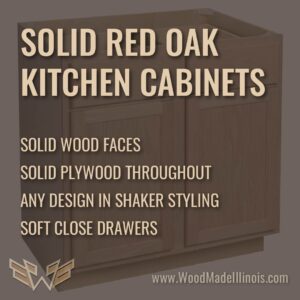
If you are planning a kitchen, a built-in or a home office in Central Illinois, we can walk through these choices on your actual walls and budget. See our kitchen cabinet service or our solid red oak kitchen cabinets if you know you want real hardwood. For smaller projects, our pallet wall accents start from $500, and you can see our full range on our main page.
FAQ
Is veneer worse than solid wood?
Not by default. Veneer on a good core can be flatter and more stable than wide solid panels, and it allows careful grain matching. Solid wood wins on repairability and on parts that carry load or take impact.
Can you paint or stain veneer?
Yes, but the thin face limits sanding. Light scuff sanding is fine, while aggressive sanding can cut through to the core. If the piece is an unknown veneer, test an inconspicuous spot first and ask a refinisher before committing to a color change.
How can I tell if a cabinet is solid wood or veneer?
Look at the edges and the end grain. Solid wood shows grain running through the thickness, while veneer shows a thin seam or a layer of core. Also check inside drawers and the back panels for composite texture.
Is solid wood always more expensive?
No. Price depends on species, thickness, finish and labor. A well-made veneered cabinet can cost more than a plain solid one, so compare written specifications rather than labels.
Sources
- “Solid” Hardwood and its Advantages, American Hardwood Information Center
- Real Wood Veneer vs. Solid Wood, UV Group
- The Shrinking and Swelling of Wood and Its Effect on Furniture, Purdue Extension
- Solid Wood vs Wood Veneer Furniture: The Roomlane Guide
- Veneer 101, Haworth
- From the Woods: Hardwood Veneer, Penn State Extension
- Frequent Questions for Consumers about the Formaldehyde Standards, EPA