Choose a naturally rot-resistant species, such as teak, white oak, ipe, cedar, or cypress, or opt for an engineered product, and prioritize proper acclimation and installation above all else. Teak, white oak, ipe, western red cedar, cypress, thermally modified wood, and engineered hardwood are known to perform well in humid settings, but acclimation and correct installation matter more than species choice alone. Sealers slow moisture exchange but never eliminate movement or rot risk entirely.
TL;DR:
- For basements, unvented bathrooms, and laundry rooms, engineered hardwood handles seasonal humidity swings better than solid flooring; at roughly 13% moisture, solid wood becomes risky.
- For flooring and furniture, dry lumber to 6% to 8% moisture content before installation, close to the level it will reach in its room.
- Choose heartwood rather than sapwood in naturally resistant species, because sapwood rots at roughly the same rate as unprotected softwood.
- Solid flooring needs expansion gaps at walls and transitions; floating installation can reduce stress in rooms with higher vapor pressure.
Table of Contents
- Top Moisture-Resistant Woods and Material Types
- How to Choose the Right Wood for Your Humid Room
- Finishing and Installation Practices That Reduce Movement and Moisture Damage
- Maintenance, Humidity Control, and Mold Prevention
- How Humidity Fluctuations Affect Different Wood Types
- Comparing Wood Performance Across Humidity Ranges
- How Indoor Climate Control Shapes Wood’s Long-Term Durability
- Choosing Wood Species for Central Illinois Humidity Conditions
- What We’ve Learned on the Job
- Let Us Handle the Wood Selection for You
- FAQ
- Sources
Top Moisture-Resistant Woods and Material Types
Every humid-climate project calls for a different material, and the right choice depends on exposure, foot traffic, and budget. Below are the species and engineered options we turn to most often, along with where each one earns its keep.
Teak carries natural oils and extractives that repel water and resist decay, which is why boatbuilders have relied on it for centuries. It thrives on outdoor furniture, deck surfaces, and any application facing direct wet exposure, though its price reflects that reputation.
Ipe and other tropical hardwoods bring extreme density and some of the longest service lives available in exterior lumber. Trade guidance on exterior species notes that exotic species like ipe offer superior rot resistance, but sourcing and workability come at a cost: these woods dull blades quickly and often require pre-drilling for every fastener.
White oak has a tight, closed grain structure that resists water infiltration far better than red oak or most domestic softwoods. It performs beautifully as flooring and furniture in humid climates, and it is widely available through domestic suppliers, which keeps cost more reasonable than exotic alternatives.
Western red cedar and cypress are naturally decay-resistant softwoods well suited to outdoor and semi-exposed applications like porch ceilings, siding, and planters. Both are lighter and easier to mill than dense tropical hardwoods, making them practical choices for builders who need decay resistance without the premium price tag of teak or ipe.
Thermally modified wood undergoes a heat treatment process that improves dimensional stability without chemical preservatives. It performs well in humid sites where it is available, though availability and cost vary by region and supplier.
Engineered hardwood and wood-plastic composites become the safer bet when solid wood risks are unacceptable, particularly for flooring in basements or high-vapor rooms. Materials guidance from Wood Magazine points out that engineered hardwood offers a more predictable dimensional response than solid hardwood in these conditions.
A few practical notes shape most of our material decisions on the job:
- Teak and ipe cost significantly more upfront but outlast many budget alternatives by decades.
- White oak and cedar strike a strong balance between cost, availability, and decay resistance for most Midwest projects.
- Family Handyman’s rot-resistant wood guide also lists black locust as a durable, naturally resistant species worth considering where it is locally available.
- Engineered products reduce movement risk but cannot match the appearance or repairability of solid wood over a long lifespan.
How to Choose the Right Wood for Your Humid Room
Picking a species starts with the room, not the catalog. We walk every client through the same framework before recommending a material.
- Match the species to the use case. Flooring and furniture favor white oak or engineered hardwood; outdoor and semi-exposed work favors teak, cedar, cypress, or ipe.
- Choose heartwood over sapwood. Heartwood contains the extractives that give naturally resistant species their decay resistance, while sapwood rots at roughly the same rate as any unprotected softwood. Ask your supplier for appearance grades that exclude sapwood.
- Lean toward engineered products in high-vapor interiors. Basements, below-grade rooms, and spaces with limited ventilation put more stress on solid wood than most species can handle gracefully.
- Confirm the supplier’s drying specification. FPL drying guidance recommends drying lumber for flooring and furniture to roughly 6 to 8% moisture content, close to the moisture level the wood will settle into once installed.
- Weigh budget against lifespan. Teak and ipe demand a higher upfront investment but can outlast pressure-treated lumber or engineered alternatives by a wide margin when installed correctly.
The budget question rarely has a single right answer. A client furnishing a screened porch in central Illinois may get decades of service from cedar at a fraction of ipe’s cost, while a client building a dock or exposed deck may find that ipe’s density pays for itself in reduced maintenance.
Finishing and Installation Practices That Reduce Movement and Moisture Damage
Finishes buy time, not immunity. Discussion among woodworking practitioners confirms that no coating permanently prevents moisture exchange: urethanes, varnishes, and oils all slow vapor movement but never stop it. That means recoat schedules matter as much as the initial finish choice.
For exterior exposure, marine spar varnish holds up best against sun and standing water. Indoors, a moisture-stable clear finish like a quality polyurethane protects furniture and flooring without trapping excess vapor against the wood.
Before any board goes into place, we dry it to the expected in-service moisture content, following FPL moisture content guidance for the room’s climate.
- Leave expansion gaps at walls and transitions, especially for solid wood flooring.
- Use floating installations in rooms with higher vapor pressure.
- Add breadboard ends on panels and tabletops to control cupping across the grain.
- Pre-drill fasteners in tannin-rich species like white oak to prevent splitting.
Pro Tip: Fasten with screws in slotted or oversized pilot holes rather than nails alone, so the wood can expand and contract without tearing itself apart.
Maintenance, Humidity Control, and Mold Prevention
Keeping wood healthy in a humid room is mostly about controlling the air around it. EPA moisture-control guidance centers on three principles: control liquid water, limit vapor flow, and choose moisture-resistant materials from the start.
- Run ventilation fans or a dehumidifier in bathrooms, basements, and kitchens to keep surface humidity down.
- Inspect joints, finish lines, and the undersides of furniture and flooring each season for early signs of rot or mold.
- Wipe up standing water immediately and let wood surfaces dry fully before closing up a room.
- Refinish before the existing coat fails completely, not after water has already reached bare wood.
Wood reaches equilibrium with its surroundings, typically settling at 6 to 9% moisture content in living areas but climbing to roughly 13% in unvented bathrooms, a gap wide enough to crack a poorly acclimated board.
How Humidity Fluctuations Affect Different Wood Types
Not every species responds to swings in humidity the same way. Dense, oil-rich woods like teak and ipe resist moisture uptake because their extractives block water from penetrating the cell structure as readily as it would in a more porous species. White oak’s tight grain slows absorption too, though it still expands and contracts measurably across a Midwest year.
Softer, more porous woods, including pine and many construction-grade softwoods, absorb and release moisture faster, which shows up as more visible seasonal movement: gaps that open in winter and close in summer, or cupping on flooring that was installed too dry.
Engineered products behave differently again. Their cross-layered construction counteracts the natural tendency of wood to move primarily across the grain, which is why engineered hardwood performs more predictably in rooms where humidity swings widely between seasons.
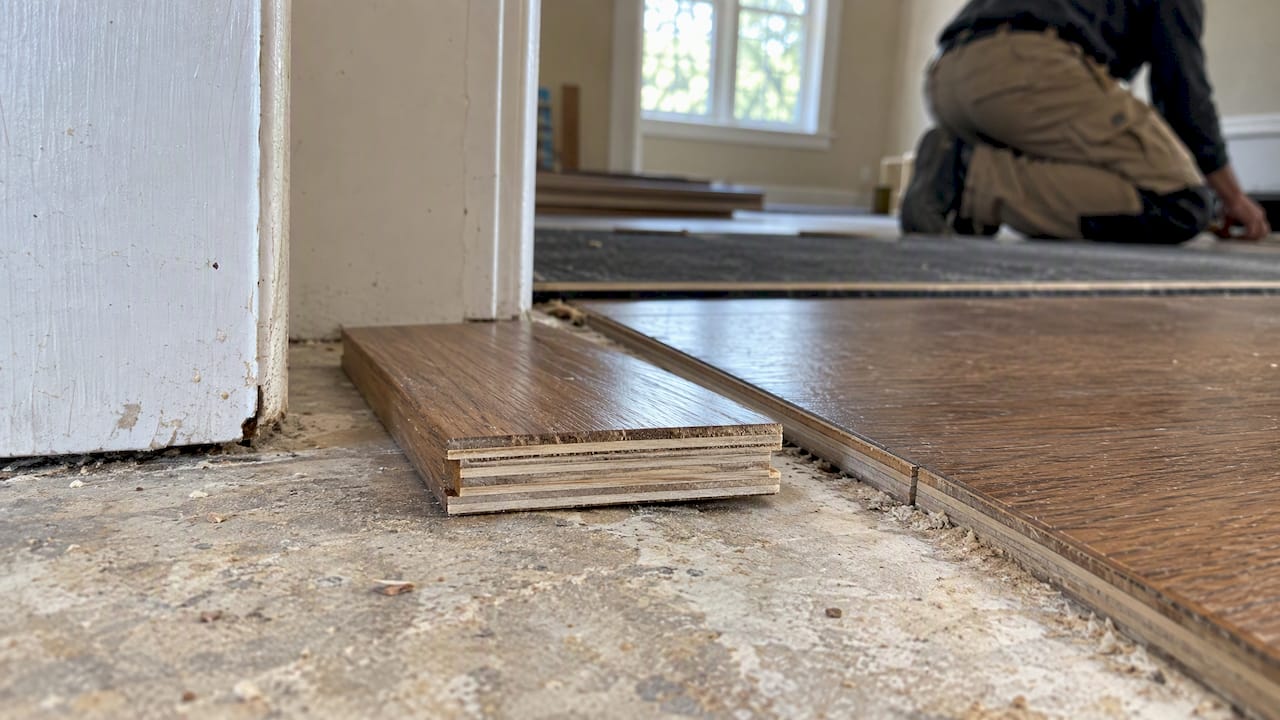
The practical takeaway: a species’ resistance to decay and its resistance to movement are related but separate properties. Teak resists rot exceptionally well, but it still moves with the seasons, just less dramatically than a softwood would. Any solid wood installation, regardless of species, needs room to expand and contract through the year.
Comparing Wood Performance Across Humidity Ranges
Wood performs differently depending on the humidity range it lives in, and matching the material to that range prevents most long-term problems.
In moderately humid spaces, such as kitchens or mudrooms with occasional water exposure, naturally resistant species like white oak and thermally modified wood hold up well, provided finishes are maintained and spills are wiped promptly.
In consistently high-humidity environments, unvented bathrooms, laundry rooms, or spaces near pools, moisture content can climb toward 13%, a range where solid wood flooring becomes risky regardless of species. Engineered hardwood, tile-adjacent wood trim, or naturally oily species like teak tend to outperform standard hardwoods in these conditions.
For true outdoor exposure, with wide daily and seasonal swings plus direct rain contact, only the most decay-resistant species, teak, ipe, cedar, or cypress, or a properly treated engineered composite, hold up without frequent intervention.
How Indoor Climate Control Shapes Wood’s Long-Term Durability
A furnace and air conditioner do more for wood longevity than most homeowners realize. Stable indoor climate control keeps relative humidity within a narrower band year-round, which means wood moves less and finishes last longer between recoats.
Homes that run a dehumidifier in summer and a humidifier in the driest winter months keep their flooring and furniture closer to that 6 to 9% equilibrium range that FPL research associates with stable living areas. Homes without that control see wider swings, and wider swings mean more frequent cupping, gapping, and finish failure.
Ventilation matters just as much as heating and cooling. EPA guidance stresses that controlling vapor flow, not just temperature, is central to preventing the kind of moisture buildup that leads to mold and wood decay. A bathroom exhaust fan that actually vents outdoors, rather than into an attic, protects wainscoting and trim far more than any finish could on its own.
For rooms prone to humidity spikes, pairing climate control with the right species pays off twice: the material resists moisture inherently, and the stable air around it keeps movement to a minimum.
Choosing Wood Species for Central Illinois Humidity Conditions
Central Illinois sees genuine seasonal extremes: humid, often sticky summers followed by cold, dry winters that pull moisture back out of every board in the house. That swing is exactly what makes species selection and acclimation so important here.
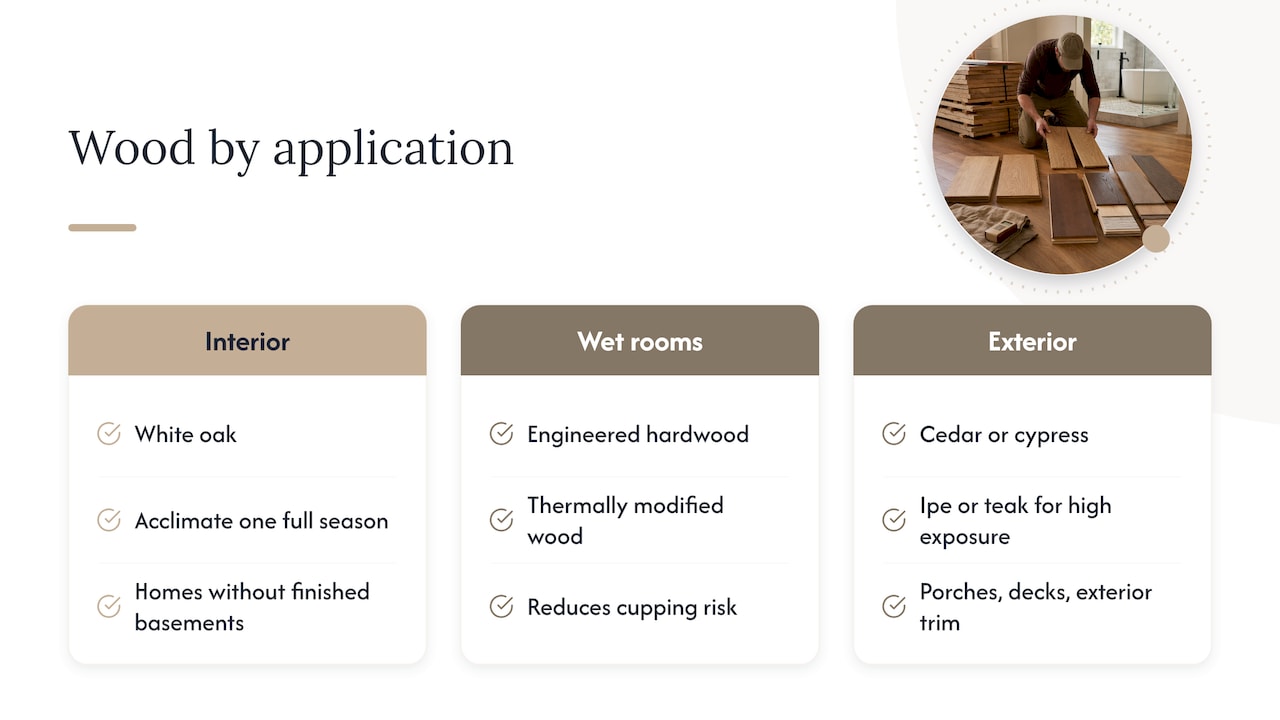
For flooring and furniture in homes without finished basements or heavy moisture sources, white oak remains a dependable choice, provided it acclimates through at least one full season before installation. For bathrooms, mudrooms, and laundry rooms, where local summer humidity pushes indoor air closer to saturation, engineered hardwood or thermally modified wood reduces the risk of cupping that solid wood faces in these rooms.
Outdoor and semi-exposed work, porches, deck boards, and exterior trim, holds up best with cedar or cypress for most budgets, with ipe or teak reserved for high-exposure surfaces where the added cost is justified by decades of service. Whatever the application, we always factor in the home’s specific ventilation and climate control before finalizing a species recommendation, since two houses on the same block can have meaningfully different indoor humidity profiles.
What We’ve Learned on the Job
With substantial carpentry experience on our team, we have seen firsthand which choices hold up and which ones fail quietly over a few seasons. Bathroom wainscoting projects taught us that solving the moisture problem starts with material selection, not just a good caulk job. On flooring jobs, we often steer clients toward engineered hardwood over exotic solids when a basement or slab-on-grade install raises the moisture stakes. Before hiring anyone for humid-area woodwork, ask what moisture content they install at, which species they recommend for your specific room, and how they handle expansion gaps.
— Wood
Let Us Handle the Wood Selection for You
Choosing the right species, sourcing it properly, and installing it with the correct acclimation plan takes experience most homeowners never need to build on their own. We bring that experience to every project, from bathroom wainscoting that solves moisture problems to wood countertops built for wet-area wear, built-ins, and custom millwork throughout the home.

If you’re planning a renovation in a humid room, whether it’s a kitchen, bathroom, or mudroom, a skilled team can walk your space, recommend the right species or engineered product, and confirm a finish and acclimation plan before any wood arrives. Visit our hardwood flooring installation page to schedule a consultation and get a plan built around your home’s specific conditions.
FAQ
Which wood is the most moisture-resistant?
Teak is widely regarded as one of the most moisture-resistant woods available, thanks to natural oils that repel water and resist decay even in direct wet exposure. Other naturally resistant options include white oak, black locust, and cedar, each suited to different applications and budgets.
What material is best for high humidity?
For high-humidity interiors, engineered hardwood often outperforms solid wood because its layered construction resists the movement that drives cupping and gapping. EPA guidance also emphasizes selecting moisture-resistant materials as one of three core strategies for reducing mold risk in any humid space.
How long does it take for wood to absorb humidity?
Wood responds to surface humidity changes within days, but deeper moisture changes driven by seasonal shifts take weeks to fully penetrate a board, according to equilibrium moisture content research. This is why proper acclimation before installation, not just a quick sit in the room, matters so much.
At what moisture level does mold grow on wood?
Mold requires sustained surface moisture along with temperatures roughly between 40 and 100 degrees Fahrenheit, according to EPA mold guidance. Keeping surface relative humidity controlled through ventilation and dehumidification is the most reliable way to prevent conditions mold needs to take hold.
What should I check before choosing a carpenter for a humid-area project?
Ask what in-service moisture content they target before installing wood, which species or engineered products they recommend for your specific room, and how they plan to accommodate seasonal expansion and contraction. A carpenter who can answer all three clearly is far more likely to deliver a lasting result.
Sources
- The equilibrium moisture content of wood in exterior locations in the United States — update
- Drying and control of moisture content (FPL GTR-282)
- Moisture control guidance — EPA
- 9 mighty woods for outdoor projects — Wood Magazine
- 8 types of rot-resistant wood — Family Handyman