Hire a restoration experienced team and budget for higher costs and slower permitting. Start by confirming whether your house carries an official historic designation, since that single fact determines nearly everything else about your project. Wood Made Illinois approaches these homes with carpentry rooted in Secretary of the Interior’s Standards and National Park Service guidance as the baseline for sympathetic work.
Once you know your designation status, expect this sequence:
- A condition assessment documenting original materials and structural health
- Portfolio and permit-history review of any contractor you’re considering
- A contingency budget built into the estimate from day one, not added later
Key Takeaways
Preserving a historic home successfully depends on confirming your designation status early, hiring specialists who can prove in-kind repair experience, and budgeting a real contingency for discovery work.
| Point | Details |
|---|---|
| Confirm designation first | Check with your local commission and state historic preservation office before planning any exterior changes. |
| Vet for craft skills | Look for portfolios showing sash restoration, lime mortar repointing, and trim replication, not just general remodeling. |
| Budget a real contingency | Set aside 20 to 25 percent above your base estimate to cover discovery work behind walls and floors. |
| Know the approval boundaries | Exterior and streetscape changes face the most scrutiny; interior work usually has more flexibility. |
| Choose carpentry-led craftsmanship | Wood Made Illinois repairs original sash, trim, and millwork in-kind, minimizing demolition on historic Central Illinois homes. |
Table of Contents
- What Historic Home Renovation Services Actually Include
- How Do You Find and Vet a Historic Home Renovation Contractor?
- Costs, Contingency Budgeting, and Realistic Timelines
- How Historic Designation Affects What You Can Change
- How Carpentry-Led Restoration Protects Original Fabric
- What Most Homeowners Get Wrong About Historic Renovation
- Get Sympathetic Restoration Instead of Guesswork Repairs
- Sources
What Historic Home Renovation Services Actually Include
A real historic home renovation service does more than swing hammers. It starts with a condition assessment that documents original fabric, plaster profiles, sash construction, trim details, before anything gets touched. That record protects you if a commission later asks what existed prior to work.
From there, the trades multiply. Structural stabilization, masonry repointing with lime mortar rather than modern Portland cement, and roof and flashing repair typically come first, since water intrusion does more damage to old houses than almost anything else. Historic window and door work follows: sash restoration, weight and cord replacement, hardware conservation instead of hardware swaps. Custom millwork, plaster repair, and finish carpentry round out the visible work, often the most labor-intensive part of the job.
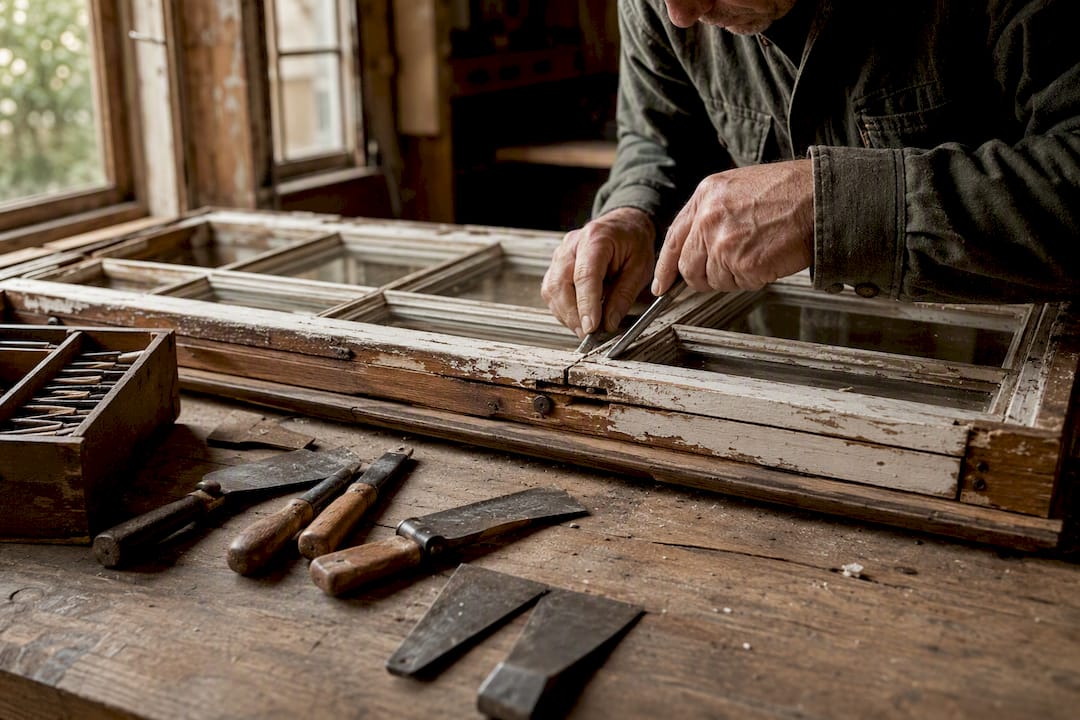
Mechanical, electrical, and plumbing upgrades need a lighter touch than in a standard remodel. Running new wiring through century-old plaster walls without destroying them takes planning most general contractors never encounter.
You’ll likely work with several roles at once:
- An architectural historian or preservation architect for compliance and design intent
- A general contractor to coordinate the schedule and trades
- Specialty carpenters and conservationists for windows, millwork, and finish work
Wood Made Illinois handles the carpentry end of that list directly, including wooden window restoration, and coordinates with architects and historians when a project calls for it.
How Do You Find and Vet a Historic Home Renovation Contractor?
Finding the right team takes more digging than a general remodeling search. Start with sources built specifically for this work rather than general contractor directories.
- Check your state historic preservation office and local commission first. Groups like the National Conference of State Historic Preservation Officers maintain contacts and referral networks in most states.
- Search AIA chapter directories for architects who list historic preservation as a specialty, not just a service offered.
- Ask your local Historic Preservation Commission for names. Commissions see contractor work firsthand through the approval process, and they know who does clean in-kind repairs versus who cuts corners.
- Request a portfolio focused on comparable work. Look for completed projects of similar age and style, with before-and-after photos and specifics on materials, not just glossy final shots.
- Run a structured interview. Ask about permit experience with your specific commission, sourcing for in-kind materials, and who’s actually on the subcontractor roster for specialty trades like masonry or plaster.
- Request documentation before signing anything. A sample scope of work, an itemized estimate, a realistic schedule for approvals, proof of insurance, and lead-safe certification under EPA’s RRP program.
Watch for red flags: contractors who can’t name a single completed historic project, vague answers about material sourcing, or estimates with no line item for discovery work. Call at least two references and ask specifically whether the final product matched the original proposal.
Pro Tip: Ask a prospective contractor to walk you through one project where something unexpected turned up mid demolition. How they answer tells you more about their judgment than any polished portfolio photo.
Costs, Contingency Budgeting, and Realistic Timelines
Historic renovation costs more than standard remodeling, and the reasons are structural, not arbitrary. Specialty labor is scarcer, in-kind and salvage materials cost more to source than off-the-shelf replacements, and discovery work behind old plaster or under old flooring routinely changes the scope mid-project.
Preservation-focused contractors commonly recommend building in a 20 to 25 percent contingency rather than the 10 percent typical of newer-home remodels, because hidden issues surface far more often in century-old construction.
Timelines vary by scope:
- Small repairs: a few weeks
- Room-scale restorations: one to three months
- Whole-house restorations: six to eighteen months or longer, especially when commission approvals or specialty material lead times enter the picture
Before you finalize a budget, check whether your property qualifies for a state or federal historic tax credit, or a local preservation grant. Many homeowners skip this step and leave real money on the table.
How Historic Designation Affects What You Can Change
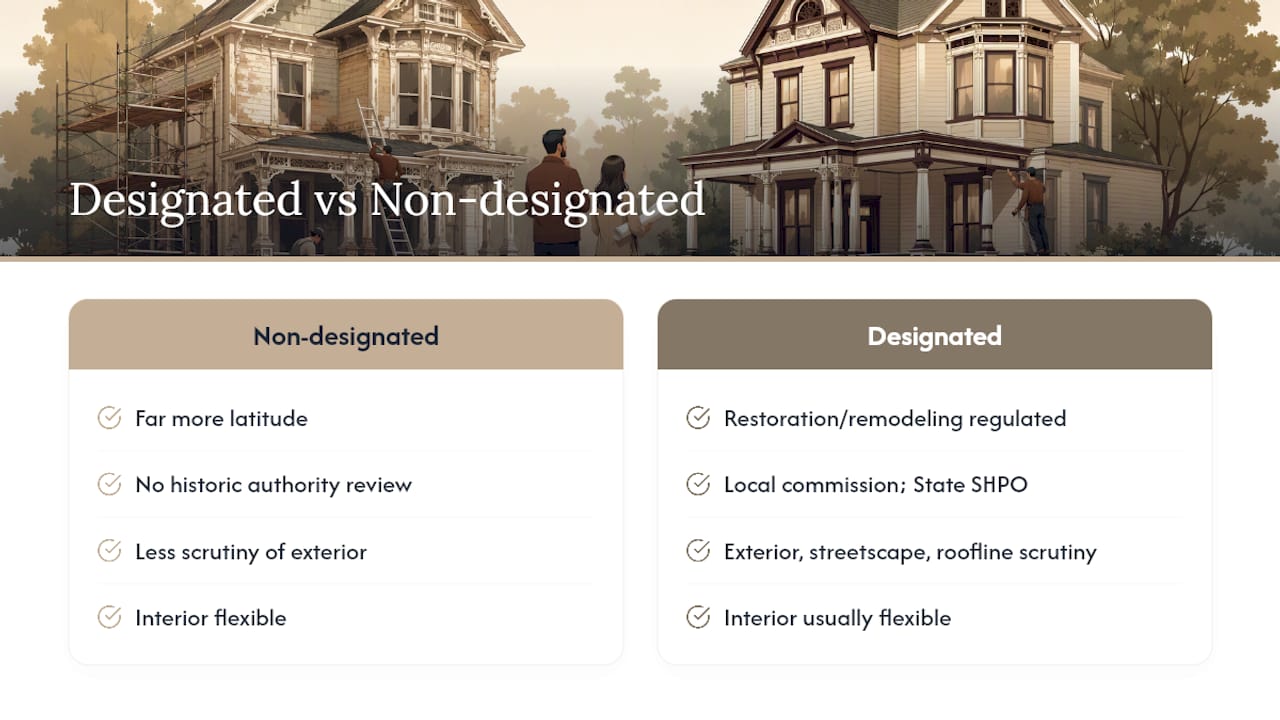
An old house and a designated historic property are not the same thing, and that distinction shapes every renovation decision you make. A 100-year-old home with no official designation gives you far more latitude than one listed on a local register or the National Register of Historic Places, where restoration and remodeling carry different rules entirely.
Two authorities matter most. Your local Historic Preservation Commission typically controls approvals for exterior work, and that review can shape both your timeline and your permitted materials. Your State Historic Preservation Office maintains designation records and can point you toward National Register resources if you’re unsure of your property’s status.
Exterior changes, streetscape visibility, and roofline alterations face the tightest scrutiny. Interior work usually has far more flexibility, which is exactly where many homeowners find room to modernize without a fight. When you do present plans to a commission, bring documentation of existing conditions and frame your proposal around in-kind or visually compatible replacement rather than wholesale change — a thoughtful approach to refresh your space without the renovation headache. Approval workflows can take anywhere from a few weeks to several months depending on your commission’s meeting schedule.
How Carpentry-Led Restoration Protects Original Fabric
Wood Made Illinois brings over 100 years of combined carpentry experience to this work, and that experience shows up in decisions most homeowners never see: repairing a sash rather than replacing it, replicating trim profile by profile instead of pulling from a catalog, sourcing salvage lumber that matches the grain and age of what’s already there.
“Do no harm” isn’t a slogan on a historic job site. It means asking whether a board can be repaired before you reach for a replacement, and it means every cut you make respects what took a craftsman decades ago to build correctly the first time.
Minimizing demolition matters as much as any single repair technique. Every wall opened, every piece of original trim removed, is a piece of the house’s history that can’t be put back exactly as it was. When a project moves beyond carpentry, structural questions, code compliance for additions, formal historic tax credit applications, the team coordinates directly with preservation architects and conservators rather than guessing at scope.
Pro Tip: Old plaster and old paint often contain lead. Seal off work areas and follow EPA lead-safe practices before any sanding or demolition begins, for your family’s safety and your contractor’s compliance.
What Most Homeowners Get Wrong About Historic Renovation
The conventional advice on this topic treats historic renovation like a permitting problem to solve, when it’s really a materials and craftsmanship problem first. Homeowners spend weeks researching commission rules and almost no time asking whether a contractor actually knows how to repair a mortise and tenon sash joint or match a hand run plaster cove. Permits matter, but they don’t save a house. Skilled hands do.
The “do no harm” principle gets treated as a nice sentiment rather than a practical filter for hiring. It should be the first question you ask any contractor: what’s the least invasive way to fix this? A team that reaches for replacement before repair, on windows, trim, or plaster, isn’t thinking like a preservationist even if their paperwork checks out.
Prioritize this: hire for demonstrated repair skill on the specific materials your house is built from, not for the smoothest sales pitch. Everything else, financing, timelines, commission approvals, follows more easily once you have the right hands on the project.
— Wood
Get Sympathetic Restoration Instead of Guesswork Repairs
Most homeowners facing a historic renovation end up choosing between a large architecture firm quoting months of planning fees, or a general contractor who treats a 1920s sash window the same as a vinyl replacement. Neither fits a house where every original board tells you something about how it was built. Wood Made Illinois gives Central Illinois homeowners a carpentry-led alternative: craftsmen who repair sash joints, replicate trim profiles, and source salvage lumber directly, without routing your project through layers of subcontractors who’ve never touched a historic house.

That direct approach means fewer surprises in the estimate and faster answers when something unexpected turns up mid-project, which it usually does in a century-old house. If you’re weighing a full restoration or a smaller room-scale project, browse recent historic renovation work or start with a straightforward step: request a consultation with Wood Made Illinois’s trusted local carpentry experts and get a real assessment of what your home needs before you commit to a scope.