The highest-impact retail display shelving ideas, ranked by versatility and merchandising return, are: wall-mounted floating shelves, modular gondola systems, pegboard and slatwall panels, tiered counter displays, freestanding display islands, and custom built-in shelving. Each solves a different problem, and the right mix depends on your floor plan, product weight, and how often you reset for promotions.
Here is the shortlist every store owner should work through before buying a single bracket:
- Wall-mounted/floating shelves: Best for boutique display shelves along perimeter walls; keeps floor space open and draws the eye upward.
- Modular gondola shelving: The workhorse of grocery, pharmacy, and general merchandise; adjustable shelves reset in minutes.
- Pegboard and slatwall panels: Flexible hook-and-accessory systems ideal for small tools, accessories, and impulse items.
- Tiered counter displays: Place high-margin, grab-and-go SKUs at the point of sale where conversion is highest.
- Freestanding display islands: Position near the entrance or in high-traffic zones to intercept shoppers before they reach the back wall.
- Custom built-in shelving: The right call when standard fixtures cannot match your dimensions, load requirements, or brand aesthetic.
Three quick styling wins you can apply today: move your highest-margin product to eye level (roughly 48–60 inches from the floor), add LED strip lighting under each shelf, and group products by color or theme rather than by SKU number. A peer-reviewed study found that shorter, denser shelf runs can increase retailer profit significantly for certain assortments, which makes compact, well-curated planograms worth serious attention.
Key Takeaways
The single highest-ROI move for most stores is re-merchandising one eye-level shelf row with a focal SKU, LED lighting, and deliberate white space before investing in new fixtures.
| Point | Details |
|---|---|
| Eye-level placement first | Place your highest-margin SKUs in the 48–60 inch zone before changing any fixture. |
| Shorter runs, denser planograms | Shorter shelf lengths can increase retailer profit significantly for certain assortments. |
| Allocate floor space deliberately | Dedicate roughly 60–70% of floor space to displays and 30–40% to circulation. |
| Match material to load | Specify cabinet-grade plywood or steel for heavy goods; use MDF only for light, painted displays. |
| Woodmadeillinois for custom needs | When standard fixtures cannot match your dimensions or load, commission a built-in from Woodmadeillinois. |
Table of Contents
- What types of retail display shelving ideas work best for your store?
- Styling and merchandising techniques that make shelves actually sell
- Which materials and finishes hold up best in a retail environment?
- How lighting and accessories can transform a shelf display
- How small shops can maximize selling space without sacrificing flow
- Custom-built vs. ready-made shelving: how do you decide?
- Five quick-build shelving templates you can execute now
- Keeping retail shelving clean and looking its best
- Safety considerations every retailer must address
- What the Woodmadeillinois team has learned from real installs
- Woodmadeillinois builds the shelving your store actually needs
- Sources
What types of retail display shelving ideas work best for your store?
Choosing the right fixture is less about aesthetics and more about matching the shelf’s structural behavior to your product’s weight, your team’s reset frequency, and your store’s footprint. The retail shelving selection guide from PFI Instore emphasizes that dimensions, weight capacity, and fixture aesthetics all interact in ways that affect both customer experience and operational cost.
| Shelf Type | Best For | Durability | Budget Shape |
|---|---|---|---|
| Wall-mounted/floating | Perimeter walls, boutique, light goods | High (when anchored to studs) | Low–mid |
| Modular gondola | Mid-floor aisles, general merchandise | High | Mid |
| Pegboard/slatwall | Accessories, impulse items, demo walls | Medium | Low |
| Tiered counter display | POS, jewelry, cosmetics, small goods | Medium | Low |
| Freestanding island | Entrance zones, seasonal features | Medium–high | Mid |
| Custom built-in | Unique dimensions, heavy goods, brand-specific | Very high | High (up-front) |
Wall-mounted and floating shelves work as the skin of a perimeter wall display: they carry the visual weight of the store’s brand without consuming floor space. Properly anchored into studs or masonry, they handle light to medium loads with ease and reset quickly when product lines change.
Modular gondola systems are the bones of most mid-size retail floors. Their adjustable shelf clips allow height changes in under a minute, and double-sided runs double your display density per linear foot. The trade-off is that gondolas are heavy, difficult to reposition, and visually industrial unless dressed with signage and lighting.
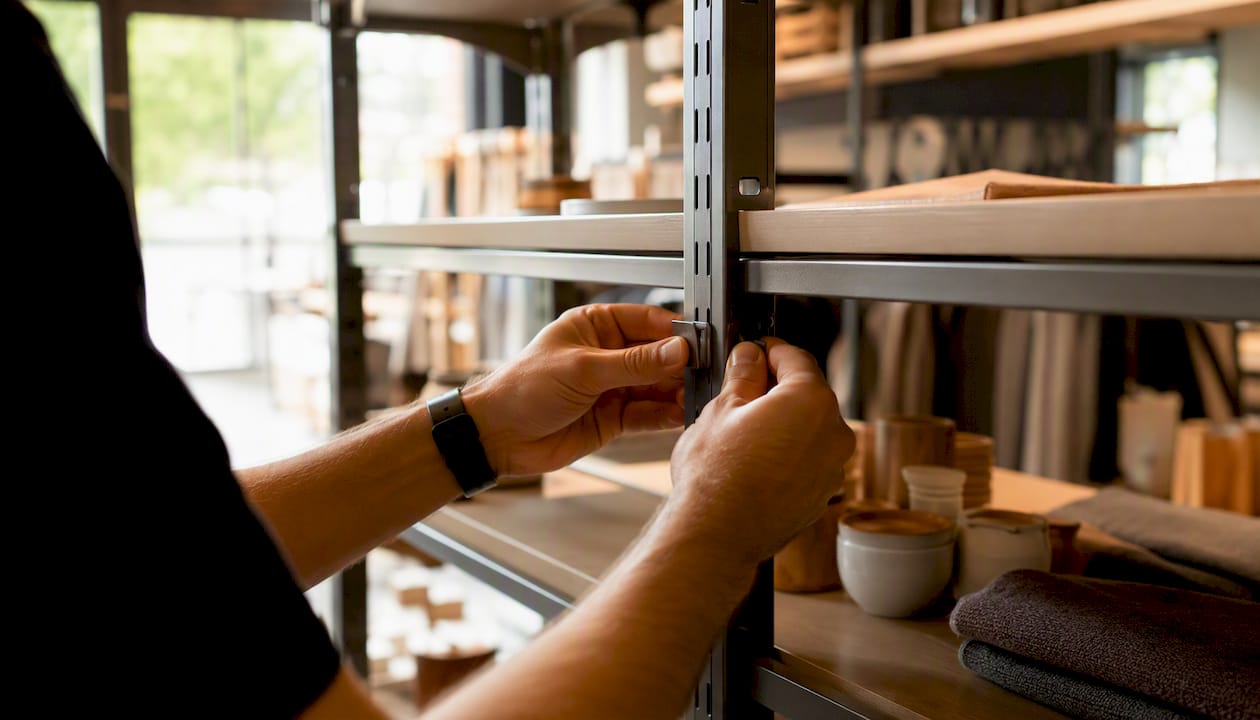
Pegboard and slatwall panels are the most flexible store shelving solutions available at low cost. A single 4×8 panel can hold hooks, bins, shelves, and sign holders simultaneously, making them ideal for demo walls or seasonal rotations.
Tiered counter displays and freestanding islands share one trait: placement drives their performance. Discovery-oriented displays placed in high-traffic zones identified through foot-traffic analysis consistently outperform the same fixtures placed in low-traffic corners.
Custom built-ins carry the highest up-front cost but the lowest long-term replacement cost. When a store’s wall angles, ceiling height, or product weight falls outside standard fixture ranges, a built-in is often the only solution that holds up over years of daily use.
Styling and merchandising techniques that make shelves actually sell
A well-built shelf that is poorly merchandised is a missed opportunity. The mechanics of shelf presentation follow a clear hierarchy, and evidence-based merchandising research confirms that eye-level priority, color-blocking, deliberate white space, and narrative displays are the four levers that most reliably guide purchase decisions.
Start every display with a single focal product or “hero SKU.” Place it at eye level, give it breathing room on both sides, and support it with two or three complementary items that tell a coherent story. A skincare display, for example, might anchor on a moisturizer, flanked by a toner and a serum, with a small prop (a rolled towel, a sprig of dried botanicals) that signals the lifestyle rather than just the product category.
The core merchandising rules, applied in order:
- Eye-level placement: The 48–60 inch zone is prime real estate. Reserve it for your highest-margin or fastest-moving SKUs; put heavy, bulky items on lower shelves and aspirational or decorative items above eye level.
- Color-blocking: Group products by color family rather than brand or SKU. A wall of graduated blues reads as intentional and curated; a random mix reads as disorganized.
- Height variation: Flat rows of identical-height products create visual monotony. Vary heights with risers, pedestals, or staggered shelf depths to create rhythm.
- White space: Resist the urge to fill every inch. Over-merchandising increases shopper hesitation; a curated display with 1–3 clear selling points per zone improves purchase intent.
- Cross-merchandising adjacencies: Place products that are used together near each other. Coffee next to mugs, candles next to matches, paint next to brushes.
- Pricing strips and signage: Keep font sizes consistent, place price tags at the left edge of each product’s shelf slot, and use shelf-edge sign holders for promotional callouts.
Pro Tip: Introduce deliberate asymmetry into at least one display per store section. A symmetrical arrangement reads as static; a slightly off-center hero product with an odd number of supporting items (three, five) creates visual tension that draws the eye and holds attention longer.
Small tactile elements, such as a texture sample, a scent strip, or a rotating compartment, boost dwell time and conversion on discovery displays by giving shoppers a reason to stop and interact rather than simply scan and move on.
Which materials and finishes hold up best in a retail environment?
Material choice is where many store owners underinvest, then pay for it in warped shelves, chipped edges, and fixtures that look tired within a year. The Display Fixture Structural Design Guide makes clear that board grade, flute orientation, and reinforcement technique all affect load capacity in ways that are not obvious from a catalog photo.
| Material | Best Retail Use | Relative Load Capacity | Key Consideration |
|---|---|---|---|
| Solid wood | Boutique, artisan, high-end retail | High | Susceptible to humidity; needs sealing |
| Plywood (cabinet-grade) | Built-ins, heavy-load shelves | High | Heavier than MDF; holds screws well |
| MDF | Painted displays, modular units | Medium | Edges chip; not suitable for wet areas |
| Steel/powder-coated metal | Industrial, grocery, pharmacy | Very high | Heavy; requires proper anchoring |
| Acrylic | Jewelry, cosmetics, small accessories | Low–medium | Scratches easily; clean with microfiber only |
| Glass | Luxury goods, watches, collectibles | Low–medium | Requires tempered glass; professional install |
Solid wood and cabinet-grade plywood are the materials of choice when load requirements are serious or when the store’s brand demands a warm, crafted aesthetic. Reinforcement techniques such as double-layer shelf construction, gussets at bracket points, and fold-lock front edges allow lighter materials to carry heavier loads safely when designed correctly.
Steel and powder-coated metal fixtures dominate high-volume retail because they handle daily restocking abuse without deforming. The trade-off is visual weight: an all-metal floor can feel cold and institutional unless softened with wood accents, fabric panels, or warm lighting.
Acrylic and glass are finishing materials, not structural ones. Use them for display cases, riser platforms, and small accent shelves where the product’s visual presentation matters more than load capacity. Always specify tempered glass for any shelf that will hold products above customer head height.
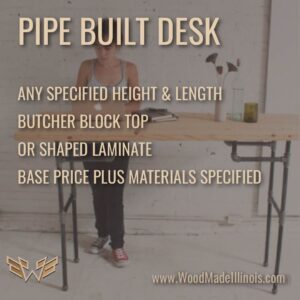
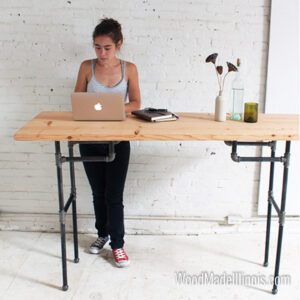
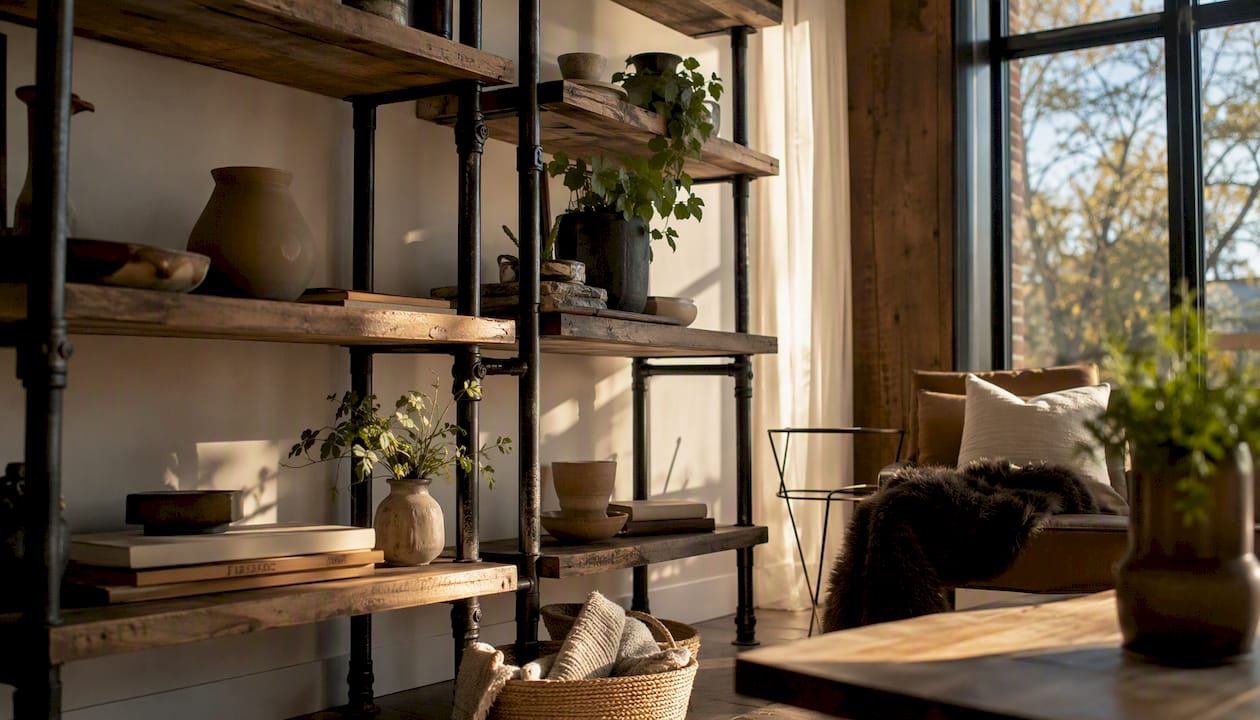
For stores that want the warmth of wood with the durability of metal, pipe-built shelving (steel pipe with solid wood planks) offers a practical middle ground. Woodmadeillinois builds pipe-built shelving that carries the industrial-chic aesthetic many boutiques and coffee shops favor while meeting the load requirements of a working retail environment.
How lighting and accessories can transform a shelf display
Lighting is the single most underused tool in retail merchandising. A well-lit shelf can make a $12 product look like a $40 one; a poorly lit shelf makes even premium goods look forgettable.
- LED strip lighting: Mount under the front lip of each shelf, angled slightly downward, to wash product faces with even light. Warm white (2700–3000K) suits lifestyle and food products; cool white (4000K) works better for electronics and tools.
- Puck lights: Battery-operated puck lights are a fast, no-wiring solution for enclosed display cases or shadow boxes. Replace batteries on a monthly schedule to avoid dimming.
- Track lighting: Overhead track systems allow you to aim individual heads at specific display zones. Most effective for endcaps, hero displays, and seasonal features where you want a spotlight effect.
- Shelf-edge signage strips: Snap-in label holders at the shelf edge keep pricing and promotional copy at the exact eye line of a shopper reading the shelf. Use consistent font sizes across all strips.
- Risers and riser tiers: Acrylic or wood risers add height variation without requiring a new shelf. A two-tier riser on a counter display can double the number of visible SKUs without adding footprint.
- Hooks and dividers: Wire hooks on slatwall keep hanging products vertical and evenly spaced. Shelf dividers prevent products from leaning and maintain the clean, curated look that signals quality.
- Anti-tip anchors: Any freestanding fixture taller than 36 inches should be anchored to the wall or floor with a tip restraint. This is both a safety requirement and a liability consideration.
Keep power routing clean: use adhesive cable channels along the back wall or inside gondola uprights to hide LED driver cords. Visible wiring signals a temporary, unfinished installation and undermines the store’s visual credibility.
How small shops can maximize selling space without sacrificing flow
The standard industry allocation of roughly a majority of floor space to product displays and a smaller portion to circulation and service areas is a useful starting point, but small-format stores often need to push display density higher while keeping aisles navigable. The key is going vertical before going wide.
Vertical-first strategies treat the wall as the primary display surface. Floating shelves stacked from counter height to ceiling can carry as much product as two gondola runs while consuming zero floor space. Wall extenders on existing gondola uprights add 12–18 inches of display height above the standard top shelf, useful for oversized packaging or decorative items.
Placement tactics for tight floors:
- Position a small island or round fixture near the entrance to intercept shoppers before they commit to a direction. Keep it under 36 inches tall so it does not block sightlines to the back of the store.
- Use angled fixtures in corners rather than standard 90-degree shelving. A 45-degree corner unit fills dead space and creates a natural browsing pocket.
- Run short gondola sections (four to six feet) rather than long aisle runs. Shorter shelf lengths enable denser planograms and reduce unused shelf segments, which matters especially in stores with narrow assortments.
- Install a mirrored back panel behind wall shelves to visually double the depth of the display and make the store feel larger.
On accessibility: the Americans with Disabilities Act requires a minimum 36-inch clear aisle width, with 44 inches preferred in primary circulation paths. Fixtures that encroach on these minimums create compliance risk and, more practically, make the store uncomfortable for anyone using a stroller, wheelchair, or mobility aid.
For stores that share retail space with a workspace or studio, the layout principles overlap significantly with small office carpentry approaches that prioritize function without sacrificing the room’s visual character.
Custom-built vs. ready-made shelving: how do you decide?
The honest answer is that most stores need both. Ready-made and modular fixtures handle the bulk of the floor; custom carpentry solves the problems that standard fixtures cannot.
Choose modular or off-the-shelf when:
- You need to reset displays frequently for promotions or seasonal campaigns. Modular, adjustable fixtures reduce labor and redesign cost for stores that run frequent resets.
- Your budget is constrained up front and you can accept a shorter fixture lifespan.
- Standard dimensions fit your space without modification.
Commission custom-built shelving when:
- Wall angles, ceiling heights, or structural features fall outside standard fixture ranges.
- Your brand aesthetic requires a specific material, finish, or profile that catalog fixtures do not offer.
- Load requirements exceed what off-the-shelf units are rated for.
- You want a one-time investment that outlasts multiple rounds of modular fixture replacement.
Questions to ask before committing to either route:
- What is the maximum load per shelf, and does the fixture’s rated capacity match your heaviest product category?
- How quickly can the layout be reconfigured for a promotion or seasonal reset?
- What is the total cost of ownership over five years, including replacement parts and labor?
- Does the fixture’s finish match the store’s existing materials and lighting?
As a rough cost shape: off-the-shelf gondola sections run from a few hundred dollars per unit; modular systems with custom accessories sit in the mid-range; custom carpentry projects for a small boutique typically start higher up-front but are built to the exact specification of the space and product. A design consultation with a local carpenter is often the fastest way to get an accurate scope and timeline for a custom project.
Five quick-build shelving templates you can execute now
These five templates range from a weekend DIY project to a professional installation. Each includes a safety note and a recommendation on when to hire a carpenter.
-
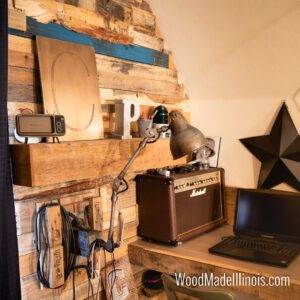
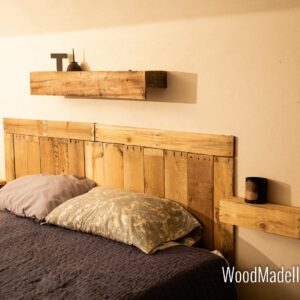
Floating shelf accent wall
- Materials: 2×10 solid pine or poplar boards, heavy-duty floating shelf brackets, wall anchors, stain or paint.
- Time: 4–6 hours for a three-shelf run.
- Cost band: Low to mid.
- Impact: Transforms a blank perimeter wall into a curated display surface; pairs well with LED strip lighting underneath each shelf.
- Safety note: Anchor every bracket into a wall stud or use toggle bolts rated for the intended load. Never rely on drywall anchors alone for retail-weight loads.
- DIY or pro? DIY-friendly for light goods; hire a carpenter for shelves that will hold heavy ceramics, bottles, or equipment. Woodmadeillinois’s floating shelf service covers both light and heavy-load installations.
-
Pipe-shelf display unit
- Materials: 3/4-inch black iron pipe, floor flanges, solid wood planks (walnut, oak, or pine), pipe fittings.
- Time: 6–8 hours including wall anchoring.
- Cost band: Mid.
- Impact: Industrial-chic aesthetic that photographs well for social media; strong enough for bottles, books, and boxed goods.
- Safety note: Pipe fittings must be tightened with a pipe wrench, not hand-tight. Test the completed unit by applying 1.5× the intended load before stocking.
- DIY or pro? Moderate DIY skill required; hire a pro for wall-anchored runs longer than six feet.
-
Tiered counter riser
- Materials: Hardwood or acrylic riser blocks, non-slip shelf liner, optional LED puck light underneath.
- Time: 1–2 hours.
- Cost band: Low.
- Impact: Doubles visible SKU count at the point of sale without adding counter footprint.
- Safety note: Keep the top tier below 12 inches of total height to prevent tip-over at the counter edge.
- DIY or pro? DIY.
-
Pegboard demo wall
- Materials: 1/4-inch pegboard panels, 1×2 furring strips (to create standoff space for hooks), pegboard hooks and bins, paint.
- Time: 3–5 hours for a 4×8 section.
- Cost band: Low.
- Impact: Highly flexible; reconfigure the hook layout in minutes for seasonal resets or new product introductions.
- Safety note: Mount furring strips into studs, not drywall. The standoff gap behind the pegboard is required for hooks to seat properly.
- DIY or pro? DIY for a single panel; hire a carpenter for a full wall installation with integrated lighting or a custom painted finish.
-
Mini display island
- Materials: Plywood carcass, solid wood top, casters (locking), optional drawer or lower shelf.
- Time: 8–12 hours including finishing.
- Cost band: Mid.
- Impact: Creates a freestanding focal point near the store entrance; movable for seasonal reconfigurations.
- Safety note: Lock all casters when the island is in its display position. Keep the center of gravity low by placing heavier products on the lower shelf.
- DIY or pro? Hire a carpenter for a finished, durable unit. A poorly built island that wobbles or chips undermines the store’s visual credibility immediately.
Keeping retail shelving clean and looking its best
Shelving maintenance is a marathon, not a sprint. A cleaning schedule that runs weekly for surfaces and quarterly for structural checks will extend fixture life significantly and keep displays looking intentional rather than neglected.
Weekly tasks:
- Wipe all shelf surfaces with a damp microfiber cloth. For wood and MDF, avoid standing water; dry immediately after wiping.
- Clean acrylic and glass shelves with a non-ammonia cleaner and a microfiber cloth only. Ammonia-based cleaners cloud acrylic over time.
- Straighten and face all products. Facing (pulling products to the shelf edge) takes under five minutes per section and has an outsized effect on perceived store quality.
- Check shelf-edge label holders and replace any that are cracked, yellowed, or missing.
Monthly tasks:
- Remove all products from one section at a time and clean the shelf surface, uprights, and bracket slots thoroughly.
- Inspect brackets and shelf clips for deformation. A bent clip is a load-capacity failure waiting to happen.
- Check LED strip connections and replace any sections showing flicker or color shift.
Quarterly tasks:
- Inspect all wall anchors, floor anchors, and anti-tip restraints. Tighten any fasteners that have worked loose.
- Refinish or touch up painted wood surfaces with matching paint to prevent moisture infiltration at chips and scratches.
- Review the planogram against current sales data and adjust shelf allocations to reflect what is actually selling.
For home organization systems that use similar shelving materials, the same cleaning principles apply: material-matched cleaners, regular structural checks, and prompt attention to any sign of deformation or moisture damage.
Safety considerations every retailer must address
Shelf safety is not a secondary concern. A fixture failure in a retail environment can injure customers and staff, trigger liability claims, and result in regulatory action. The structural principles that govern safe retail shelving are well-documented in the Display Fixture Structural Design Guide, which covers board grade, flute orientation, and reinforcement techniques that affect load capacity in ways that are not visible from the finished surface.
Weight limits: Every shelf fixture carries a rated load capacity per shelf and a total unit capacity. Never exceed either figure. When in doubt, specify the next grade up. Common failure modes include overloaded MDF shelves that sag at the center and gondola uprights that bow outward when top shelves carry weight the base was not designed to handle.
Stability and anchoring: Any freestanding fixture taller than 36 inches must be anchored to a wall or floor. This is both a practical safety measure and, in many jurisdictions, a code requirement for commercial spaces. Use anti-tip straps rated for the fixture’s total loaded weight, not just its empty weight.
Wall-mounted shelves: Anchor into studs wherever possible. When studs are not available at the required spacing, use toggle bolts or hollow-wall anchors rated for the specific drywall thickness and load. Document the anchor type and rated capacity for each installation so future staff know what the shelf can safely hold.
Seismic and impact considerations: In stores with high foot traffic, fixtures experience lateral forces from shopping carts, strollers, and customers leaning on shelves. Specify fixtures with welded or bolted joints rather than press-fit connections for any unit that will see daily contact.
Compliance checkpoints:
- Confirm aisle widths meet ADA minimums (36 inches clear, 44 inches preferred for primary paths).
- Verify that overhead shelving above 84 inches does not create a protruding hazard in the aisle.
- Check local fire code for maximum fixture height and required clearance from sprinkler heads.
What the Woodmadeillinois team has learned from real installs
Custom retail shelving projects teach lessons that no catalog can prepare you for. After more than 100 years of combined carpentry experience across Central Illinois, the Woodmadeillinois team has seen the same pattern repeat: store owners who invest in properly anchored, material-matched shelving early spend far less on repairs and replacements over the following five years than those who start with the cheapest available fixture and patch problems as they arise.
One practical test the team applies to every taller display before it goes into service: load the shelves to their intended capacity, then apply a gentle lateral push at the top of the unit. A well-built, properly anchored fixture should feel solid with no perceptible sway. Any movement at the top is a signal to add a wall anchor or floor brace before the unit opens to customers.
Pro Tip: When specifying shelf depth for a retail display, measure the depth of your deepest product and add two inches. That two-inch margin keeps products from overhanging the shelf edge, which is both a safety issue and a visual one — products that hang over the edge look precarious and shoppers are less likely to pick them up.
The team has completed floating shelf accent walls, pipe-built display units, and full custom built-in shelving for small businesses across Central Illinois. Portfolio examples and project context from the Peoria area are available at Woodmadeillinois’s local project archive.
Woodmadeillinois builds the shelving your store actually needs
Off-the-shelf gondolas and catalog fixtures solve the easy problems. When your store has non-standard wall angles, a brand aesthetic that demands real wood, or products too heavy for standard-rated shelves, a custom carpentry solution is the more durable and cost-effective path over a five-year horizon.
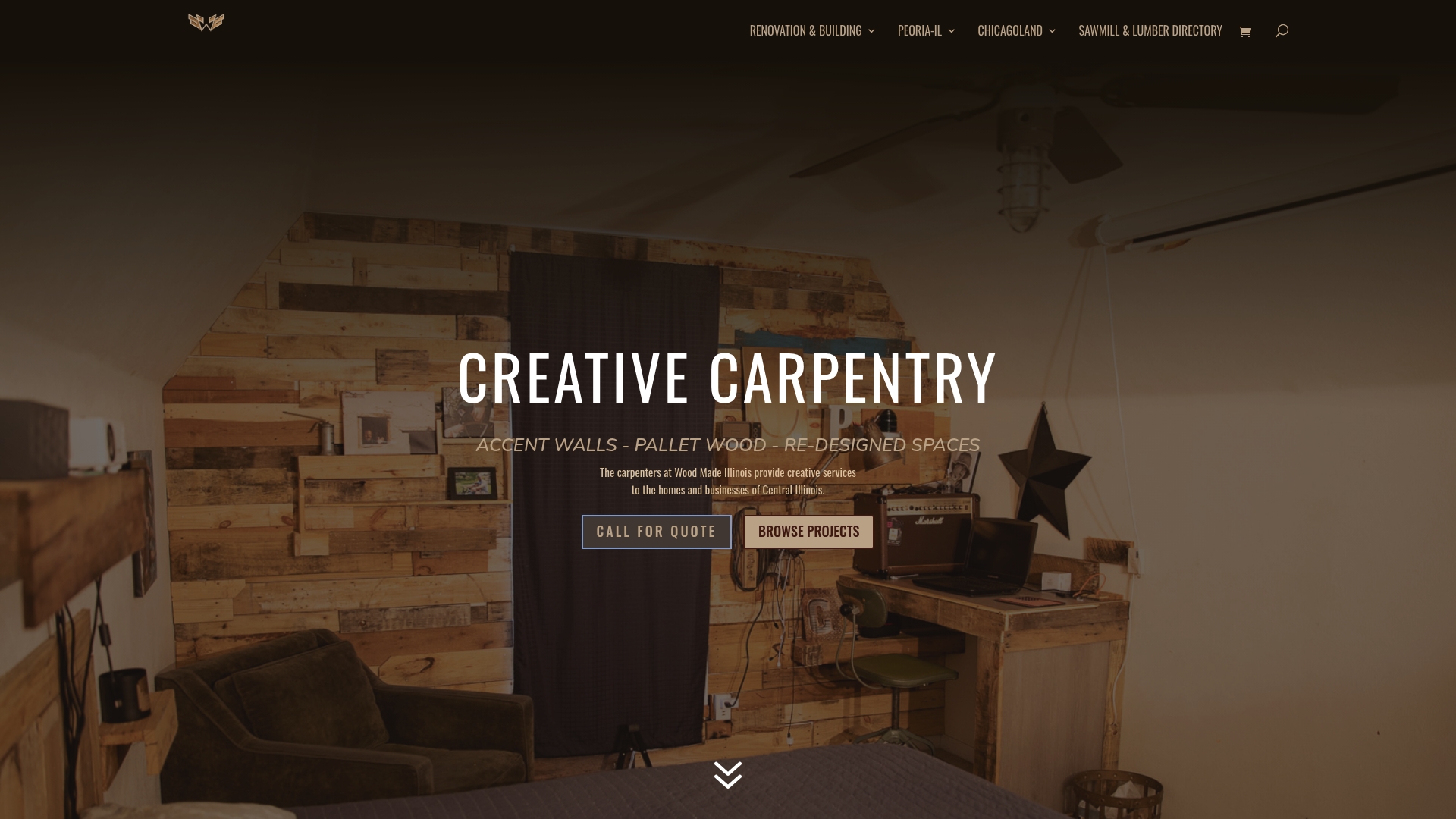
Woodmadeillinois designs and installs custom retail shelving built to your store’s exact dimensions, load requirements, and visual identity, from floating shelf accent walls to full pipe-built display systems. A design consultation covers scope, materials, timeline, and a realistic cost range before any work begins. Reach out to the trusted local carpentry team to schedule your on-site measure and get a clear picture of what your space can become.
Sources
- Display Fixture Structural Design Guide | Load & Stability Testing
- How to plan your gondola shelving layout
- Shorter shelf lengths increase retailer profit (journal study)
- Effective Retail Shelf Display Ideas – The Home Decor Corner
- Designing for discovery with space-efficient retail display solutions | Modern Retail
- A Guide to Retail Shelving