A selective renovation strategy is defined as the deliberate preservation of a building’s core structure and systems while upgrading specific areas to improve function, aesthetics, and value. Unlike a full gut renovation, this targeted remodeling approach leaves sound walls, framing, plumbing, and electrical intact, directing resources only where they produce the greatest return. For homeowners and property managers in Central Illinois and beyond, understanding this method is the first step toward making renovation decisions that protect both budget and long-term asset value.
What is a selective renovation strategy and why does it matter?
A selective renovation strategy, known in the construction industry as selective demolition and targeted remodeling, treats a property the way a skilled surgeon treats a patient. Only what needs attention gets touched. The rest stays protected. This approach stands apart from a full gut renovation, which strips a building to its studs regardless of what is still functional.
The core logic is straightforward. Selective renovation costs typically range between $75 and $150 per square foot depending on scope and specification. That range is significantly narrower than a full gut, which often carries higher disposal, structural, and rebuild costs on top of the base labor. Homeowners who choose this path spend money on visible, high-impact upgrades rather than replacing systems that still have years of useful life.

For property managers, the financial case is equally clear. Adaptive reuse and selective revitalization yield a savings ratio of 1.93, producing nearly double the value in savings and environmental benefits over a project’s lifecycle compared to new construction. That ratio reflects real-world economics: preserving embodied carbon and existing structure costs far less than rebuilding from scratch.
What are the key benefits of a selective renovation strategy?
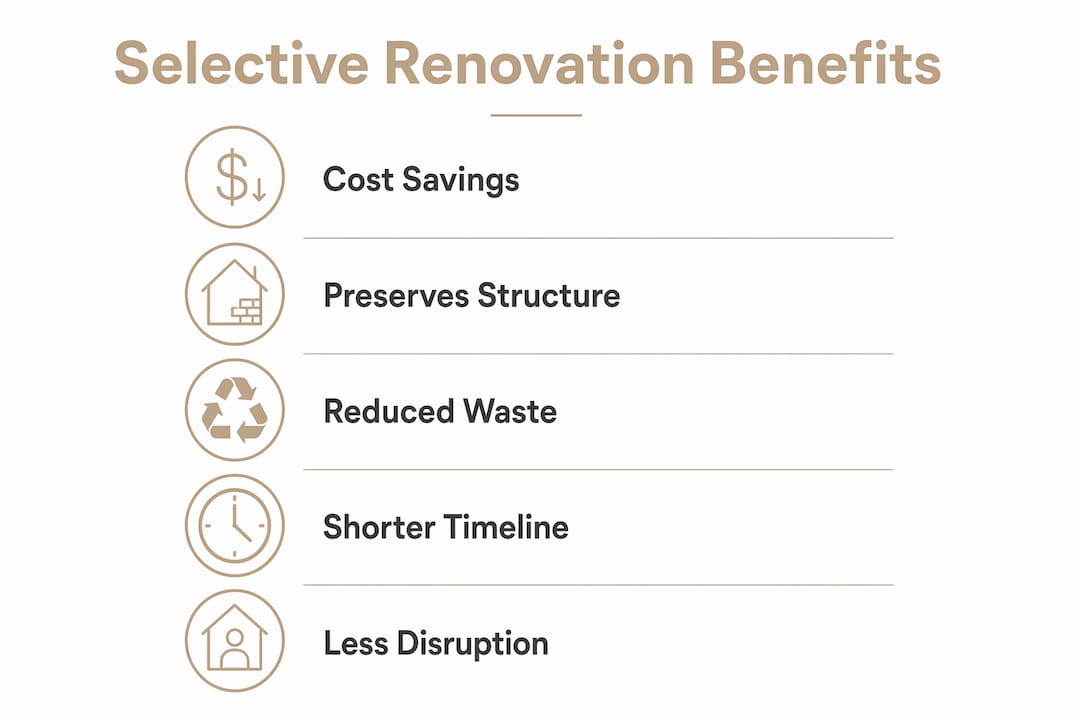
The benefits of a targeted renovation strategy reach well beyond the initial cost savings. Homeowners who apply this approach gain on multiple fronts simultaneously.
- Cost control. Focusing spending on kitchens, bathrooms, and flooring rather than full structural rebuilds keeps projects within a defined budget. The $75–$150 per square foot range gives homeowners a realistic planning baseline.
- Reduced waste. Preserving existing materials reduces landfill contributions and protects the embodied carbon already locked into the building’s bones. Retrofitting and selective renovation preserve embodied carbon while delivering fast performance improvements.
- Operational continuity. Selective renovations can often be performed while you remain living in the home, provided you plan carefully. Setting up a temporary kitchen during a kitchen upgrade, for example, keeps daily life functional.
- Long-term asset value. Buildings that adapt to evolving occupant needs while balancing environmental and financial goals avoid obsolescence and hold their value longer.
- Energy savings. Integrating energy efficiency measures during selective upgrades compounds the financial benefit. Proper renovation work targeting heating and cooling systems can generate meaningful annual household savings on utility bills.
The combination of these factors makes selective renovation the preferred method for properties with sound structural bones. It is renovation as a precision instrument, not a sledgehammer.
How do selective renovation techniques work in practice?
Selective renovation techniques follow a clear sequence. Understanding each phase helps homeowners plan realistically and avoid the costly surprises that derail projects.
- Condition assessment. A qualified contractor inspects the property’s plumbing, electrical panel, framing, and HVAC before any work begins. This assessment determines which systems are worth preserving and which require replacement regardless of the renovation scope.
- Scope definition. The homeowner and contractor agree on exactly which rooms or components will be upgraded. Common targets include kitchen cabinetry, bathroom tile and fixtures, flooring, lighting, and insulation. Everything outside the defined scope stays untouched.
- Selective demolition. Workers remove only the targeted materials. Selective demolition requires more manual labor and careful protection of existing finishes, which is why it often carries a higher labor cost per square foot than full gut demolition. Protecting adjacent surfaces from dust, debris, and tool damage demands skill and patience.
- Targeted installation. New materials, fixtures, or systems go in only where the old ones were removed. A cabinet refacing project, for instance, replaces door fronts and hardware while keeping the existing cabinet boxes in place. This is selective renovation at its most efficient.
- Phased upgrades. Some properties benefit from a hybrid approach, combining selective renovation in one area with a more thorough gut in another. A homeowner might selectively upgrade the kitchen this year and gut the master bathroom next year, spreading cost and disruption across a manageable timeline.
Pro Tip: Create a detailed occupancy plan before demolition begins. If your kitchen is the renovation target, set up a temporary kitchen with a microwave, electric skillet, and mini-fridge in an adjacent room. This keeps your household functional for the 4–8 weeks a typical kitchen selective renovation requires.
Challenges in this process are real. Protecting existing hardwood floors from subcontractor foot traffic, or keeping original plaster walls intact while running new electrical, demands a crew that respects the work already in the building. Choosing contractors with selective demolition experience is not optional. It is the difference between a clean result and a costly repair bill.
How to budget a selective renovation project
Budgeting a selective renovation requires more upfront analysis than a full gut, not less. The reason is counterintuitive: because you are preserving existing systems, you need to know their condition precisely before committing to a scope.
| Cost factor | Selective renovation | Full gut renovation |
|---|---|---|
| Labor intensity | Higher per sq ft due to manual care | Lower per sq ft, machinery-driven |
| Material disposal | Low, minimal removal | High, full strip-out costs |
| Structural surprises | Lower risk if assessment done early | Higher risk, full exposure |
| Project timeline | Shorter for defined scopes | Longer, full rebuild required |
| Occupancy during work | Often possible | Rarely possible |
The table above shows why selective renovation budgets behave differently from full gut budgets. Labor costs more per square foot because workers protect what stays. But disposal costs drop sharply, and the shorter timeline reduces carrying costs for property managers.
Pro Tip: Commission a structural and systems assessment before finalizing your budget. Discovering a failing electrical panel mid-project adds cost and delays that a $500 inspection would have caught in advance.
Early feasibility studies and scenario testing are the single most effective way to avoid expensive late-stage scope changes. Contractors who skip this step expose homeowners to “project shocks,” where a hidden plumbing issue or outdated wiring forces unplanned spending. Exploring ways to save money renovating before finalizing a scope can also surface local incentives and material sourcing options that reduce total project cost.
When should you choose selective renovation over other strategies?
Selective renovation is the right choice in specific circumstances. Applying it to the wrong property produces poor results and wasted spending.
- Post-1970 construction. Homes built after 1970 typically have updated plumbing and electrical systems that meet modern code with minor modifications. These properties are the ideal candidates for selective renovation because their core infrastructure is sound.
- Functional layout. If the existing floor plan works for your household, selective renovation preserves it while improving finishes and systems. A full gut is only justified when the layout itself needs to change.
- Defined problem areas. Properties where one or two rooms are outdated while the rest of the home is in good condition are perfect candidates. A kitchen refresh that targets cabinetry, countertops, and lighting can transform the most-used room in the house without touching anything else.
- Sustainability goals. Homeowners and property managers with environmental commitments favor selective renovation because it preserves embodied carbon and reduces construction waste.
- Occupied properties. Rental property managers who cannot afford vacancy periods benefit from selective renovation’s ability to phase work around tenants.
Selective renovation is not the right choice when aging infrastructure requires full replacement, when the layout needs significant structural changes, or when deferred maintenance has compromised the building’s core systems. The decision between selective and full gut should rest on current home condition and long-term goals, not budget alone. A property manager who chooses selective renovation to save money on a building with failing plumbing will spend far more correcting the oversight later.
Consulting a professional early, before scope is set, is the most reliable way to determine which strategy fits your property. A feasibility study that takes two days to complete can save months of rework.
Key Takeaways
A selective renovation strategy delivers the strongest return when applied to structurally sound properties with defined upgrade targets, clear budgets, and early professional assessment.
| Point | Details |
|---|---|
| Cost range is defined | Selective renovation costs $75–$150 per sq ft, giving homeowners a reliable planning baseline. |
| Labor costs more, disposal costs less | Higher manual labor per sq ft is offset by minimal material disposal compared to full gut projects. |
| Occupancy is often possible | Careful planning, including temporary kitchen setups, allows homeowners to stay in place during work. |
| Early assessment prevents surprises | Structural and systems inspections before scope is set eliminate costly mid-project discoveries. |
| Long-term value is measurable | Selective revitalization produces a savings ratio of 1.93 over a project’s lifecycle versus new construction. |
What I’ve learned from years of targeted renovation work
After years of working on selective renovation projects across Central Illinois, the pattern I see most often is this: homeowners underestimate the value of what they already have. A solid oak subfloor, a well-framed interior wall, a cast-iron drain stack that still flows clean. These are not obstacles to renovation. They are assets worth protecting.
The biggest mistake I see is late scope changes. A homeowner decides mid-project to expand the kitchen renovation into the adjacent dining room because “we’re already in there.” That decision, made without a feasibility study or updated budget, is where projects go sideways. The cost of adding scope after demolition begins is always higher than planning for it from the start.
Whole-life thinking changes how you approach every project. The question is not “what does this cost today?” It is “what does this cost over the next 15 years, including energy, maintenance, and resale value?” When you frame it that way, integrating energy efficiency measures during a selective renovation becomes obvious. You are already opening walls. Running better insulation or upgrading to a high-efficiency HVAC zone costs a fraction of what it would as a standalone project.
My honest advice: partner with craftspeople who respect existing work as much as they respect new work. The crew that tears out a perfectly good hardwood floor because it is faster than protecting it is not the crew you want on a selective renovation. Precision and patience are the skills that matter most here.
— Wood
Woodmadeillinois and your selective renovation goals
Woodmadeillinois brings over 100 years of combined carpentry experience to selective renovation projects across Central Illinois. The team specializes in targeted upgrades, from custom cabinet installations and countertop replacements to built-in shelving and full kitchen refreshes, all executed with care for what already exists in your home.

Whether you are a homeowner planning a phased kitchen upgrade or a property manager coordinating tenant-friendly improvements, Woodmadeillinois builds solutions that fit your scope and your budget. The team’s trusted local carpentry experts offer personalized consultations that start with your property’s condition, not a generic price list. For homeowners ready to see what a focused, well-planned renovation can achieve, custom carpentry interior design guidance is available to help you define the right scope from day one.
FAQ
What is a selective renovation strategy in simple terms?
A selective renovation strategy preserves a building’s sound structural elements while upgrading specific rooms or systems. It targets only the areas that need improvement, reducing cost and disruption compared to a full gut renovation.
How much does a selective renovation typically cost?
Selective renovation costs typically range between $75 and $150 per square foot, depending on scope and the condition of existing systems. Homes built after 1970 with functional plumbing and electrical are the most cost-effective candidates.
Can you live in your home during a selective renovation?
Selective renovations can often be performed while you remain in the home, provided you create a detailed occupancy plan. Temporary kitchen setups and phased scheduling keep daily life functional during the work.
When does selective renovation make more sense than a full gut?
Selective renovation makes more sense when the property has a sound structure, a functional layout, and defined problem areas such as an outdated kitchen or bathroom. Full gut renovation is better suited to properties with failing infrastructure or layouts that require major structural changes.
How does selective renovation affect long-term property value?
Selective revitalization produces a savings ratio of 1.93 over a project’s lifecycle compared to new construction, reflecting the financial and environmental value of preserving existing structure. Properties that adapt to occupant needs through targeted upgrades consistently hold their value longer than those left unimproved.