Sustainable interior wood is reclaimed or responsibly sourced wood backed by verifiable data, such as an Environmental Product Declaration, and finished with low-emitting coatings that limit both embodied carbon and indoor air impact. Professionals and homeowners choose it for three practical reasons: it stores carbon rather than releasing it, it tends to outlast cheaper alternatives when properly maintained, and it keeps usable material circulating instead of heading to a landfill. The immediate checks worth making are an EPD, a chain-of-custody code, and confirmation of low-VOC finishing.
TL;DR:
- Reclaimed wood has the strongest carbon benefits because it involves no new harvesting and is reused, but supply may be limited for large projects.
- Certified new wood from FSC, SFI, or PEFC sources is environmentally responsible only when accompanied by verified chain-of-custody codes and product-specific impact data.
- A life-cycle assessment, especially when including biogenic carbon storage, provides the most accurate comparison of a wood product’s true environmental impact over its service life.
- Engineered wood stretches raw material through veneer layering, making it more resource-efficient and often better suited for stability in floors and cabinetry.
- Choosing low-VOC finishes and proper ventilation is crucial to ensuring interior air quality and minimizing health impacts from sustainable wood installations.
Table of Contents
- What “sustainable wood” means for interiors
- Environmental performance: what the life-cycle data shows
- Types of sustainable interior wood and when to use each
- Common interior applications and design considerations
- How to evaluate and specify sustainable interior wood
- Finishes, indoor health, and maintenance for low-impact interiors
- Practical carpentry tips from Wood Made Illinois for reclaimed and pallet wood installs
- Cost considerations and economic benefits of choosing sustainable interior wood
- Comparative durability and lifespan of different sustainable wood options for interior use
- Author perspective: pragmatic trade-offs between sustainability, cost, and aesthetics
- How Wood Made Illinois can help with sourcing and installing sustainable interior wood
- Sources
- FAQ
What “sustainable wood” means for interiors
The term covers several distinct categories, and vendors often blur them. Reclaimed or reused wood comes from old barns, factories, or pallets and carries no new harvesting footprint. Certified wood, whether from the Forest Stewardship Council, the Sustainable Forestry Initiative, or the Programme for the Endorsement of Forest Certification, comes from forests audited against a defined standard. Recycled-content panels blend post-industrial wood fiber into new sheet goods. Engineered wood, such as plywood or engineered flooring, stretches raw material further than solid-sawn lumber but depends on the resin and core material used.
Chain-of-custody, or CoC, is the paper trail that proves a certified log stayed certified through milling, distribution, and sale. Without a valid CoC code checked against the supplier’s invoice, a “certified” label is just a claim.
- Reclaimed or reused wood: no new harvest, limited and variable supply.
- FSC, SFI, or PEFC certified new wood: audited sourcing, verified through CoC codes.
- Recycled-content panels: diverted fiber, common in mid-range sheet goods.
- Engineered wood: efficient material use, quality depends on core and adhesive.
An Environmental Product Declaration and the life-cycle assessment behind it are the tools that let you compare these categories on actual data rather than marketing language.
Environmental performance: what the life-cycle data shows
A life-cycle assessment traces a product from raw material through manufacturing, use, and disposal, and it is the only rigorous way to know whether a flooring or paneling choice is actually lower-impact over its service life. An EPD reports those findings in a standardized format so one product can be measured against another. Service life matters enormously here: a floor that lasts 40 years with refinishing spreads its manufacturing footprint over far more years than one replaced every decade.
A cradle-to-grave LCA of prefinished engineered wood flooring found a measurable quantity of CO2 equivalent released per square meter across its full life cycle, using roughly 840 megajoules of energy per square meter. When the wood’s own stored, or biogenic, carbon was factored in, net global warming potential dropped substantially to a significantly lower range of CO2 equivalent per square meter, and a notable portion of the study’s primary energy came from renewable sources.
That single figure illustrates why biogenic carbon accounting matters: wood that stores carbon while growing can offset much of its own manufacturing footprint.
- An EPD reports a product’s impact per functional unit, so compare apples to apples: same unit, same boundary.
- Ask whether the EPD is product-specific or an industry average. Product-specific data is stronger evidence.
- Favor products where biogenic carbon accounting is disclosed separately from fossil-based emissions.
WoodWorks notes that wood generally carries lower embodied carbon than steel or concrete precisely because of this carbon-storage effect, though the benefit only shows up clearly when you look at verified LCA data rather than assuming wood is automatically the lighter-footprint choice.
Types of sustainable interior wood and when to use each
Each category fits different budgets, timelines, and design goals.
Reclaimed and salvaged wood brings a patina and history that new material cannot replicate, and because no new tree is harvested, its carbon story is simple. The trade-off is supply: quantities are limited, board sizes vary, and every batch needs inspection for old fasteners, coatings, or pest damage before it goes into a home.
FSC, SFI, or PEFC certified new wood suits projects that need consistent dimensions and volume, such as flooring runs or full kitchens, where reclaimed stock cannot supply enough matching material.
Engineered wood, including plywood and engineered flooring, often outperforms solid lumber environmentally because it uses thinner veneers of slower-growing species over a faster-growing core, stretching scarce material further. It suits floors and cabinetry where dimensional stability matters more than showing a single solid board.
- Reclaimed wood: strongest carbon story, best for accent walls and one-off furniture.
- Certified new wood: reliable supply, best for full-room flooring or cabinetry runs.
- Engineered wood: material-efficient, best where stability and consistent sizing matter.
- Rapidly renewable or recycled-content panels: niche fit for budget-driven interior partitions.
Common interior applications and design considerations
Every application carries its own trade-offs between durability, installation cost, and long-term footprint.
- Flooring rewards durability planning: a solid or engineered floor that can be sanded and refinished several times spreads its manufacturing impact across decades, which is exactly the kind of service-life advantage the engineered flooring LCA captured.
- Wall paneling and acoustic slats offer a lighter-material way to add warmth and sound control; a project like an acoustic slat wall installation shows how thin wood strips can deliver the look of a solid wall using far less material.
- Cabinetry and built-ins frequently rely on composite panels such as MDF or particleboard, which makes formaldehyde labeling under TSCA Title VI a real factor in the specification, not an afterthought.
- Design-for-repair choices, like modular panels or replaceable trim strips, let a homeowner fix a damaged section without tearing out an entire wall or floor, extending the life of the whole installation.
How to evaluate and specify sustainable interior wood
Specifying well means asking for documentation before the wood arrives on site, not after.
- Request the EPD or, at minimum, an industry-average EPD covering the product category.
- Ask for the CoC code on the invoice for any FSC, SFI, or PEFC claim, and verify it independently.
- Confirm expected service life, hardness or wear class, and compatibility with the finish you plan to use.
- Check that composite panels carry TSCA Title VI compliance labeling and ask about the finish’s VOC content.
Pro Tip: Keep every EPD, CoC code, and TSCA label in a single project folder. You will need that paper trail if the project ever pursues green building documentation.
USGBC’s procurement guidance recommends a multi-attribute approach rather than chasing a single number: a product with a strong EPD, a low-emitting finish, and verified sourcing beats one that only wins on a single metric. That framework also covers transport distance and end-of-life planning, both worth raising with a supplier before you commit to an order. A custom carpentry consultation is often the simplest way to walk through these questions with someone who sources material regularly.
Finishes, indoor health, and maintenance for low-impact interiors
The wood itself is only half the sustainability picture. The finish determines what occupants actually breathe.
- Choose waterborne polyurethanes, hardwax oils, or low-VOC penetrating sealers over solvent-based lacquers.
- Look for finishes independently tested for low emissions rather than labels that simply say “eco-friendly.”
- Confirm composite panels carry TSCA Title VI labeling, which covers hardwood plywood, MDF, and particleboard sold for interior use.
- Plan refinishing intervals for floors and localized touch-ups for paneling rather than full replacement.
The EPA’s rule requires third-party testing and labeling on regulated composite products, which gives homeowners a straightforward way to confirm compliance rather than taking a retailer’s word for it. On site, ventilate the space and respect the finish manufacturer’s cure time before moving furniture back in. That single habit does more for indoor air quality than almost any product choice.
Practical carpentry tips from Wood Made Illinois for reclaimed and pallet wood installs
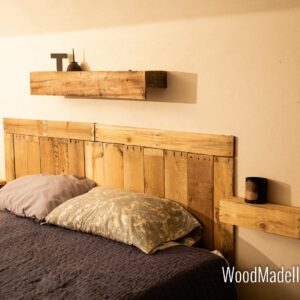
Reclaimed and pallet wood need real preparation before they belong in a living room. Boards are kiln-dried or conditioned to a stable moisture content, every hidden nail and staple is removed, and checks for pest activity and old treatments are done before cutting begins. Finishing goes on after that prep, paired with a low-VOC coating suited to the wood’s density. Where possible, designs include replaceable wear strips or modular panels so a damaged section can be swapped without rebuilding the whole wall.
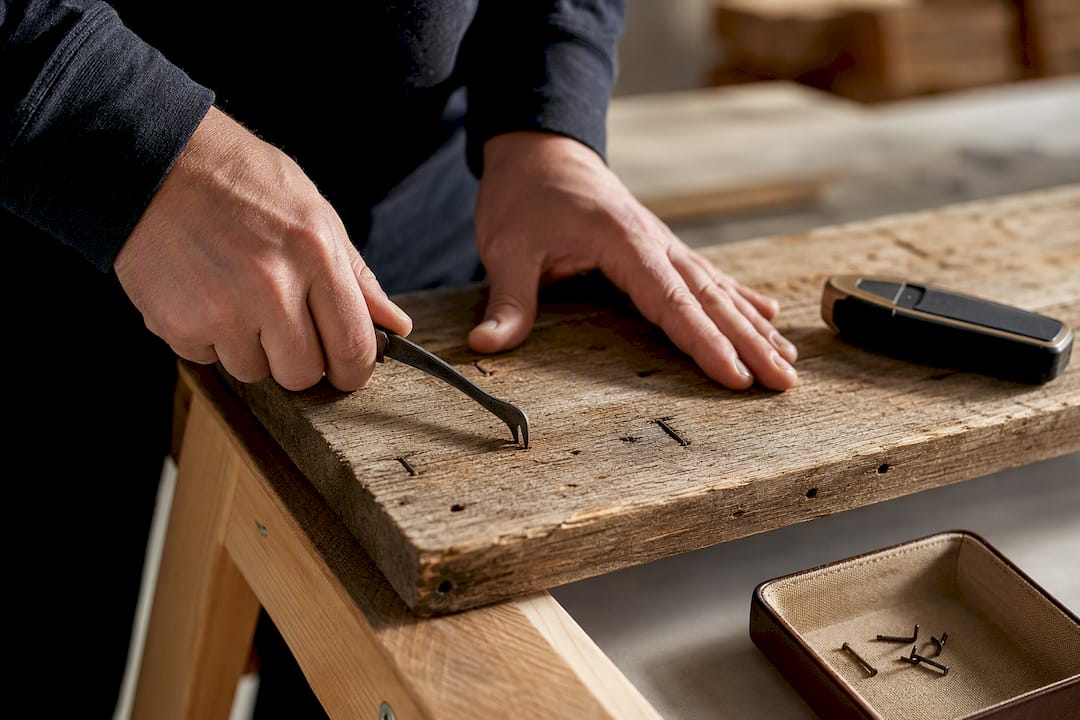
Pro Tip: A pallet board that looks clean can still hide chemical residue from shipping treatments. Have it inspected before it goes anywhere near a bedroom or kitchen.
Small accent projects may be reasonable weekend work for a confident DIYer, but full accent walls, built-ins, or anything touching structural framing are better handled by professionals who can catch problems a first-timer might miss.
Cost considerations and economic benefits of choosing sustainable interior wood
Reclaimed wood often costs less upfront than premium certified new lumber simply because it skips the harvesting and milling steps embedded in a new board’s price, though supply limits can push costs up when a project needs large matched quantities. Certified new wood typically carries a modest premium over uncertified stock, reflecting the cost of third-party auditing throughout the supply chain, but that premium buys documentation a homeowner can point to later if the property is ever appraised or sold.
The larger economic case is durability. A floor or panel system built to be refinished or repaired, rather than replaced, spreads its original cost over a much longer service life. That is the same logic behind the engineered flooring life-cycle study: a product engineered for a long service life reduces both its environmental and its financial cost per year of use. Composite panels that meet TSCA Title VI standards also tend to hold their value better at resale, since buyers increasingly ask about formaldehyde compliance during inspections.
Where budgets are tight, prioritizing one or two high-visibility applications, such as a reclaimed accent wall or a certified hardwood floor in a main living space, delivers most of the aesthetic and sustainability benefit without pricing out the rest of a renovation. A home interior upgrade planned around that kind of prioritization tends to stretch further than one that tries to source everything sustainably at once.
Comparative durability and lifespan of different sustainable wood options for interior use
Solid hardwood flooring, whether certified new or reclaimed, can typically be sanded and refinished multiple times over its service life, which is what gives it the strong long-term economics described in the engineered flooring LCA. Engineered flooring offers a thinner wear layer, so it can usually be refinished fewer times before the veneer runs out, though it often resists moisture and temperature swings better than solid boards.
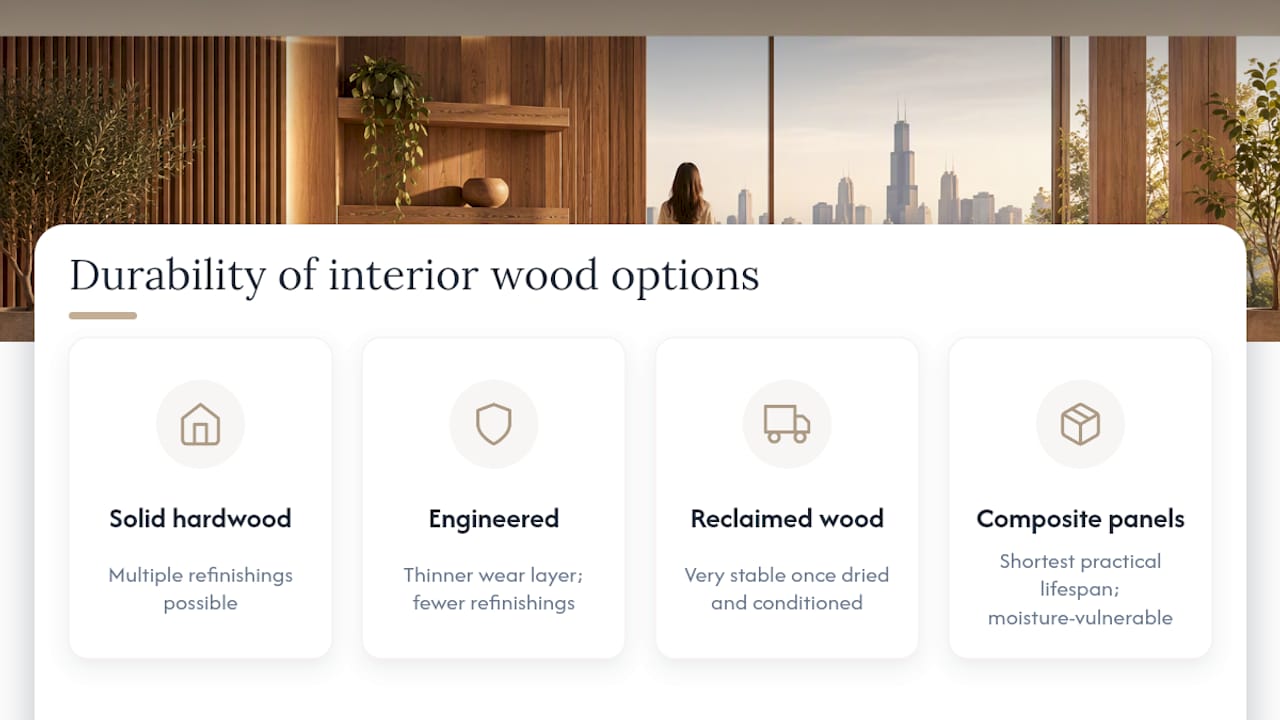
Reclaimed wood used for paneling or accent walls tends to be extremely stable once properly dried and conditioned, since old-growth timber often has tighter grain than fast-grown modern lumber, though individual boards vary and each batch needs its own inspection. Composite panels like MDF or particleboard, used mainly in cabinetry, generally have the shortest practical lifespan of the group and are more vulnerable to moisture damage, which is part of why their formaldehyde labeling and finish quality matter so much for both health and longevity.
Across all these options, maintenance habits affect lifespan as much as the material itself: a certified hardwood floor that never gets refinished will wear out faster than a reclaimed floor that is cared for on a regular schedule.
Author perspective: pragmatic trade-offs between sustainability, cost, and aesthetics
Reclaimed wood wins on carbon and character; certified new wood wins on consistency and volume. Chase all three, EPD, low-emitting finish, and durability, before chasing any single label. A local carpenter who reuses material well does more for circularity than any certificate alone.
— Wood
How Wood Made Illinois can help with sourcing and installing sustainable interior wood
Sourcing reclaimed material and verifying certification paperwork takes time most homeowners do not have. Services include design consultation, material sourcing, and installation for pallet wall accents, built-in millwork, home office renovations, and flooring for homes and small businesses.
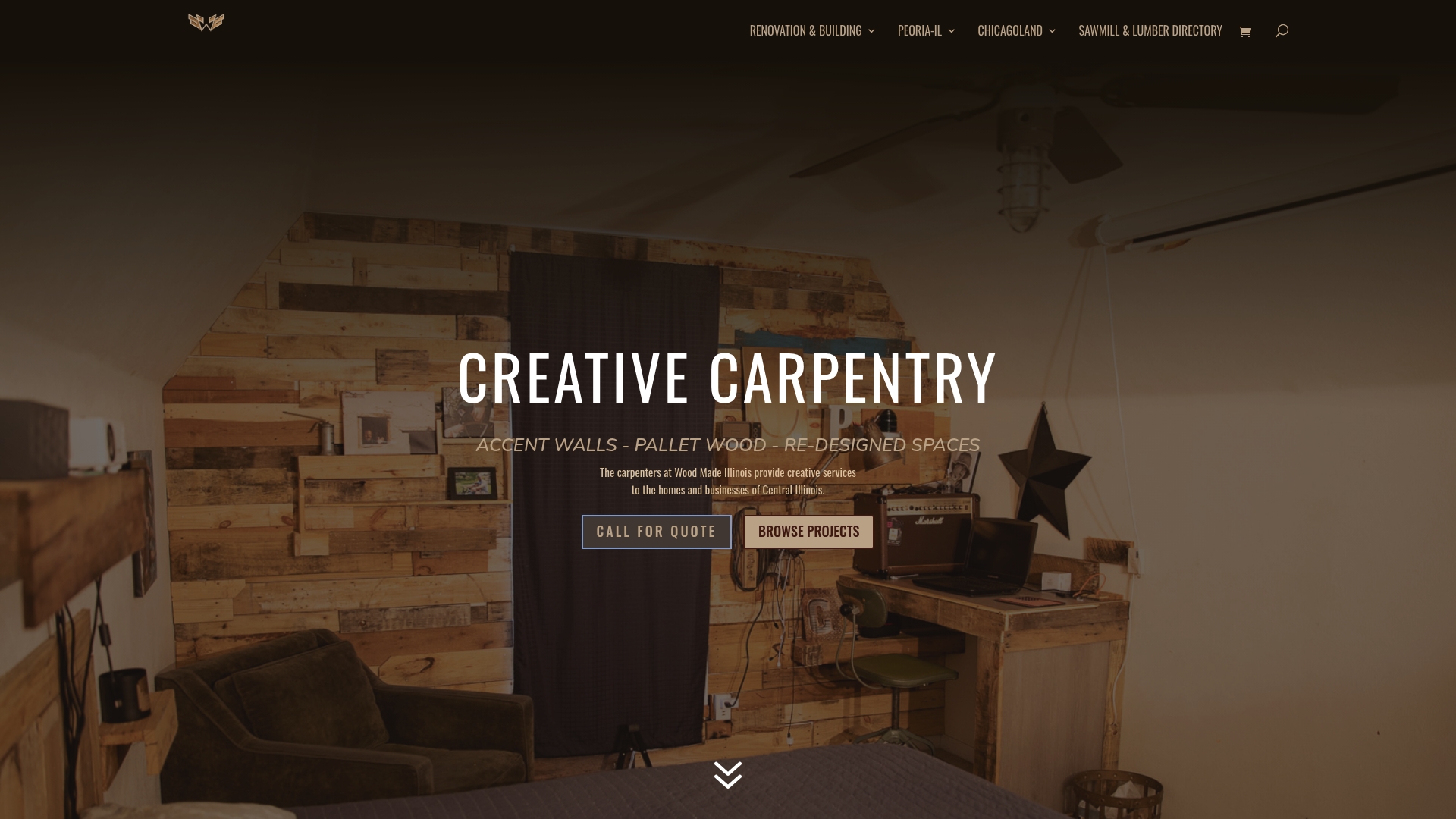
Whether you want a reclaimed accent wall or certified flooring installed correctly the first time, our carpentry services start with a consultation, not a sales pitch. Reach out to talk through your space and get a project started.
Sources
Domestic wood generally travels a shorter distance to the job site, which trims the transportation slice of its overall footprint and simplifies verifying chain-of-custody paperwork, since fewer parties handle the material between forest and mill. Regional species commonly used in interior work, such as oak, maple, and ash, are widely available through certified domestic suppliers.
Imported species offer characteristics, like exotic grain patterns or exceptional hardness, that some domestic species cannot match, but they add transportation distance and can make CoC verification harder to confirm across international supply chains. A supplier sourcing imported material should still be able to produce a valid CoC code and, ideally, a product-specific EPD; if they cannot, that is a reasonable signal to ask more questions or look elsewhere.
Reclaimed wood sidesteps the domestic-versus-imported question entirely, since it is already in circulation and simply needs to be found, inspected, and reused. Availability varies by region and by what local salvage yards, demolition projects, or mills happen to have on hand at a given time, which is part of why reclaimed material works best for accent applications rather than large uniform runs. For interior projects that need matched flooring across an entire home, certified domestic supply is usually the more reliable route.
- Life-cycle assessment of prefinished engineered wood flooring in the eastern United States
- EPA: Formaldehyde standards for composite wood products – consumer FAQ
- WoodWorks – Why wood / sustainability
FAQ
What type of wood is most sustainable?
There is no single “most sustainable” species; the strongest choice is reclaimed wood, since it requires no new harvesting, followed by FSC, SFI, or PEFC certified new wood with verified chain-of-custody documentation. The right answer depends on supply availability and the application.
What are some sustainable materials for interior design?
Reclaimed wood, certified solid and engineered wood, recycled-content panels, cork, and bamboo are common sustainable choices for interiors. For wood specifically, pairing a certified or reclaimed material with a low-VOC finish rounds out the environmental profile.
What are some environmentally friendly wood types?
Reclaimed wood from barns, pallets, or factories, along with FSC, SFI, or PEFC certified new lumber, are generally considered environmentally friendly because of verified sourcing or the absence of new harvesting. Engineered wood flooring also performs well once biogenic carbon storage is factored into its life-cycle assessment.
What does “sustainable wood” mean?
Sustainable wood means material that is either reclaimed from prior use or harvested under an audited forestry standard, with documentation such as a chain-of-custody code or an Environmental Product Declaration to back the claim. Without that verification, a “sustainable” label is only a marketing statement, not a checked fact.