Choose a trim carpenter when a project’s success depends on visible finish quality: tight joints, consistent reveals, and durable detailing that hold up through seasons of wood movement. A skilled specialist delivers neat miters and copes, seamless transitions between rooms, and surfaces that are truly finish-ready, not just close enough. The sections ahead walk through exactly how to find one and what to check before you sign anything.
TL;DR:
- The best trim carpenters focus on detailed work such as tight miters, seamless transitions, and durable joints that withstand wood movement.
- Portfolio quality and references, especially showing corners and transitions, are more reliable indicators of skill than job titles or certifications alone.
- Precise inspection of corner copes, reveal consistency, and long runs is essential to assess a carpenter’s true craftsmanship before hiring.
- Get a detailed, written scope covering profiles, scope, installation, and cleanup, as low bids often exclude key costs like caulking and finishing.
- Vague design descriptions should be replaced with specific examples, profiles, or photos to ensure your expectations match the final work.
Table of Contents
- What Does a Trim Carpenter Actually Do?
- Why Hire a Trim Carpenter for Finish Work?
- How Do You Evaluate and Hire a Skilled Trim Carpenter?
- What Should Be in a Written Quote?
- What Details in a Portfolio Reveal Real Skill?
- How Wood Made Illinois Approaches a Trim Project
- What Training Do Trim Carpenters Typically Have?
- How Do You Communicate Design Preferences to a Trim Carpenter?
- Author’s Perspective: Why the Details Matter
- Ready to Talk Trim? Here’s What to Expect From Wood Made Illinois
- Sources
- FAQ
What Does a Trim Carpenter Actually Do?
A trim carpenter specializes in the finish work that gives a room its character: baseboards, casing around windows and doors, crown molding, wainscoting, chair rails, interior doors, decorative millwork, and built-ins. It’s detail-oriented work that depends on precision rather than structural calculation.
Here’s where it gets confusing for homeowners: “trim carpenter” and “finish carpenter” overlap significantly, and contractors use the terms loosely. One might focus tightly on installed moldings, while another under the finish carpenter label also handles cabinetry, stair parts, and custom shelving. The title tells you less than you’d think.
That’s why a portfolio matters more than a job title. Ask to see the specific type of work you need done, not a general “carpentry” gallery.
A general contractor is the right call when you’re coordinating multiple trades on a larger renovation, structural changes, or permitting. But if the job is really about how a room looks and feels at eye level, a specialist earns their fee.
Why Hire a Trim Carpenter for Finish Work?
Trim gets judged from three feet away, not from across the yard. A slightly uneven baseboard or a gapped miter joint is invisible in a wide-angle photo and glaring the moment you walk past it every day. Trim carpentry is judged at close range, and small errors in miters, copes, or reveals remain visible even after painting covers them. That’s the core reason for hiring a specialist: control over the details a generalist might rush past.
Durability matters just as much as looks. Wood expands and contracts with humidity, and a carpenter who understands acclimation and joint selection avoids the gaps and cracks that show up six months later.
The visual payoff can be substantial. Crown molding, updated casing, wainscoting, and built-ins add architectural character and hide gaps while protecting walls, often transforming a room without touching a wall or a cabinet box. And because a specialist repeats these installations constantly, the work usually moves faster and cleaner than a generalist handling trim as a side task.
How Do You Evaluate and Hire a Skilled Trim Carpenter?
Start with your own scope before you contact anyone. Walk through the rooms involved, note the profiles you like (or want replicated), and decide on materials and finish. Vague requests get vague, unreliable quotes.
From there, follow a sequence:
- Request portfolio photos that show your specific project type, especially close-ups of inside corners and long runs.
- Ask for three to five recent references and actually call them.
- Confirm who does the hands-on work, since some companies subcontract.
- Verify licensing where your municipality requires it, plus proof of liability insurance.
- Get a written scope before agreeing to anything verbally.
During the conversation, ask specific questions rather than general ones:
- How do you decide between coping and mitering on inside corners?
- What’s your plan for walls that aren’t perfectly plumb?
- How long does the wood acclimate on site before installation?
- What’s covered for floor and furniture protection and cleanup?
- What’s your touch-up policy if something shows a gap after a few months?
Pro Tip: Ask every reference the same question: “Did anything need a callback after the first season change?” That single question tells you more about joint quality and acclimation practices than almost anything else.
Watch for red flags: no portfolio at all, refusal to put scope in writing, timelines that sound too fast for the job’s complexity, or a bid dramatically lower than everyone else’s. That last one deserves its own section.
What Should Be in a Written Quote?
A bid that looks like a bargain often just leaves things out. Compare quotes item by item, not just by the bottom-line number.
A complete written quote should specify:
- Exact rooms and openings included in the project
- Trim profiles and materials, and who’s supplying them
- Prep and removal of existing trim
- Installation method and who’s responsible for finishing (caulk, fill, paint)
- Start and estimated completion dates
- What’s explicitly excluded from the price
- Payment schedule and how change orders get handled
Homeowners frequently discover after the fact that a low bid didn’t include caulking, nail-hole filling, painting, or disposal of old material. Each of those adds real cost once you realize they’re missing, and a low initial price is more often a sign of omitted scope than a genuine deal. Put every responsibility in writing so you’re comparing the same job twice, not two different ones wearing the same price tag.
What Details in a Portfolio Reveal Real Skill?
Anyone can photograph a straight, well-lit wall of trim. What separates competent work from mediocre work shows up at the corners and transitions.
- Look closely at inside-corner copes. A clean cope sits tight with no visible gap, even where the wall itself isn’t perfectly square.
- Check miter tightness at outside corners and window casing joints.
- Scan for consistent reveal around door and window openings. Uneven reveals are one of the most common signs of rushed work.
- Inspect long baseboard runs for level and plumb lines, and look at how returns and built-ins integrate with the surrounding trim.
- Look for filled nail holes that are sanded smooth, not just dabbed with putty.
When you talk to references, ask specifically how the trim has held up through a full season of temperature and humidity swings, and whether anything needed a callback.
How Wood Made Illinois Approaches a Trim Project
A typical project starts with an in-home consultation, where profiles, materials, and finish preferences get discussed against the actual rooms involved. From there: material selection, an acclimation period appropriate to the wood and the space, installation, then touch-ups and cleanup before walkthrough.
Wood Made Illinois brings over 100 years of combined carpentry experience to that process, with a stated focus on personalized design consultations, creative small-space storage solutions, and turnaround times that respect a homeowner’s budget.
Whoever you hire, put the same commitments in your contract: a realistic timeline, surface and floor protection during work, and a clear touch-up policy after installation.
What Training Do Trim Carpenters Typically Have?
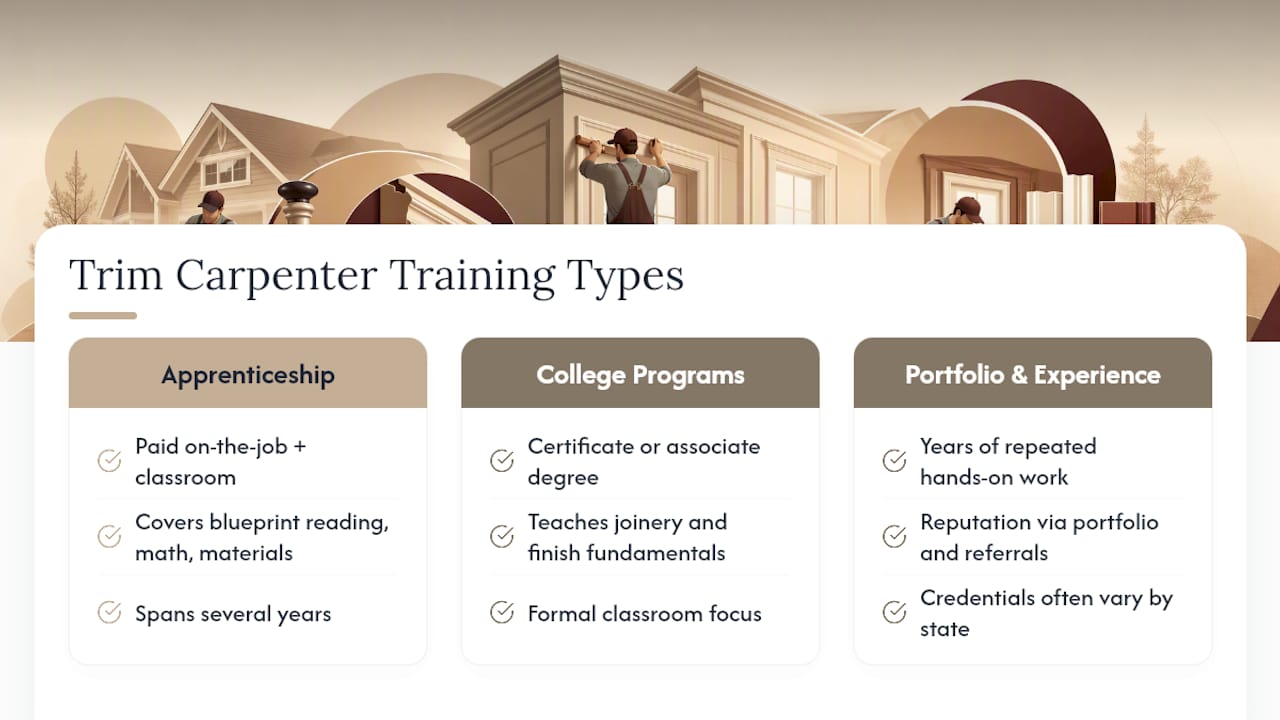
Most trim carpenters build skill through a mix of formal apprenticeship and years of repeated, hands-on work. Union and trade-association apprenticeship programs typically combine paid on-the-job training with classroom instruction covering blueprint reading, math, and material science, spread across several years. Community and technical colleges also offer carpentry certificate and associate-degree programs that cover joinery and finish work fundamentals.
Formal certification requirements vary significantly by state and municipality, and many skilled trim carpenters build their reputation entirely through portfolio and referrals rather than a specific credential. This is part of why a job title alone tells you less than direct evidence of past work, echoing the overlap between trim and finish carpentry roles discussed earlier.
What matters more than a certificate is a track record of solving imperfect site conditions cleanly: walls that aren’t square, floors that aren’t level, transitions between rooms with different flooring heights. That kind of judgment develops through repetition, not a single training course. If a carpenter mentions ongoing trade association involvement, continuing education, or specialty training in areas like historic restoration, treat those as reinforcing signals. But always weigh them alongside the portfolio and references you’ve already vetted, since credentials describe potential while finished work describes results.
How Do You Communicate Design Preferences to a Trim Carpenter?
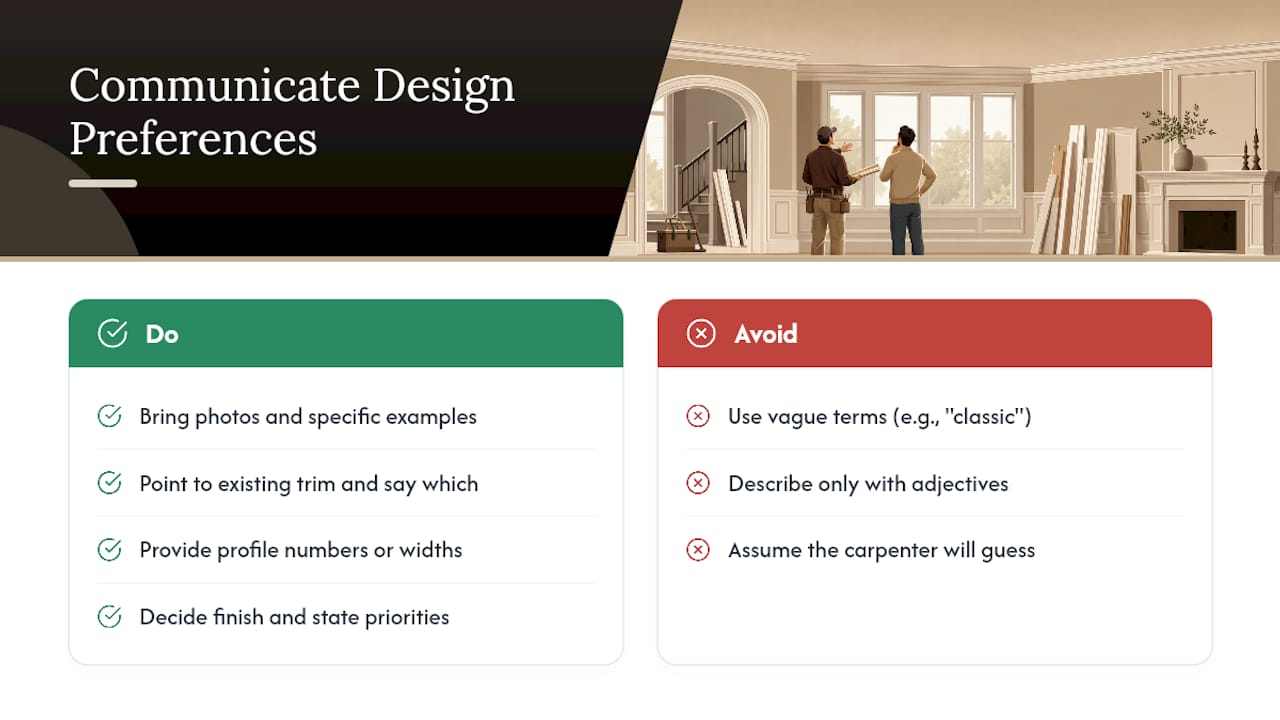
Vague language is the biggest source of miscommunication between homeowners and carpenters. “Something classic” or “not too fussy” means different things to different people. Bring specifics instead.
Photos of trim profiles you like, even from other houses or online galleries, do more work than adjectives. If you already have some trim in the home you want to match or intentionally contrast with, point to it directly and say which. Naming actual profile numbers or widths, if you know them, removes guesswork entirely.
Walk the carpenter through the rooms in person if possible, and talk through transitions between spaces: where one profile stops and another starts, how doorways and hallways connect. Decide in advance whether you want stain-grade or paint-grade material, since that choice affects both cost and the carpenter’s approach to joints and filling.
Be direct about your priorities. If durability against your dog scratching baseboards matters more than perfectly matched grain, say so. If resale value is the primary driver rather than personal preference, that changes which profiles and finishes make sense. The clearer your input, the less the finished project depends on the carpenter guessing what you meant.
Author’s Perspective: Why the Details Matter
Good trim work is judged in the moments nobody photographs: the corner behind a door, the joint under a light switch. What separates a carpenter worth hiring is how they handle the wall that isn’t quite plumb, not how straight their sample board looks. Hire based on repeated proof of that kind of problem solving, never on title alone.
— Wood
Ready to Talk Trim? Here’s What to Expect From Wood Made Illinois
Wood Made Illinois works directly with homeowners across Central Illinois on the kind of finish work this article covers: custom trim, built-in storage, interior door installation, and home office renovations designed for people who need a functional, good-looking space without a full remodel budget.

At first contact, expect the same things you’d ask any specialist for: relevant portfolio examples matched to your project, a written scope covering profiles and materials, and a realistic timeline before any work begins. If your project touches interior doors alongside trim, it’s also worth reviewing whether solid wood doors are worth the upgrade while you’re planning casing and hardware.
Visit the Wood Made Illinois portfolio and contact page to send project photos and get a scope started.
Sources
- Carpenters : Occupational Outlook Handbook: : U.S. Bureau of Labor Statistics
- A Remodeler’s Guide To Interior Trim Moldings and Finish Carpentry | Forward Design Build Remodel
FAQ
How much does a good trim carpenter make?
The BLS reported median carpenter pay of $59,310 per year, or roughly $28.51 hourly, as a labor-market benchmark. Actual project pricing for homeowners varies widely by scope, materials, region, and finish complexity, so this wage figure describes earnings, not what your project will cost.
What is the difference between a trim carpenter and a finish carpenter?
The terms overlap heavily and are often used interchangeably. A trim carpenter typically focuses on installed moldings like baseboard, casing, and crown, while “finish carpenter” can also cover cabinetry, stairs, and custom built-ins. Because titles vary by contractor, checking the actual portfolio matters more than which label someone uses.
What are the three types of carpenters?
Carpentry generally splits into rough carpentry (framing and structural work), finish carpentry (trim, millwork, and cabinetry), and specialty carpentry (such as cabinetmaking or scenic/theatrical carpentry). Trim carpenters fall under the finish carpentry category, focused specifically on visible interior details.
Is trim carpentry hard?
Trim carpentry demands real precision because it’s judged at close range, and small errors in miters, copes, or reveals stay visible even after painting. It also requires ongoing problem solving for uneven walls and material movement, which is why experience and a strong portfolio matter more than tools alone.