The single factor that decides everything else is what the bracket is anchored to. Studs and masonry hold; drywall alone does not, and a shelf with an MDF core will never carry what solid hardwood carries at the same thickness.
TL;DR:
- Mounting surface quality has the greatest impact, with studs supporting significantly more weight than drywall anchors or masonry when anchors are properly installed.
- Shelf material, thickness, and length dramatically influence load capacity, with hardwoods and thicker shelves resisting sag better, especially over longer spans.
- Using the correct fasteners, properly spacing brackets, and adding center supports extend the load shelf can hold safely, especially for heavy or permanent loads.
- Manufacturer-reported capacities are optimistic; a safe guideline is to plan for around 35 to 40 pounds per stud when loading shelves permanently.
- Custom installation and wall assessment by professionals can unlock maximum load capacity and prevent failures common with improper mounting.
Table of Contents
- What Affects Floating Shelf Weight Capacity
- How Much Weight Can Shelves Hold at Common Sizes?
- How to Install Floating Shelves for Maximum Weight Capacity
- Choosing the Right Bracket and Material for Your Load
- Real-World Loading Examples and a Quick Safety Check
- A Carpenter’s Take on Floating Shelf Capacity
- How Woodmadeillinois Handles Load-Rated Floating Shelves
- Sources
What Affects Floating Shelf Weight Capacity
The number printed on a shelf’s product listing means almost nothing without context. Floating shelves weight limits swing wildly based on five variables working together, and a shelf rated for 75 pounds in a showroom can fail at half that in a real wall if the mounting doesn’t match.
Mounting surface decides more than anything else on this list. A bracket driven into a solid 2×4 stud can carry serious weight. The same bracket floating in drywall, held only by plastic anchors, is working with a fraction of that strength. Concrete and masonry, when anchored correctly, often out-hold studs. Standard drywall anchors typically manage 10 to 25 pounds, heavy-duty toggle bolts stretch that to 25 to 50 pounds, and masonry anchors can reach 200 pounds or more depending on the anchor size and how deep it’s set.
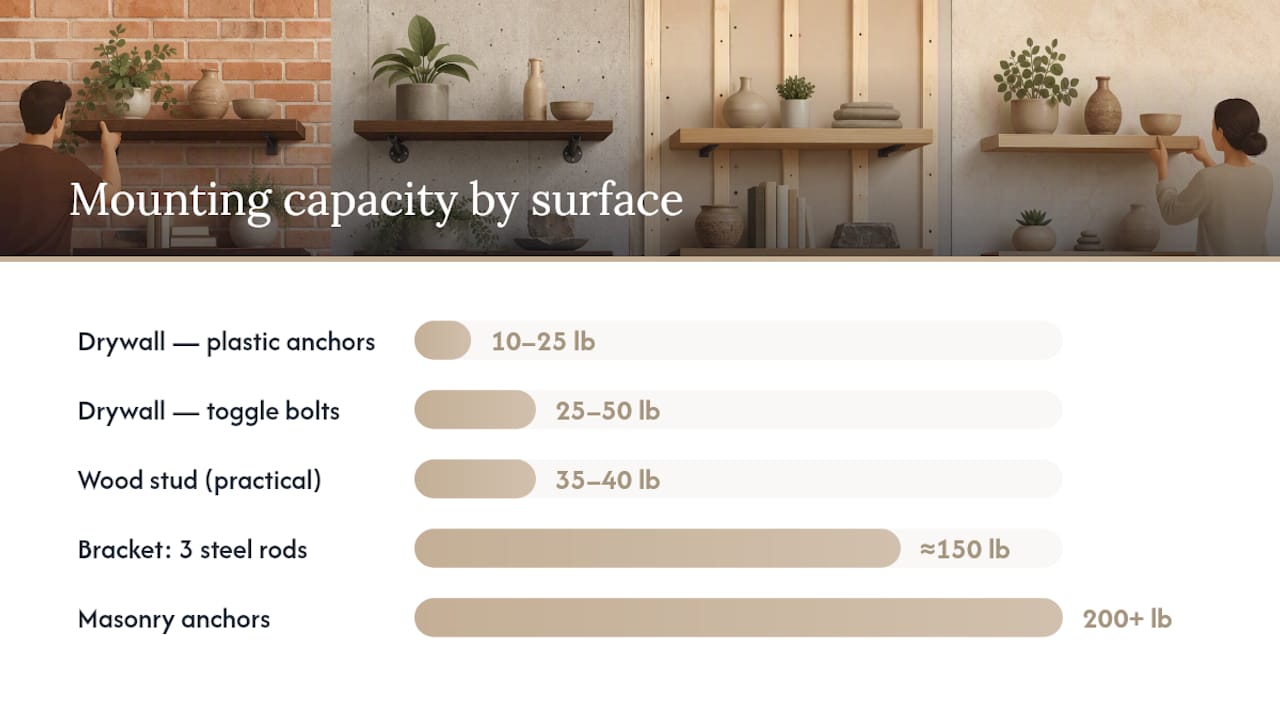
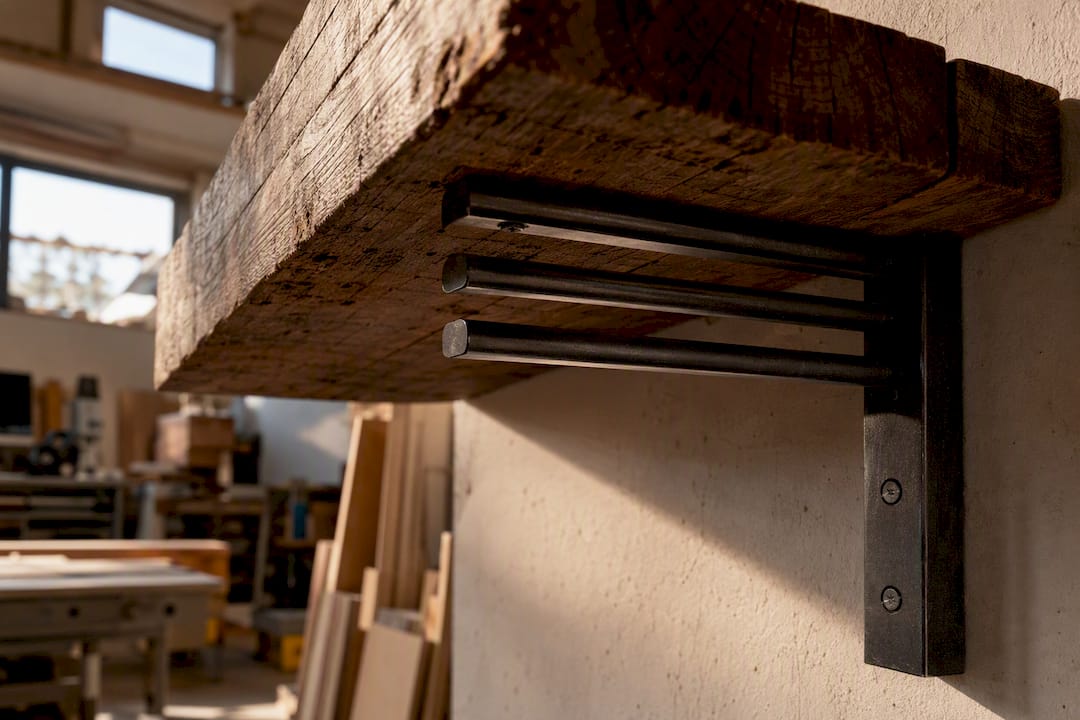
Bracket design matters almost as much as the wall behind it. Hidden steel rods distribute load along their length and scale with rod count. A bracket with three rods rated at 50 pounds each can approach 150 pounds total, while a single thin rod on a long shelf invites sag no matter how strong the wall is behind it. Visible L-brackets and French cleats spread the load differently and often win on raw strength when looks aren’t the priority.
Material and thickness change the shelf’s own ability to resist bending, independent of what’s holding it up. Solid hardwood outperforms softwood, and softwood outperforms MDF or particleboard at the same dimensions. Thickness isn’t a straight-line improvement, either: doubling a hardwood shelf’s thickness increases its stiffness roughly eightfold, since resistance to bending scales with the cube of thickness, not the thickness itself.
Span and depth work against you the longer and deeper a shelf gets. A 24 inch shelf and a 48 inch shelf using identical brackets and material are not carrying the same practical load. The longer shelf has a bigger bending moment across its center, which is exactly where books and decor tend to pile up.
A few practical notes worth keeping in mind:
- Studs beat drywall anchors in nearly every case where real weight is involved.
- Rod count and rod diameter scale bracket capacity roughly in proportion.
- Thicker hardwood resists sag far better than thin hardwood, not just modestly better.
- Longer, deeper shelves need more support, not the same bracket stretched further.
Pro Tip: Treat any manufacturer’s stated capacity as a best-case lab number. For anything you plan to leave loaded permanently, plan around 35 to 40 pounds per stud instead of the full 50, so the wood has margin left for years of settling.
How Much Weight Can Shelves Hold at Common Sizes?
There’s no single figure that covers every shelf, but a few common configurations cover most homes and offices. The ranges below assume evenly distributed load, quality fasteners driven at the correct depth, and a bracket properly seated into the wall.
| Span | Material | Mounting Method | Typical Safe Load |
|---|---|---|---|
| 24 in. | Solid hardwood, 1.5 to 2 in. thick | Two wall studs | 75 to 100 lb |
| 24 in. | MDF or particleboard, 0.75 to 1 in. thick | Two wall studs | 25 to 50 lb |
| 24 in. | Solid hardwood, 1.5 to 2 in. thick | Two wall studs | 75 to 100 lb |
| 24 in. | Softwood, 1 to 1.5 in. thick | Two wall studs | 35 to 40 lb |
| 24 in. | Solid hardwood, 1.5 to 2 in. thick | Toggle anchors, drywall only | 20 to 35 lb |
| 48 in. | Solid hardwood, 1.5 to 2 in. thick | Two wall studs plus center support | 100 to 120 lb |
| 48 in. | MDF or particleboard, 0.75 to 1 in. thick | Two wall studs | 25 to 40 lb |
| 24 to 24 in. | Any listed material | Concrete or masonry anchors | 100 to 200+ lb |
The per-stud math behind these numbers is simple to scale yourself. Two studs at roughly 50 pounds each gets you close to 100 pounds under even loading, which lines up with the hardwood rows above. Add a third attachment point, whether that’s a center stud or a longer bracket with a third rod, and you’re pushing toward 150 pounds on the same span.
A quick gut check before you load anything up:
- These figures assume the load sits evenly across the shelf, not stacked in one corner.
- Quality fasteners matter as much as the wall. A cheap lag screw undersized for the hole loses grip fast.
- Rod insertion depth has to match the manufacturer’s spec, or the bracket is only working at a fraction of its rating.
How to Install Floating Shelves for Maximum Weight Capacity
Good installation is what turns a table of numbers into a shelf that actually holds them. Skip a step here and the strongest bracket in the world won’t save you.
Tools to gather first: a stud finder (magnetic or electronic both work, though electronic finders are more reliable through thicker drywall), a drill with sharp bits sized to your fasteners, a 4-foot level, and a tape measure. Masonry work adds a hammer drill and the correct masonry anchors for your wall type.
- Locate every stud in the mounting zone, not just one. Mark both edges of each stud with a pencil so you know the center, not just where the finder beeped.
- Mark bracket placement against your level line, then double-check it against the stud marks before drilling anything.
- Drill pilot holes perpendicular to the wall, holding tolerance to about 1mm. A loose or angled hole concentrates stress on one edge of the fastener instead of spreading it evenly, and that’s often where failures start months later.
- Choose fasteners by wall type. Lag screws into studs for the strongest hold, heavy toggle bolts if you’re stuck with drywall alone and keeping loads conservative, and masonry anchors set to the manufacturer’s embedment depth for concrete or brick.
- Seat the bracket fully, checking rod insertion depth against spec, then test the shelf with a light load before committing your books or dishes.
For spans past 48 inches, or any shelf you plan to load heavily and permanently, add blocking or a center support rather than relying on a single long bracket. Two or three shorter brackets spread across a long span outperform one bracket stretched to its limit, and blocking inside the wall gives you attachment points where studs happen to fall short.
Pro Tip: If you’re not confident about what’s inside your wall, whether that’s the stud spacing, old electrical, or plumbing, stop and call a professional before you drill. A mismarked stud on a heavily loaded shelf is a repair job waiting to happen.
Choosing the Right Bracket and Material for Your Load
Matching bracket and material to your actual load stops you from either underbuilding a shelf that sags within a year or overspending on hardware you don’t need.
Hidden-rod brackets look clean and work well for light to moderate loads spread evenly across the shelf, things like framed photos, a row of paperbacks, or decorative objects. They start to struggle when weight concentrates in the center of a long span, since a single rod or pair of thin rods wasn’t built to resist that kind of point loading. For heavier, center-loaded shelves, visible L-brackets or a French cleat setup carry more weight and scale predictably: add brackets, add capacity.
Material choice comes down to what’s actually going on the shelf:
- Hardwood at 1.5 to 2 inches thick handles books, kitchenware, and anything with real heft.
- Softwood at 1 to 1.5 inches thick works for lighter everyday use but sags sooner under sustained weight.
- MDF or particleboard at 0.75 to 1 inch thick suits light décor only, picture frames, small plants, and little else.
- Rod diameter and rod count should scale with your heaviest expected load, and a center support earns its keep on anything past 4 feet.
Woodmadeillinois builds shelves around the load you actually intend to put on them, not a generic spec sheet, sourcing hardwood slabs sized to the job rather than defaulting to whatever thickness happens to be in stock.
Real-World Loading Examples and a Quick Safety Check
Numbers on a spec sheet only mean something once you translate them into what’s actually sitting on your shelf. A foot of stacked hardcover books runs 10 to 15 pounds. A set of 12 dinner plates lands around 12 to 18 pounds. A medium potted plant with a ceramic pot can hit 15 to 20 pounds on its own, and a gallon of cooking oil or paint sitting decoratively adds another 8 pounds.
Run through this before you load anything permanently:
- Weigh your heaviest items instead of guessing, especially plants and stacked dishware.
- Spread weight across the full shelf length instead of clustering it in the center.
- Keep permanent loads at or below 75% of the tested rating to leave margin for years of settling.
- Load gradually and watch the fasteners and bracket line for the first few days, not just the first few minutes.
Sagging that appears within days, a bracket that shifts when you press down on the shelf’s front edge, or plaster dust appearing near the wall mount are all warning signs worth taking seriously. None of them mean catastrophe is imminent, but all three mean it’s time to unload the shelf and check the mounting before adding anything back.
A Carpenter’s Take on Floating Shelf Capacity
Woodmadeillinois has spent more than 100 years of combined shop time watching floating shelves succeed and fail, and the failures almost never come down to a bad bracket. They come down to someone mounting a great bracket into the wrong thing, usually drywall where a stud should have been, or skipping the pilot hole tolerance because it seemed like a minor detail.
Hardwood thickness gets underestimated constantly. A shelf that looks identical to the eye at 1 inch versus 1.75 inches thick behaves completely differently under a stack of books, and that’s before anyone factors in blocking. Blocking between studs, added during a wall opening or a renovation, turns a mediocre mounting location into a genuinely strong one, and it’s the kind of detail that pays off years after the drywall goes back up.
Custom brackets earn their cost on anything past a standard bookshelf load. A shelf built to hold a fish tank or a stereo system isn’t the same project as one holding paperbacks, and treating them the same is where trouble starts.
— Wood
How Woodmadeillinois Handles Load-Rated Floating Shelves
Woodmadeillinois builds shelves rated for the actual load a homeowner or business owner intends to put on them, not a generic capacity pulled from a catalog. That means an on-site assessment of your wall, stud spacing, and framing before a single bracket gets ordered, followed by fastening guaranteed into structural members rather than drywall alone.

That site-specific approach is the real advantage over buying a shelf online and hoping the included hardware matches your wall. A custom floating shelf installation accounts for your span, your material preference, and whether blocking or a center support makes sense before anything gets mounted. Homeowners weighing a full storage overhaul instead of a single shelf can also look at custom shelving options or pair a shelf project with a broader home organization system for closets and utility spaces. If you’re ready to get a wall assessed and a shelf built to hold what you actually own, request a consultation with Woodmadeillinois to get started.
Sources
Capacity figures throughout this guide draw from Ashdeco’s material and span breakdown, Shelfology’s per-stud rule, MD Ultrashelf’s drywall guidance, and Lifehacker’s variable-based estimation approach. All figures assume stud mounting, even load distribution, and quality fasteners installed to spec.
- How Much Weight Can Floating Shelves Hold? Real Tests & Numbers | Ashdeco
- How Much Weight Can a Floating Shelf Hold? | Shelfology
- How Much Weight Can a Floating Shelf Hold? – MD Ultrashelf Inc