A solid walnut bar top is a custom piece of carpentry, not a catalog item, and the best result comes from a builder who selects the lumber, mills it, joins it, finishes it and installs it as one job. Wood Made Illinois designs and builds solid wood bars for homes and small businesses in Central Illinois, and a bar top is where that single-point responsibility matters most: the boards, the joints, the finish and the way the top is fastened all decide whether it still looks right in ten years.
This guide explains what “solid” really means, how a walnut top is built, what moves the price, and what to ask a builder before you sign.
TL;DR
- Solid walnut means real walnut boards or slabs through the full thickness of the top, not a thin veneer over a core. That is why it can be sanded and refinished later.
- Walnut moves with humidity. A good builder uses kiln-dried stock and fastens the top so it can shift across the grain instead of cracking or cupping.
- A bar takes spills, so the finish matters as much as the wood. Ask what film finish will protect the surface and how it handles alcohol and water rings.
- Price is set by lumber selection, size, edge profile, finish and installation. A site visit and a written project quote beat any per-foot guess.
- For Central Illinois homes and small businesses, we design and build solid wood bars as a single project, from consultation to installation.
Table of Contents
- What “solid walnut” means for a bar top
- How a solid walnut bar top is made
- Design choices to settle before the build
- What a walnut bar top costs in Illinois
- How to choose a walnut bar top builder
- Caring for a finished walnut bar top
- Our approach to solid wood bars
- Start your bar project
- FAQ
- Sources
What “solid walnut” means for a bar top
Three products are often sold under the same word, and they behave very differently over time.
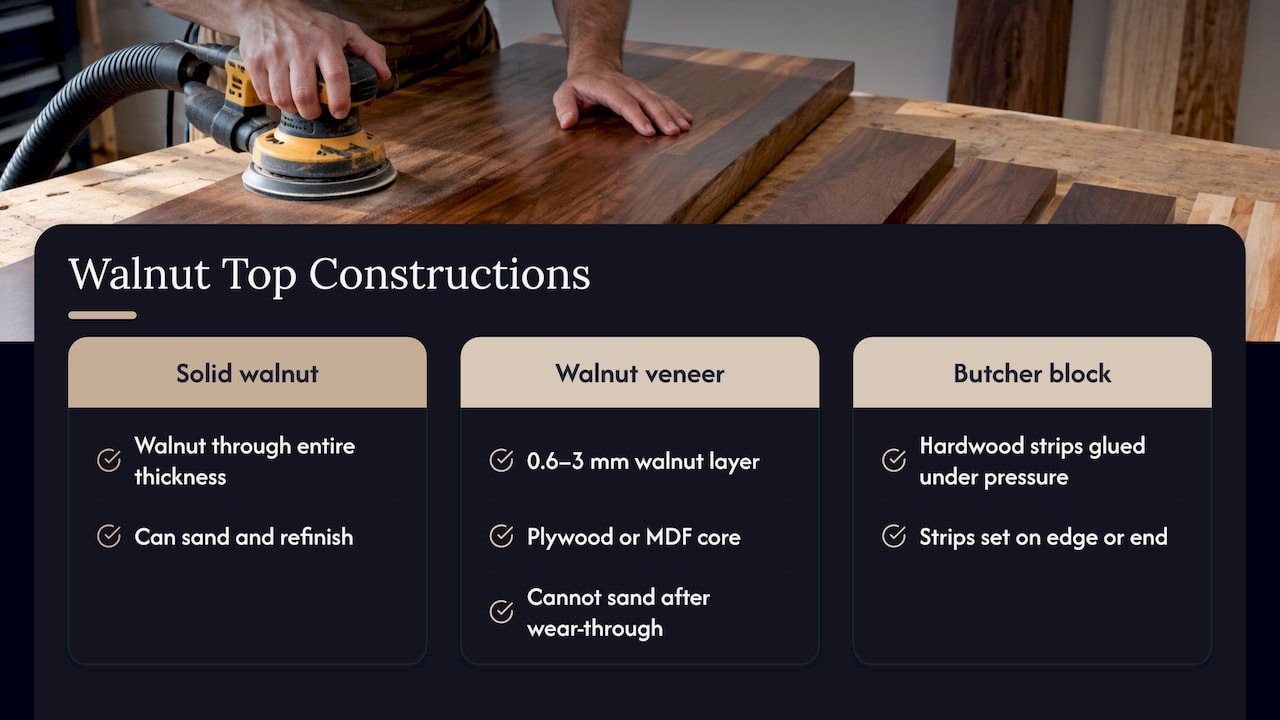
Solid walnut is real walnut all the way through. It can be a single slab or several boards joined edge to edge. Because the wood is walnut at every depth, it can be sanded back and refinished when the surface is worn or marked.
Walnut veneer is a thin layer of real walnut, typically 0.6 to 3 mm, bonded to a plywood or MDF core. It resists warping on large flat panels, but once the veneer wears through there is nothing left to sand.
Butcher block is a different construction again: strips of hardwood glued under pressure into a slab, with the strips set on their edge or on their end. A top made of wide boards in a single plank layout is sold as a wood countertop but is not technically butcher block, and it shows more seasonal movement.
For a bar that people lean on, set drinks on and gather around, most homeowners who call us want the real thing: a thick walnut top they can live with and refinish rather than replace.
Why walnut for a bar
Walnut is prized for its chocolate-brown heartwood, with paler sapwood sometimes visible at the board edges. On the Janka scale, which measures how hard a wood is, black walnut rates 1,010 lbf. That makes it a little harder than cherry and softer than white oak or hard maple. In practice it is a comfortable, workable hardwood that takes a fine finish and develops character with use, which suits a home bar, a basement entertaining space or a small business counter.
The same source puts walnut’s stability ratio at 1.4, lower than white oak at 1.9 and hard maple at 2.1. A lower ratio means less difference between how much the wood moves across the growth rings and along them, which is a quiet advantage for a wide top.
How a solid walnut bar top is made
A bar top can be milled from a slab, or made by milling and edge-joining boards, then shaped, sanded and finished. Each path gives a different look, and the choice is the first design decision.
Slab or joined boards
A single slab gives you dramatic grain and a one-of-a-kind face. It also means you accept what the tree gave you: knots, color shifts, and sapwood bands. A top built from several boards gives the builder more control. Boards can be arranged for color balance and straight grain, and a long run is easier to mill and handle. Neither is better in the abstract. A rustic, characterful bar suits a slab. A clean, even look suits a multi-board panel.
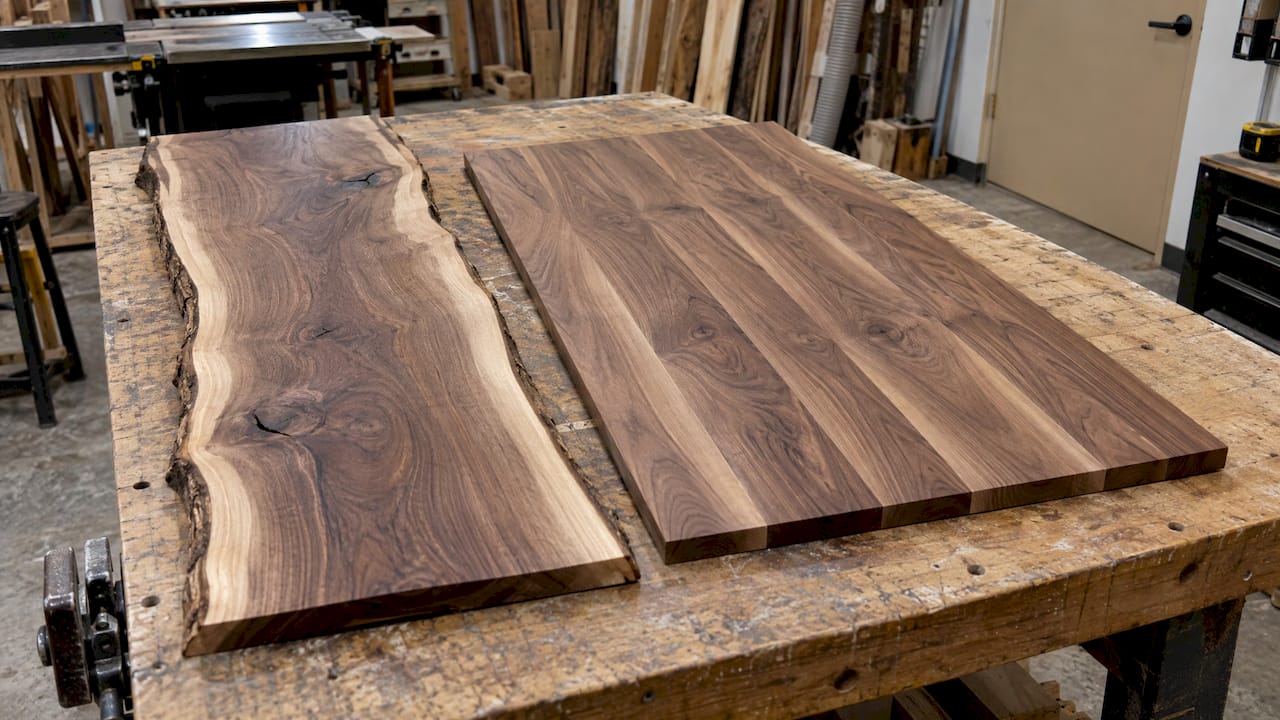
When you review lumber, look at the board-to-board variation and decide how much of it you want. Walnut can range from light to very dark, and the finish will change both color and figure. That is why a sample finished from the same stock tells you more than any photo.
Dry lumber is not optional
Wood absorbs and releases moisture, and a wide solid top will respond to Illinois’s humid summers and dry, heated winters. Fine Homebuilding’s countertop guide advises that kiln-dried stock helps minimize movement, and its author tests for a moisture content of 6% to 9% before building. A seasonal swing is normal: a 12-inch flat-sawn walnut panel moves about 5/16 to 3/8 inch over the year. Multiply that over a deep, wide top and you see why joints and fasteners have to be planned, not improvised.
We wrote a separate piece on avoiding warped bar tops with 6 to 8% dry lumber if you want the details of why moisture is the first thing we check.
Joints, flattening and sanding
After the boards are chosen and dried, they are milled flat, edge-joined, glued, then flattened and sanded in stages. The glue lines should be tight enough to look like part of the grain. The flattening step matters more than most people expect: a bar top is a long, visible surface, and light running along it shows every ripple.
Design choices to settle before the build
A bar top is furniture and architecture at once. These are the decisions that shape the quote and the final look.
Size, thickness and overhang
Depth depends on how the space is used. A home bar where people sit needs enough depth for a drink, a plate and elbows, plus an overhang so knees fit. Thickness changes the look: a thicker top reads as heavy and substantial, a thinner one as lighter and more modern. Very long runs may be built in sections, which also helps with handling and wood movement. Share the room dimensions and the stool height with the builder early, so the top, the base and the seating work together.
Edge profile
The edge is what people touch. A softly rounded edge is comfortable on forearms. A square, crisp edge looks modern. A live edge keeps the natural contour of the tree. Each has consequences for finishing, since sharp corners are where finish wears first.
Finish: the choice that protects the top
A bar sees spills, condensation rings and alcohol. Oil finishes look natural, but they are the least forgiving around beverages. For a regularly used bar, a film finish, such as a catalyzed varnish or a multi-coat polyurethane, forms a protective layer on top of the wood. Ask the builder which finish they recommend for your use, how many coats go on, and how to clean it. Expect the finish to change how the walnut looks, which is another reason to see a sample first.
Support and installation
Because the top will move, it cannot be fixed rigidly across its width. The usual approach is to hold it down with slotted clips, elongated screw holes or figure-eight fasteners, so it stays in place but can shift slightly with humidity. The base needs to be level and strong, and any cabinetry below should be built to carry the weight. This is where a builder who also does built-ins and finish carpentry has an edge: the top and the structure are designed together.
What a walnut bar top costs in Illinois
No honest builder can give a reliable number without knowing the project. Walnut lumber is priced by the board foot, a measure of volume, so thickness and size drive the material cost directly. A thicker top needs far more wood than a thin one, and a wide slab with fewer defects costs more than a mixed run. On top of that, labor changes with the layout, edge profile, number of sections, finishing system and the work needed to install the base and fasteners.
These are the factors that move the price most:
| Factor | Why it changes the cost |
|---|---|
| Length, depth and thickness | More volume means more board feet of walnut |
| Slab versus joined boards | Selected wide slabs cost more and take more careful milling |
| Grain and figure selection | Straighter, cleaner, more uniform stock costs more to source |
| Edge profile | Custom or live edges add shaping and sanding time |
| Finish system | Multi-coat protective finishes add labor and curing time |
| Base and installation | Built-in cabinetry, leveling and fastening add to the job |
We bill custom carpentry per project, and a bar top does not have a published price, so the right next step is a conversation about size, look and use. Our piece on the one decision that sets the cost of a solid wood bar walks through how that decision shapes the budget.
How to choose a walnut bar top builder
When you compare builders, the right questions are about process, not just price.
- How is the lumber dried and checked? You want kiln-dried walnut at a stable moisture content and a builder who can explain it.
- Will I see the wood before it is cut? Choosing boards or a slab for grain and color is part of the design.
- How will the top be fastened? The answer should involve allowing movement, not screwing it down tight.
- What finish will it get, and why? The answer should reference how you will actually use the bar.
- Who builds and installs the base? A single builder responsible for both the top and the structure avoids gaps between trades.
- Is the quote a written, per-project figure? It should list the materials, the finish and the installation.
Platform listings and directories can show you who is nearby, but a bar top is judged by the craft in the work and the clarity of the plan, so look at finished projects and talk through the details.
Caring for a finished walnut bar top
A protected walnut top is easy to live with. Wipe spills promptly, clean with a damp soft cloth and a mild soap, and dry the surface afterward. Use coasters under sweating glasses. Keep hot pans and heavy heat off the surface. Avoid harsh solvents, since they can dull a film finish. Keep indoor humidity reasonably steady if you can, because the wood responds to the season, and ask your builder for the exact care instructions that match the finish they applied. A film finish can be refreshed when the day comes, and because the top is solid walnut, deeper wear can be sanded out, which is the lasting advantage over veneer.
Our approach to solid wood bars
Wood Made Illinois is a Central Illinois carpentry company whose team brings over 100 years of combined carpentry experience. We offer personalized design consultations and custom installations, and solid wood bars sit alongside our built-ins, kitchen builds and finish carpentry. Our solid wood bar builder page shows how we design and build millwork for bars.
Maintaining a good bar is like maintaining a historic house: it is a marathon, not a sprint. The finish is the skin, the joinery is the bones, and both have to be right from day one.
We think of a walnut bar top as a long-term piece of the home. That is why we begin with a consultation about how you will use the space, then build the top, the base and the details as one coordinated project. Solid wood can be refinished, so what we build is meant to be kept, not replaced.
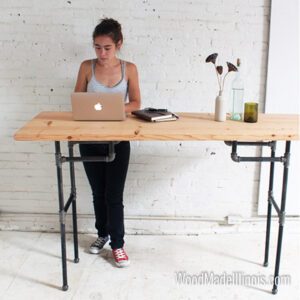
For families and remote workers who need every square foot to count, a bar can do double duty as storage, a serving counter or a standing desk surface, and we design with that in mind. Our approach to materials, including reclaimed and pallet wood elsewhere in the home, keeps the work practical and within a budget.
Wood
Start your bar project
If you are planning a walnut bar in a basement, kitchen or small business space in Central Illinois, we begin with a design consultation to talk through the layout, the wood and the finish. Our carpentry is billed per project, so you will have a clear scope to review.
See our custom carpentry services on the Wood Made Illinois site and tell us about your space.
FAQ
Is a solid walnut bar top better than a veneer top?
For a bar that gets daily use, solid walnut gives you a surface that can be sanded and refinished, because the wood runs through the full thickness. A veneer top has only a thin layer of walnut, so repeated refinishing is limited. Solid walnut also lets the builder shape custom edges without exposing a core.
Will a walnut bar top warp or crack?
Wood moves with humidity, but proper construction manages that movement. Kiln-dried lumber at a stable moisture content, well-planned joints and fasteners that let the top shift across its width all reduce the risk. Steady indoor humidity helps too.
What finish is best for a bar top?
Because bars see spills and alcohol, a protective film finish is usually the practical choice over a plain oil. Your builder should recommend one based on how often the bar is used and how you want the walnut to look, and show you a sample.
How long does a custom bar top take?
The timeline depends on the size, the lumber on hand, the finish and the base. A consultation gives you a realistic schedule for your project, including finish curing time before the top goes into service.
Sources
- Making Wood Countertops, Fine Homebuilding
- Using Black Walnut for Cabinets, WoodWiki
- Walnut Kitchen Cabinets: Complete Buying Guide, DG Floors
- Butcher Block Countertops: The Complete Guide, Decor Full