Choose floating shelves when the shelf should look like part of the wall and the load is light to medium: decor, plants, a few books. Choose visible brackets when the shelf has to carry real weight, such as a kitchen’s dishes, a row of hardcovers or tools, or when you want to move shelves later. The twist is that every floating shelf is still held up by a bracket, only a hidden one. So the real question is how much weight you need, what is behind your wall, and how the shelf will look in the room. A custom-built shelf, cut to your wall and anchored to the framing, can give you the clean look of a floating shelf with the strength you actually need.
TL;DR
- A floating shelf hides its steel support inside the board. A bracket shelf shows it, usually an L-bracket or corbel under the board.
- Bracket shelves generally carry more. One 2026 guide puts heavy-duty brackets at 2 to 3 times the capacity of a standard floating shelf.
- Either style is only as strong as what it is screwed into. Wall studs matter more than the shelf.
- Floating shelves suit living rooms, bedrooms and bathrooms. Brackets suit kitchens, pantries, garages and heavy-use offices.
- For heavy loads with a seamless look, a custom-built shelf or built-in is the better route.
Table of Contents
- What actually separates the two
- Strength: why brackets usually win
- Looks: hidden hardware or visible character
- Cost and flexibility
- Which one for which room
- The downsides, handled
- A quick way to decide
- A third option: custom shelving built for the wall
- Work with a Central Illinois carpenter
- Our perspective
- FAQ
- Sources
What actually separates the two
A floating shelf looks like a plank growing out of the wall. Inside it, a steel bracket is bolted to the wall, and its rods slide into holes drilled in the back of the board. The board covers the hardware completely. That is why “bracketless” is a misnomer: the support exists, you just do not see it.
A bracket shelf is the traditional version. A board rests on L-shaped brackets or decorative corbels fastened to the wall. The support is visible, and it can be plain, industrial, ornate or rustic.
That difference in hardware drives everything else: strength, installation difficulty, cost, flexibility and style.
Strength: why brackets usually win
The physics is a lever. A floating shelf is a cantilever: the load sits out in front of the wall, and the farther it sits, the harder the top screws are pulled. One comparison explains that a shelf rated for 50 lbs assumes the weight is centered or toward the back, while a 50 lb object at the front edge creates the equivalent of 100+ lbs of torque. A visible bracket usually runs nearly to the front edge, which shortens that lever and makes the shelf more forgiving.
Typical published ranges look like this, and they vary by product and installation:
| Floating shelf | Bracket shelf | |
|---|---|---|
| Typical capacity | Roughly 30 to 75 lbs when well installed | Highest of the wall-mounted types |
| Heavy-duty option | French cleat or multi-rod systems | Heavy-duty steel brackets, 150 to 300 lbs |
| Weak point | Rods flexing, top screws pulling out | Mounting into drywall only |
| Adjustable later | Rarely | Often |
The 30 to 75 lb range for well-installed floating shelves depends heavily on whether the shelf reaches studs. The same comparison notes that a rated capacity means little if the shelf is not anchored into the right wall structure.
We go deeper on capacity in our guide to how much weight floating shelves can hold.
The wall matters more than the shelf
A shelf bracket anchored directly into a wood stud can support roughly three to four times the load of the same bracket in drywall alone. One source quoted in a shelf comparison says lag screws into wood studs can each hold 80 to 100 pounds in shear, so four screws into two studs can realistically carry over 200 pounds. Toggle bolts in drywall between studs offer far less, and drywall can tear under sustained load.
If you must mount between studs, one guide says a shelf on two toggle bolts can safely hold 75 to 100 pounds of evenly spread weight, while a floating shelf on self-drilling anchors should stay under 30 to 40 pounds. Heavy books deserve a stud.
What this means in practice:
- Find the studs before you pick a shelf. In most US homes they sit 16 or 24 inches apart, center to center.
- Match the shelf length to the stud spacing. A 36-inch shelf that crosses two studs is stronger than a 24-inch shelf that crosses none.
- Older homes with plaster over lath behave differently from modern drywall. In a historic house in Central Illinois, the wall construction should be known before anything heavy goes up.
Depth is a hidden weight limit
Deeper shelves hold less on the same hardware, because the lever gets longer. For a floating shelf, keep heavy items toward the wall and keep depth reasonable: roughly 10 inches suits most books, which are under 9 inches deep, and 12 inches is common for kitchen shelves. A deep floating shelf stacked with cookware is the classic way to pull a bracket out of the wall.
Looks: hidden hardware or visible character
Floating shelves read as architecture. They suit modern, Scandinavian and minimalist rooms, and they keep sightlines clean in tight spaces, because nothing sits underneath to catch the eye or your head.
Visible brackets are a design choice, not a compromise. In rustic, farmhouse or industrial rooms, iron or timber brackets echo pendant lights, beams and barn doors. A simple rule works well: if the bracket would compete with what sits on the shelf, hide it. If the bracket belongs in the room’s style, show it.
Are floating shelves out of style?
Not really, but the look has matured. Design coverage in 2026 describes open shelving as still in style, but balanced with closed cabinetry rather than replacing it, and one designer noted that thick wood shelves integrated into millwork feel substantial and age well, while thin floating boards can start to feel temporary. Another analysis argues the criticism targets the stark, empty look rather than the shelf itself: shelves now display collections, art, plants and everyday items.
The takeaway for your wall: a thicker solid wood shelf, in a finish that matches your trim or cabinetry, looks intentional. A thin white board on hidden rods looks like a product.
Cost and flexibility
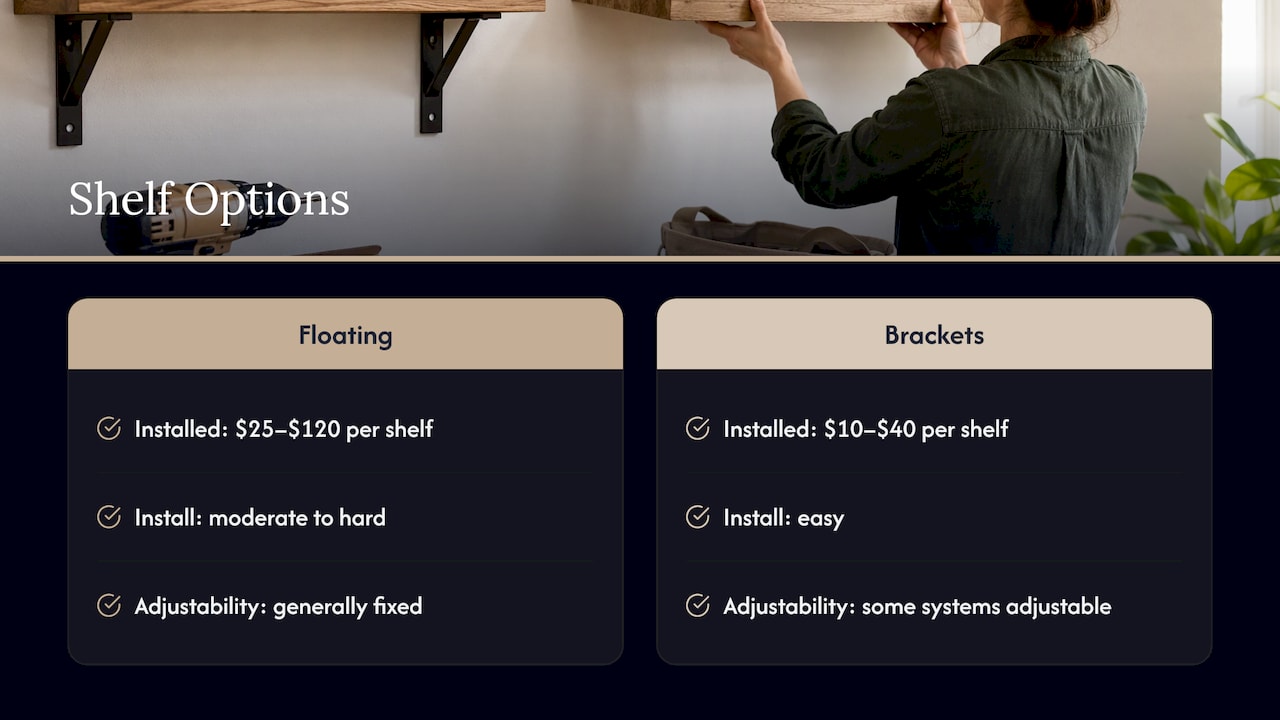
Published comparisons give ballpark figures, which vary with size, material and region. One comparison lists installed costs of $25 to $120 per floating shelf versus $10 to $40 per bracket shelf, and calls floating shelves moderate to hard to install and bracket shelves easy. Hidden hardware costs more and takes more precision: rod holes must be drilled accurately in both wall and board, or the shelf will not sit flush.
Flexibility is where brackets pull ahead. Floating shelf systems are generally fixed once installed, while certain bracket and track systems let you raise or lower shelves. If your kids, books or hobbies will change, that adaptability is worth more than the hidden look.
The retail price is only the start for a wall of shelving. A custom run with trim, finish and stud-anchored hardware is priced by the project, and our breakdown of carpenter prices for built-in shelves shows how per-foot costs work.
Which one for which room
Living room, bedroom and bathroom
Floating shelves fit best here. Loads are light: photos, plants, candles, a few books. The clean look keeps the room calm. Keep depth modest, and use stacked spacing of about 10 to 18 inches depending on what you display.
Kitchen and pantry
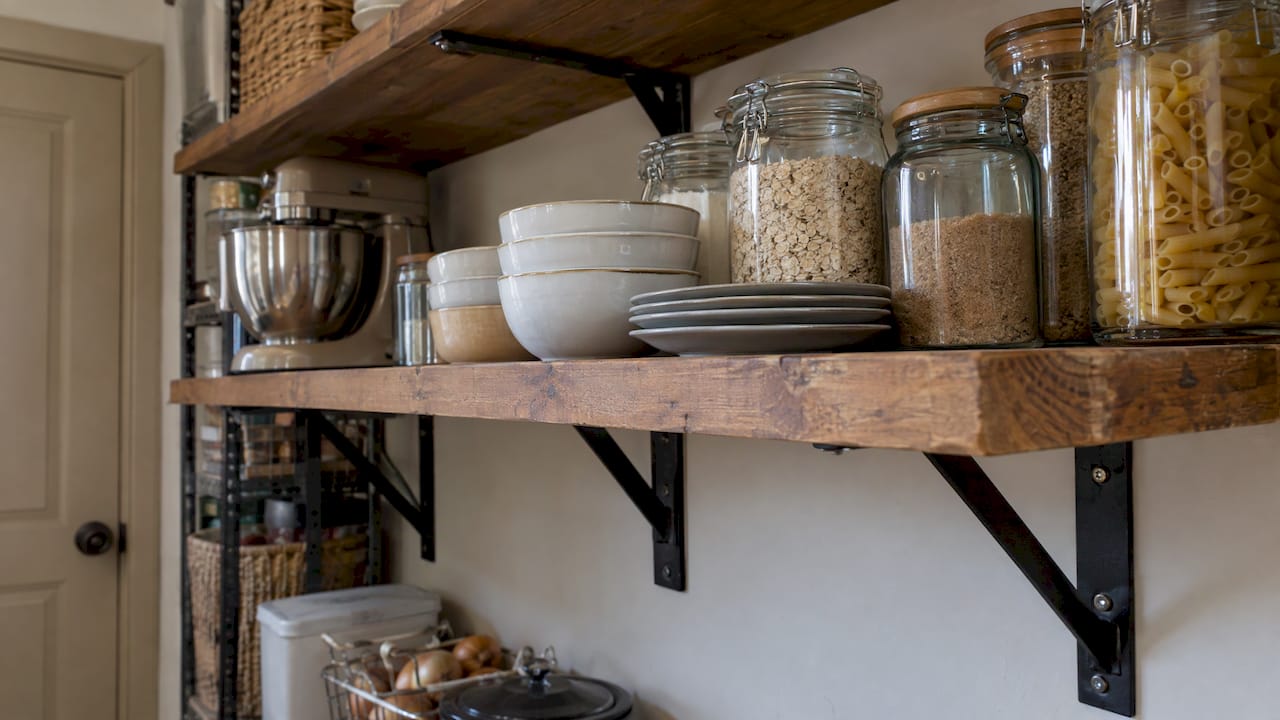
Dishes, jars and small appliances are heavier than they look. A glass-front cabinet’s worth of dinnerware on a shelf adds up fast. Brackets, or a thick custom shelf supported into studs, are the safer choice. Kitchens also see grease and steam, so a sealed finish matters.
Home office
Shelves above a desk hold books, monitors’ accessories, speakers and files. That is often heavier than the “floating” look suggests, and you sit directly beneath them. A good office shelf should be sized to the desk, mounted into at least two studs, and positioned so you do not bump your head. For remote workers, we usually think about the desk, the shelves and the cable routing together, which is easier with a built-in than with a shelf bought separately. Our home office builds are designed around that.
Garage, mudroom and storage walls
Here, strength and adjustability come first. Visible brackets or a purpose-built storage wall are the better fit, and the anchoring matters more than the system. We explain why in garage storage walls and anchoring.
The downsides, handled
Floating shelves fail for predictable reasons, and each is avoidable:
- Drywall-only mounting. The top fasteners pull out as the shelf levers forward. Fix: fasten into studs or added blocking inside the wall.
- Undersized hardware. Thin or cheap rods flex under load. Fix: choose rods and fasteners sized for the load, with more rods for longer or deeper shelves.
- Thin boards. Rod brackets need a board thick enough to hold the holes, around 1.5 inches. Fix: a thicker solid wood or built-up shelf.
- Deep shelves with heavy front loads. Fix: limit depth and keep heavy items near the wall.
- Imprecise drilling. A board that does not seat tight to the wall sags and wobbles. Fix: careful layout and a level reference line.
Bracket shelves have their own concerns: visible hardware that clashes with the room, brackets mounted into drywall alone, and spacing too wide for the board to stay straight under load. Both styles reward the same discipline: find the studs, size the hardware to the load, and keep the load near the wall.
A quick way to decide
Ask these four questions in order:
- What will it hold? Under about 30 pounds of decor: floating is fine. Books, dishware, tools or files: brackets or a stud-anchored custom shelf.
- What is behind the wall? Studs where you need them, plaster, tile or masonry all change the answer.
- How will it look? Modern and quiet: hidden. Rustic, industrial or farmhouse: show the bracket.
- Will you rearrange? If yes, choose brackets or a track system.
If your answers point both ways, such as heavy books on a seamless modern wall, that is exactly the case for custom work rather than off-the-shelf hardware.
A third option: custom shelving built for the wall
Store-bought shelves force a trade-off between looks and strength. A carpenter can build around it: thick solid wood shelves, trim that matches your cabinets, supports sized for what you actually store, and spacing planned to your stud layout. When shelves are integrated into millwork or built into a nook, they read as part of the house rather than something hung on it.
This is the territory of built-ins and custom shelving, and it is especially useful for families in small spaces, where every inch of wall has to work.
Work with a Central Illinois carpenter
Wood Made Illinois builds custom carpentry for homes and small businesses in Central Illinois, including built-in storage, home office installations, mudroom organization, kitchen builds and floating shelves. We offer design consultations, and our team brings over 100 years of combined carpentry experience. We also work with pallet wood: our Pallet Wall Accents start from $500, a practical way to add texture and character with a budget in mind.
If you are deciding between floating and bracket shelves for a particular wall, tell us about your project and we will talk through what the wall, the load and the room call for.
Our perspective
We care about homes, and especially older ones, where a wall is rarely as simple as it looks. Plaster, uneven studs and decades of renovations all change how a shelf should be hung.
Our view is that the choice between floating and bracket is really a choice about structure. A shelf is a small piece of carpentry, and it should be designed the way we design anything else: start with the load, find the framing, then decide how it should look.
That is why we lean toward custom shelving. A thick, solid wood shelf anchored to the framing gives you the seamless look people want from a floating shelf and the strength people want from a bracket. And when visible supports suit the room, we can make them part of the design instead of an afterthought.
Shelves are part of how a home works day to day. Built well, they should be forgotten, and simply do their job for decades.
Wood
FAQ
Are bracket shelves stronger than floating shelves?
Generally yes. Visible brackets pass the load straight into the wall and sit closer to the front edge of the board, so the lever effect is smaller. Published comparisons put heavy-duty brackets at two to three times the capacity of a standard floating shelf. A well-anchored floating shelf with a heavy-duty cleat or multi-rod bracket can still carry a lot, when it reaches studs.
What are the downsides of floating shelves?
They need precise installation, they should be fastened into studs, and they carry less weight the deeper they are. They are also hard to reposition once installed. Choosing a thicker board, sizing the hardware to the load and keeping heavy items near the wall addresses most of this.
Are floating shelves out of style in 2026?
No. Designers describe open shelving as still popular, though balanced with closed cabinetry, and favor thicker wood, varied sizes and curated displays over sparse, thin boards. A substantial solid wood shelf in a finish that matches the room looks current.
What is the rule for floating shelves?
Two habits matter most: fasten into studs, never drywall alone for anything heavy, and match depth to the load. For stacked shelves, many guides suggest roughly 10 to 18 inches between them, depending on what you display, so measure your tallest item and add a couple of inches of clearance.
Sources
- Floating Shelf vs Brackets: strength and torque comparison
- Floating, Bracketed, or Picture Ledge: which wall shelf to choose
- Floating shelf weight capacity and load ratings
- How to hang shelves without studs
- Open shelving in 2026
- Are floating shelves dated?
- Floating shelves vs brackets: costs and installation
- Wall mounted shelving units for first-time homeowners