A kitchen refresh is defined as a set of cosmetic and functional upgrades that modernize a kitchen without altering its layout, plumbing, or structural footprint. The industry term for this scope is “cosmetic renovation,” and it stands in direct contrast to a full remodel, which involves tearing out cabinets, moving walls, and rerouting mechanical systems. For homeowners with a functional kitchen that simply looks tired, the refresh almost always wins on cost, speed, and return on investment. Understanding why kitchen refresh beats full remodel comes down to three factors: what your kitchen actually needs, what you can afford, and how long you can live without it.
What are the main cost and timeline differences?
The financial gap between a refresh and a remodel is not a matter of degrees. It is a different category of investment entirely.
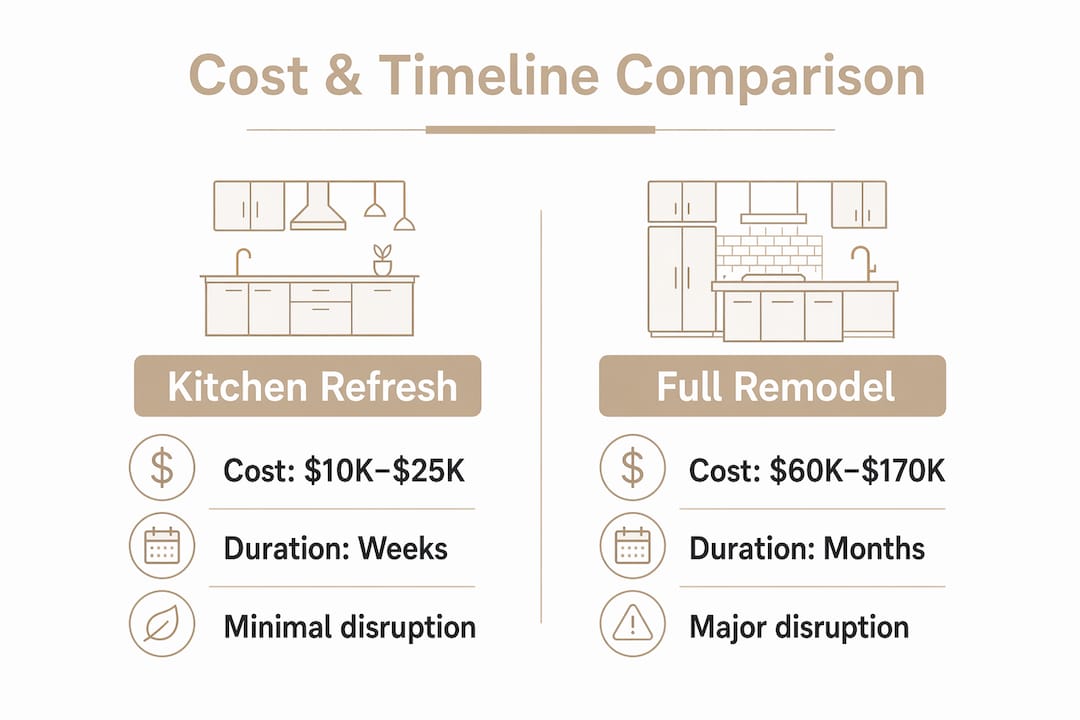
A kitchen refresh costs $10,000–$25,000, while a full remodel runs $60,000–$170,000. That means a refresh can cost as little as one-sixth of a full remodel. The timeline gap is equally significant: refreshes complete in 2–4 weeks, while remodels stretch 8–14 weeks. For a family that relies on their kitchen every day, that difference is not just financial. It is a quality-of-life issue.

Full remodels also carry a hidden cost that most homeowners underestimate: the expense of living without a functional kitchen for months. Takeout meals, paper plates, and temporary cooking setups add up fast. Remodels cause 6–10 weeks of kitchen downtime, while refreshes maintain kitchen functionality throughout the project. That is a concrete advantage that rarely appears in contractor quotes but shows up clearly in your monthly budget.
Remodels also carry a structural risk called scope creep. Hidden code upgrades in wiring and plumbing can push a $60,000 remodel past $80,000 before the first cabinet goes in. Refreshes avoid this entirely by keeping the layout intact.
| Factor | Kitchen refresh | Full remodel |
|---|---|---|
| Typical cost | $10,000–$25,000 | $60,000–$170,000 |
| Timeline | 2–4 weeks | 8–14 weeks |
| Kitchen downtime | Minimal | 6–10 weeks |
| Permits required | Rarely | Almost always |
| Scope creep risk | Low | High |
Pro Tip: Get a structural assessment of your cabinet boxes before committing to either path. If the boxes are solid, a refresh is almost certainly the right call.
When does a kitchen refresh make sense?
The refresh is the right choice when your kitchen works well but no longer looks the part. The key question is not how old your kitchen is. The question is whether its bones are still sound.
A kitchen qualifies for a refresh when all of the following are true:
- The work triangle functions. The path between your refrigerator, sink, and stove is efficient and unobstructed.
- Cabinet boxes are structurally intact. No water damage, no failed joinery, no sagging shelves.
- Storage meets your needs. You are not fighting the layout every time you cook.
- Cosmetic dissatisfaction drives the desire to change. Dated finishes, worn hardware, or old countertops are the primary complaints.
- No mechanical upgrades are needed. Electrical panels, gas lines, and plumbing are code-compliant and functional.
A full remodel becomes necessary when the structure or mechanics fail. Remodels are required when cabinets are compromised by water damage, the layout is genuinely dysfunctional, or mechanical systems need code upgrades. Attempting a cosmetic refresh over serious structural problems is a costly mistake. Designers warn that half-measure refreshes ignoring structural issues lead to wasted money and deferred problems that grow more expensive over time.
The good news is that most kitchens in homes built after 1980 with no history of water damage or major neglect qualify for a refresh. If your layout passes the work triangle test and your cabinets pass a basic structural check, you are a strong candidate.
Pro Tip: Open every cabinet door and press firmly on the interior corners. Solid joinery means no flex. Any give or soft spots signal water damage and warrant a professional assessment before you commit to a refresh.
How does a kitchen refresh improve function and aesthetics?
A refresh works because it targets the parts of a kitchen that age visually without failing structurally. Cabinet hardware, faucets, lighting, countertops, and backsplash tile are all high-visibility surfaces that wear out cosmetically long before the underlying structure does.
The most impactful refresh upgrades, ranked by return on investment, follow a clear pattern:
- Cabinet refinishing or repainting. If cabinet boxes have solid joinery, painting or refacing yields equivalent visual impact at 50–70% less cost versus full cabinet replacement. Professional-grade prep work, including cleaning, sanding, and priming, is the difference between a result that lasts a decade and one that chips within a year.
- Hardware replacement. New pulls and hinges cost $80–$180 for a full kitchen set and deliver an immediate visual update. This is the single highest-return upgrade per dollar spent in any refresh project.
- Faucet upgrade. A quality faucet replacement runs $140–$220 and changes the feel of the sink area completely. It also eliminates the drips and pressure issues that make older faucets frustrating to use.
- Under-cabinet LED lighting. At $40–$80 for a standard kitchen run, under-cabinet LED lighting improves task visibility and creates a finished, modern look that photographs well for resale.
- Countertop and backsplash updates. New laminate or butcher block countertops and fresh subway tile backsplash bring the kitchen’s visual age forward by 15 years without touching a single cabinet box.
The total cost of a well-executed DIY refresh using all five upgrades runs $400–$1,500. A professionally managed refresh with higher-end materials stays well within the $10,000–$25,000 range. Interior design experts note that tailored refreshes preserving efficient layouts create kitchens with more character and practicality than generic remodels that start from scratch.
A phased refresh approach spreads investment across months or years while keeping the kitchen fully functional. Start with hardware and lighting, then move to countertops, then tackle cabinet refinishing. Each phase delivers immediate impact without requiring the full budget upfront.
What are the resale value and long-term considerations?
The return on investment numbers tell a clear story. Refreshes return 50–75% of investment at resale, while full remodels return 75–100%. At first glance, the remodel looks like the better investment. The math changes when you account for the cost base.
A $20,000 refresh returning 60% yields $12,000 in added value. A $100,000 remodel returning 85% yields $85,000 in added value, but you spent $80,000 more to get there. For homeowners planning to sell within five years, the refresh delivers far more value per dollar spent. The phased approach also allows you to spread costs and maintain kitchen usability, which matters enormously when you are still living in the home.
“Homeowners often underestimate the psychological and financial costs of living without a functional kitchen for months. A refresh keeps your daily life intact while still delivering a kitchen you are proud to show.”
For homeowners planning to stay in their home for more than five years and whose kitchen has genuine layout or mechanical deficiencies, a full remodel may be the right long-term investment. Safety and code compliance are not negotiable. If your electrical panel cannot support modern appliances or your plumbing is failing, a refresh does not solve those problems. A full remodel is necessary when infrastructure is compromised, and no amount of fresh paint changes that reality.
The honest calculus is this: if your kitchen works but looks dated, refresh it. If your kitchen is genuinely broken, remodel it. Most kitchens fall into the first category.
Key takeaways
A kitchen refresh delivers the highest return per dollar spent for homeowners whose kitchen layout and cabinet structure remain functional, making it the smarter choice over a full remodel in most cases.
| Point | Details |
|---|---|
| Cost advantage is significant | Refreshes cost $10,000–$25,000 versus $60,000–$170,000 for a full remodel. |
| Timeline favors the refresh | Refreshes complete in 2–4 weeks with minimal disruption to daily kitchen use. |
| Structural condition is the deciding factor | Sound cabinet boxes and a functional work triangle qualify a kitchen for a refresh. |
| Phased approach spreads the investment | Prioritize hardware and lighting first, then countertops, then cabinet refinishing. |
| Resale math favors the refresh | A refresh returns more value per dollar spent for homeowners selling within five years. |
What I have learned from real kitchen projects
After years of working on kitchens across Central Illinois, the pattern I see most often is this: homeowners walk in convinced they need a full remodel, and they walk out with a refresh plan that delivers 90% of the visual result at 25% of the cost.
The kitchens that genuinely need full remodels are rarer than most contractors will tell you. Water damage, failed cabinet boxes, dysfunctional layouts, and outdated mechanical systems are the real triggers. When those problems exist, a refresh is a waste of money. But when the bones are solid, tearing out a functional kitchen to replace it with a new one is like replacing a car engine because the paint is faded.
What I have found works best is a structured assessment before any decision is made. Open the cabinets. Check the joinery. Walk the work triangle. Test the lighting. Most of the time, the kitchen that looks hopeless in a dim, dated state transforms completely with refinished cabinets, new hardware, and proper task lighting. The transformation is not cosmetic in the dismissive sense. It is a genuine improvement in how the space feels and functions every day.
The phased refresh is the approach I recommend most often for budget-conscious homeowners. Start with the upgrades that cost the least and change the most: hardware, lighting, and a fresh coat of paint on the cabinet boxes. Live with that for six months. You may find you need nothing else. If you do want more, the countertop and backsplash phase is ready when your budget is.
The mistake I see most often is the half-measure: homeowners who know they have a structural problem but try to paper over it with cosmetic work. That path leads to spending refresh money now and remodel money later. If the problem is structural, address it fully. If it is not, a well-executed refresh is not a compromise. It is the right answer.
— Wood
Woodmadeillinois can help you refresh your kitchen right
Choosing between a refresh and a remodel is easier when you have an experienced eye on your kitchen before you commit. Woodmadeillinois brings over 100 years of combined carpentry experience to kitchen projects across Central Illinois, from cabinet refinishing and custom hardware installation to countertop upgrades and lighting work.

The team at Woodmadeillinois specializes in cost-effective kitchen updates that deliver real visual and functional impact without the disruption of a full remodel. Whether you are preparing a home for sale or simply want a kitchen you enjoy cooking in again, a consultation with trusted local carpentry experts is the fastest way to know exactly what your kitchen needs and what it will cost.
FAQ
How much does a kitchen refresh cost compared to a full remodel?
A kitchen refresh typically costs $10,000–$25,000, while a full remodel runs $60,000–$170,000. The refresh completes in 2–4 weeks versus 8–14 weeks for a remodel.
What upgrades are included in a kitchen refresh?
A kitchen refresh includes cabinet repainting or refacing, hardware replacement, faucet upgrades, under-cabinet lighting, and countertop or backsplash updates. These changes improve both aesthetics and daily function without altering the kitchen’s layout.
Does a kitchen refresh add value to my home?
A kitchen refresh returns 50–75% of its cost at resale. For homeowners selling within five years, the refresh delivers more added value per dollar spent than a full remodel.
When is a full remodel necessary instead of a refresh?
A full remodel is necessary when cabinet boxes are structurally compromised, the kitchen layout is genuinely dysfunctional, or mechanical systems such as plumbing or electrical need code upgrades. Cosmetic refreshes cannot fix structural or infrastructure problems.
Can I do a kitchen refresh in phases?
A phased refresh allows you to prioritize high-impact, low-cost upgrades first, such as hardware and lighting, and defer deeper investments like countertops or cabinet refinishing. This approach spreads costs while keeping the kitchen fully functional throughout.