
Return on investment (ROI) in home renovation is defined as the percentage of your project cost you recover in increased resale value when you sell. The ROI formula is straightforward: ROI% = (Resale Value Added ÷ Project Cost) × 100%. A 100% ROI means you broke even. Above 100% means you gained more than you spent. Below 100% means the project cost more than it added to your home’s value. Understanding renovation ROI gives homeowners and property investors a concrete way to compare projects, set budgets, and avoid costly mistakes before the first nail goes in.
What does return on investment mean in renovation math?
The formula is simple, but the interpretation takes practice. Divide the resale value your renovation adds by what the project costs, then multiply by 100. The result tells you how much of every dollar spent comes back to you at sale.
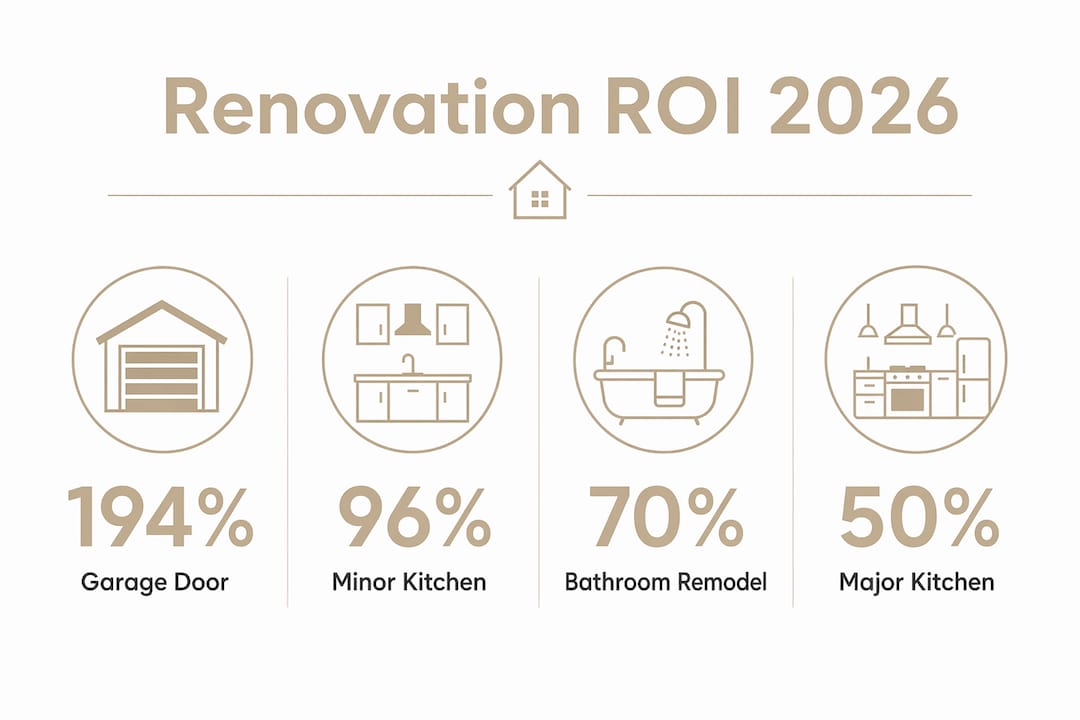
Here is a practical example. A minor kitchen remodel costs $26,000 and adds roughly $25,000 in resale value. That produces an ROI of about 96%. You recover nearly all of your cost. A major upscale kitchen gut renovation, by contrast, returns approximately 38% on average. You spend $150,000 and recover around $57,000 at sale. The gap is significant.

The table below shows how the math plays out across three common project types:
| Project | Estimated Cost | Resale Value Added | ROI% |
|---|---|---|---|
| Garage door replacement | $4,302 | $8,347 | 194% |
| Minor kitchen remodel | $26,000 | $25,000 | ~96% |
| Major kitchen gut renovation | $150,000 | $57,000 | ~38% |
Resale value estimates like these come from industry benchmarks such as the annual Cost vs. Value Report, which surveys contractors and real estate professionals across the country. These figures are averages. Your actual return depends on your local market, your home’s condition, and how recently the work was completed.
Pro Tip: Always get a pre-renovation appraisal. Knowing your home’s current value before you spend a dollar gives you a baseline to measure actual ROI, not just estimated ROI.
Which renovation projects offer the highest and lowest ROI?
The single most important pattern in renovation ROI data is this: smaller, cosmetic projects almost always outperform large structural overhauls. The 2026 Cost vs. Value Report confirms it clearly.
Top-performing projects in 2026
- Garage door replacement: 194% ROI, costing $4,302 and adding $8,347 to home value. This is the top-performing project in the country for 2026.
- Manufactured stone veneer: 153% ROI. A relatively affordable exterior upgrade that dramatically lifts curb appeal.
- Minor kitchen remodel: ~96% ROI. Painting cabinets, replacing hardware, and installing new countertops beats a full gut renovation every time.
Lower-performing projects to approach carefully
- Major upscale kitchen gut renovations return approximately 38% on average.
- Luxury bathroom additions and in-ground pools typically fall below 50% ROI in most markets.
- Sunroom additions and home theaters rarely recoup more than half their cost.
The reason high-cost projects underperform is not poor workmanship. It is market math. Buyers do not pay dollar-for-dollar for high-end finishes. A $50,000 chef’s kitchen in a neighborhood where comparable homes sell for $250,000 will not push your sale price to $300,000. The market simply does not support it.
Curb appeal projects achieve the highest ROI because they cost less and strongly influence buyer interest from the moment someone pulls up to the house. A buyer who loves the exterior walks in already sold. That psychology has real financial value.
Pro Tip: Before planning any renovation, research the three most recent comparable sales in your neighborhood. If the top sale price is $320,000, keep your total renovation budget well below that ceiling. Over-improving for your street is the fastest way to destroy your ROI.
For a practical checklist of cost-effective interior updates that protect your ROI, Woodmadeillinois has assembled guidance specifically for Central Illinois homeowners.
What factors cause renovation ROI to vary by market and situation?
ROI numbers from national reports are averages. Your actual return depends on several factors that no single statistic can capture.
Regional demand shapes project value. Finished basements recoup 80% of their cost in cold northern markets where buyers actively want that space. In subtropical southern markets, the same project returns only 40%. Buyers in warm climates simply do not value below-grade living space the same way. Knowing your regional buyer priorities is as important as knowing the national average.
Neighborhood price ceilings cap your upside. Market value is constrained by comparable sales in your neighborhood, not by the amount you invested. No renovation, regardless of quality, will push your sale price significantly above what neighboring homes have sold for. This is the single most common mistake homeowners make when planning large projects.
Time erodes renovation value. Renovations lose resale value influence after 3–5 years as wear and use show. A kitchen remodel completed six years before you sell contributes far less to your sale price than one completed six months prior. If you plan to sell, timing your renovation closer to your listing date protects your financial return.
Lifestyle ROI is real and worth counting. Experts distinguish financial ROI from lifestyle ROI, which measures personal enjoyment and quality of life. A home office addition may return only 55% at resale, but if it saves you a daily commute and improves your productivity for a decade, the personal value far exceeds the financial loss. Both forms of return belong in your decision.
Pro Tip: Deferred maintenance delivers the highest ROI of any category. Fixing a failing roof or outdated electrical panel prevents sale price reductions that routinely exceed the repair cost. Address maintenance before cosmetic upgrades.
How can homeowners apply renovation ROI to real financial decisions?
Understanding the formula is step one. Applying it to your specific situation is where the real work begins.
-
Set a total budget ceiling before you plan anything. A widely used rule of thumb limits total renovation spending to 30% of your home’s current market value. Spending beyond that threshold almost always produces diminishing returns at sale.
-
Match your project list to your ownership timeline. If you plan to sell within two years, prioritize high-ROI exterior projects and minor cosmetic refreshes. If you plan to stay for fifteen years, a lower-ROI project that genuinely improves your daily life may be the right call. The math changes depending on how long you benefit from the work.
-
Prioritize exterior projects first. Garage door replacement, stone veneer, fresh paint, and landscaping consistently outperform interior renovations on a cost-per-dollar-returned basis. Buyers form their first impression before they open the front door.
-
Consult a local appraiser or real estate agent before committing. National data gives you a starting point. A local professional gives you the neighborhood-specific ceiling that determines your actual upside. This conversation costs little and can save thousands.
-
Avoid the “while we’re at it” trap. Scope creep is the most common budget killer in renovation projects. A minor kitchen refresh that expands into a full gut renovation because “we’re already in there” can drop your ROI from 96% to 38% without any additional benefit to the buyer.
For homeowners weighing a kitchen update, the case for a kitchen refresh over a full remodel is well documented and worth reviewing before you commit to a larger budget.
Pro Tip: Track every renovation dollar in a dedicated spreadsheet from day one. When you sell, you will need accurate cost records to calculate your actual ROI and to provide documentation that supports your asking price.
Key Takeaways
Renovation ROI is the most reliable tool homeowners have for comparing projects financially, but it works best when paired with honest thinking about your timeline and your neighborhood’s price ceiling.
| Point | Details |
|---|---|
| ROI formula | Divide resale value added by project cost, then multiply by 100 to get your percentage. |
| Highest ROI projects | Garage door replacement (194%), stone veneer (153%), and minor kitchen remodels (~96%) top the 2026 rankings. |
| Neighborhood ceiling | Market comparables cap your upside regardless of how much you invest in finishes. |
| Time erodes value | Renovation value influence fades after 3–5 years, so timing your sale matters. |
| Maintenance first | Deferred repairs prevent sale price reductions that routinely exceed the cost of the fix. |
Why I think most homeowners calculate ROI too late
Most homeowners I talk with calculate ROI after they have already decided on a project. They use the numbers to justify a choice they have already made emotionally. That is backwards, and it costs real money.
The homeowners who get the best financial outcomes run the ROI math before they fall in love with a design. They look at their neighborhood’s comparable sales, set a hard budget ceiling, and then choose the project that fits within it. That discipline is unglamorous, but it works.
The other mistake I see constantly is treating financial ROI as the only measure of a renovation’s worth. A homeowner who spends ten years in a house with a beautifully functional home office, even one that returns only 55 cents on the dollar at sale, has received genuine value. The lifestyle return is real. The problem is when homeowners confuse lifestyle spending with investment spending and expect full financial recovery on projects that were always personal choices.
My honest advice: use ROI as a planning guardrail, not a permission slip. It tells you where the financial floor is. What you build above that floor is your call, and it should reflect how you actually live in the space.
— Wood
Woodmadeillinois and your renovation ROI goals
Choosing the right projects is only half the equation. The quality and craftsmanship of the work determines whether your renovation actually delivers the value you planned for.

Woodmadeillinois brings over 100 years of combined carpentry experience to homes and businesses across Central Illinois. The team specializes in custom carpentry solutions that improve both function and resale appeal, from built-in storage that buyers notice immediately to pallet wood accent walls that transform a room at a fraction of typical remodel costs. If you are planning a renovation and want work that holds its value, a conversation with a trusted local expert is the right first step. Reach Woodmadeillinois at 309.704.0132 or visit woodmadeillinois.com to schedule a consultation.
FAQ
What does ROI mean in home renovation?
ROI in home renovation is the percentage of your project cost you recover in increased resale value. It is calculated as (Resale Value Added ÷ Project Cost) × 100%.
Which renovation has the highest ROI in 2026?
Garage door replacement leads all projects in 2026 with a 194% ROI, costing $4,302 and adding $8,347 to home value.
Does a kitchen remodel increase home value?
A minor kitchen remodel returns approximately 96% of its cost in resale value. A major gut renovation returns only around 38%, making smaller refreshes the stronger financial choice.
How long does renovation ROI last?
Renovation value influence erodes after 3–5 years of use. Selling closer to your project completion date maximizes the financial return on your investment.
Is renovation ROI the same in every market?
No. Regional buyer demand significantly affects ROI. A finished basement returns 80% in northern markets but only 40% in southern markets where buyers place less value on below-grade living space.