Small office carpentry is defined as the practice of designing and installing custom built-in furniture, storage, and structural elements to maximize function within compact work environments. The best examples of small office carpentry go far beyond a floating shelf or a freestanding desk. They treat the room itself as the skeleton and the woodwork as the connective tissue, turning dead corners, bare walls, and awkward alcoves into purposeful, productive space. Woodmadeillinois has spent over 100 years of combined team experience doing exactly this for offices and home workrooms across Central Illinois, and the results consistently outperform anything pulled from a big-box furniture catalog.
1. Examples of small office carpentry that define the category
Custom joinery for small offices falls into five core project types. Each one solves a different spatial problem, and understanding the distinctions helps you choose the right starting point for your own room.
- Floating wall-mounted desks. Floating desk designs anchored to the wall without legs create the illusion of a larger room by clearing the floor plane entirely. The visual effect is significant in rooms under 120 square feet.
- Built-in storage cabinets. Floor-to-ceiling cabinetry with closed lower sections and open upper shelves keeps clutter contained while keeping reference materials within reach. When built-ins reach crown molding, they draw the eye upward and make the room feel taller.
- L-shaped desk returns. A standard desk run paired with a perpendicular return creates two distinct work zones in the same footprint. Returns typically add 36–48 inches of surface, which is enough for a printer, a second monitor, or reference binders.
- Wood and glass partitions. In open-plan offices, timber-framed glass panels define zones without blocking light. They reduce acoustic distraction while preserving the sense of openness.
- Integrated cable management channels. Routed directly into the desk surface or cabinet carcass, these channels eliminate the tangle of power cords that accumulates under most office desks.
Pro Tip: Mount upper cabinets 18–22 inches above the desktop surface. That range keeps items accessible without the cabinet face hovering at eye level, which creates a cramped, tunnel-like feeling in small rooms.
2. How carpentry solves the most common small office problems
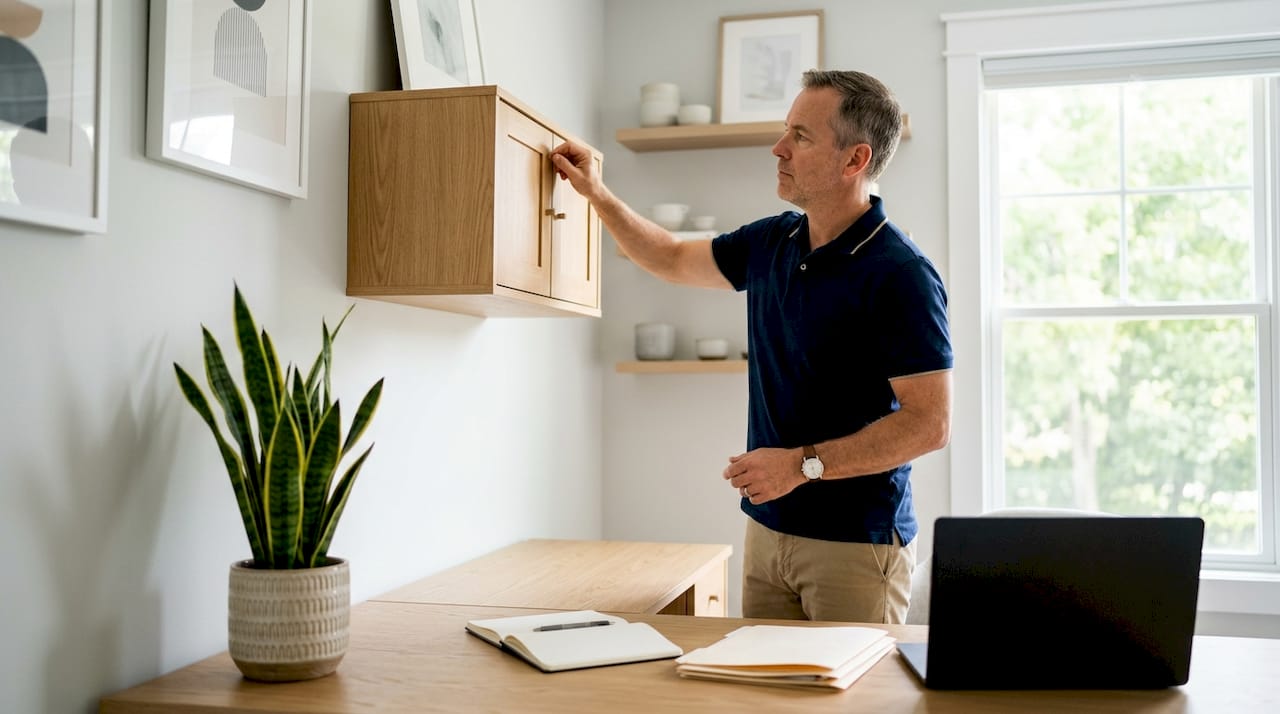
The root cause of a dysfunctional small office is almost always disorganization compounded by furniture that was not designed for the room. Custom carpentry solves this by giving every item a designated place, which prevents clutter from accumulating on the desk surface and floor.
| Common problem | Carpentry solution |
|---|---|
| No dedicated storage | Built-in cabinets with task-specific compartments |
| Physical discomfort from poor desk height | Ergonomic custom desk at correct seated height |
| Wasted corner space | Adjacent straight desk run with corner dedicated to secondary functions |
| Cable clutter | Routed cable channels built into desk carcass |
| Lack of acoustic separation | Timber-framed glass partition panels |
| Visual clutter from exposed equipment | Closed lower cabinets with flush doors |
Proactive ergonomic carpentry upgrades reduce work-related physical discomfort by more than 30%. That figure matters because physical discomfort is one of the most consistent drags on afternoon productivity in home offices and small commercial workrooms alike.
Pro Tip: Avoid placing your primary keyboard and monitor directly in a corner. Position the main setup on an adjacent straight run and reserve the corner for secondary functions like a printer shelf or reference storage.
3. Creative design examples that maximize a small footprint
The most effective small space office designs share one trait: the carpentry reads as part of the architecture, not as furniture placed inside a room. That distinction is the difference between a workspace that feels built and one that feels assembled.
- Floating desk with integrated shelving above. A wall-mounted desk at standard height (28–30 inches) with a continuous shelf run above it at 50–52 inches creates a complete work wall. The open floor beneath the desk makes the room feel twice its actual size.
- L-shaped return for multi-use zones. The primary run handles computer work. The return handles paperwork, a second screen, or video call framing. Standard ergonomic desk depth starts at 28 inches, and the return leg adds 36–48 inches of usable surface without expanding the room’s perimeter.
- Shoji-style sliding panels. Modern carpentry favors restraint and traditional mechanisms like sliding shoji panels, which move without metal fittings and allow a room to shift between open collaboration and focused solo work within seconds.
- Closed lower cabinets with open upper shelves. This combination keeps the visual weight of the room low and the upper zone light. Books, plants, and framed items on open shelves soften the space without adding bulk.
- Integrated LED task lighting. Recessed LED strips built into the underside of upper cabinets eliminate desk-lamp clutter and provide even, glare-free illumination across the entire work surface.
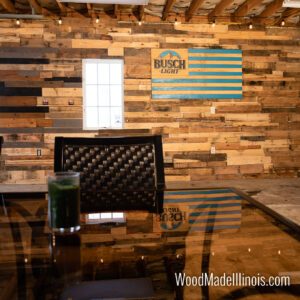
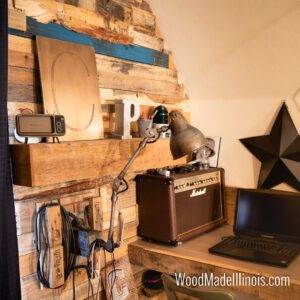
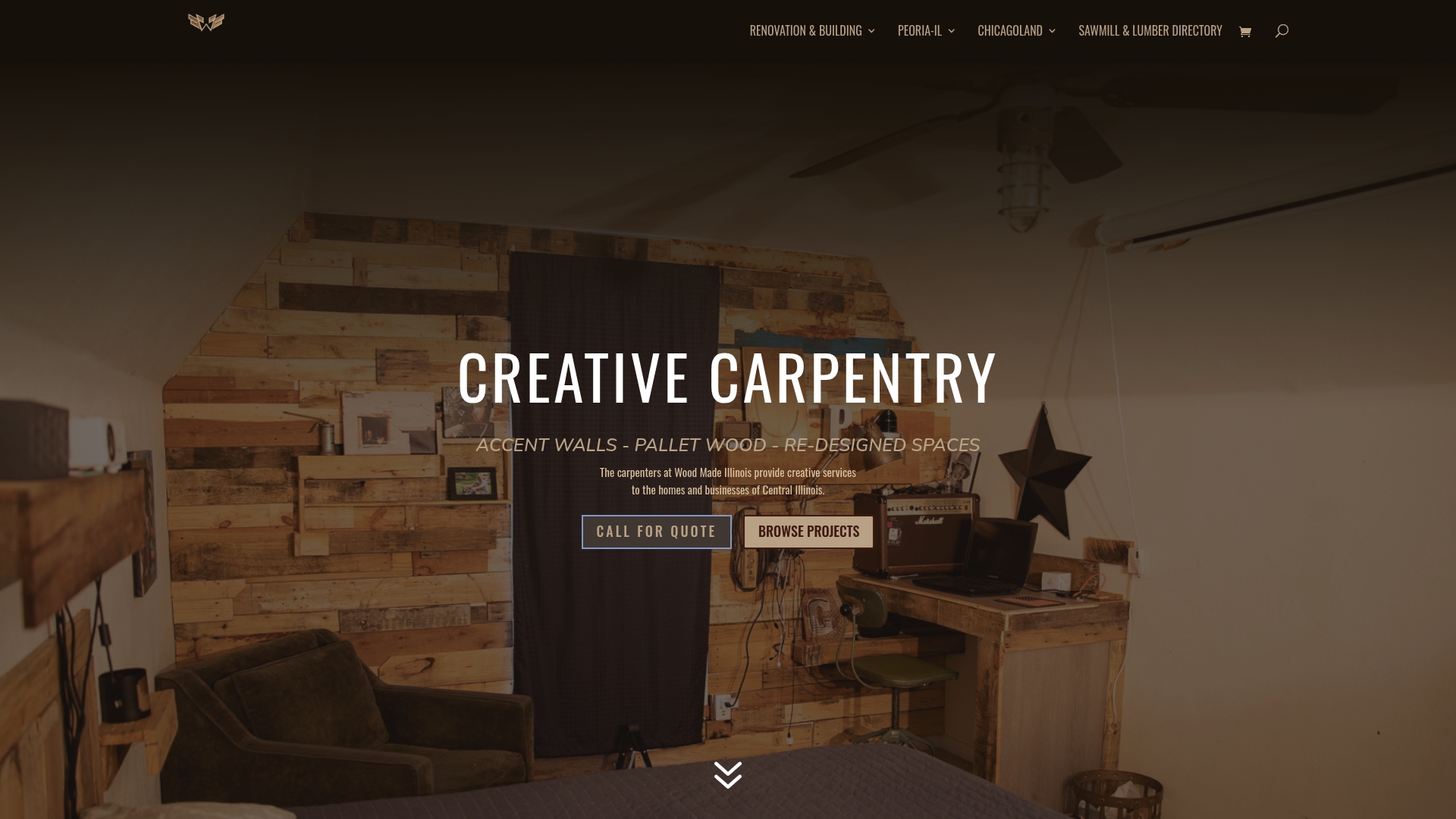
Material choices matter as much as configuration. White oak and painted MDF both read as clean and contemporary. Pallet wood adds warmth and texture at a lower material cost, which is a specialty Woodmadeillinois applies frequently in Central Illinois home office makeover projects.
4. Matching carpentry solutions to your office size and work style
Not every small office has the same constraints. A 90-square-foot spare bedroom used by a single remote worker has different needs than a 200-square-foot commercial workroom shared by two people on alternating schedules.
| Office profile | Recommended carpentry approach |
|---|---|
| Ultra-compact single-user (under 100 sq ft) | Floating wall desk, minimal open shelving, no freestanding furniture |
| Standard single-user home office | Full work wall with built-in cabinets, 72-inch desk run for single monitor |
| Dual-monitor or multi-peripheral setup | 96–120 inch desk run with integrated cable management |
| Multi-user or hybrid workroom | Modular built-ins with adjustable shelf pins, two separate desk zones |
| Open-plan commercial space | Timber-framed glass partitions, shared storage wall |
A 72-inch desk run suits single-monitor use comfortably. Dual-monitor setups with a printer require 96–120 inches of continuous surface to avoid the constant shuffling of equipment that kills focus. Sizing the desk correctly from the start is the single most cost-effective carpentry decision you can make.
For hybrid workrooms where two people use the space on different days, adjustable shelf pins and modular cabinet carcasses allow the room to reconfigure without a full rebuild. That adaptability is worth specifying upfront, even if the room currently has only one user.
Custom shelving designed around your specific equipment and storage volume outperforms generic shelving units in both capacity and visual coherence. Generic units leave gaps, create dead zones, and rarely align with ceiling height or window placement.
5. How carpenters design multifunctional offices from a single brief
The design process for a small office built-in follows a consistent sequence. A skilled carpenter measures the room in three dimensions, catalogs every item that needs a home, and then works backward from storage volume to surface area to structural attachment points.
The first decision is always the desk configuration. Single-monitor users need depth more than width. A 28-inch-deep surface gives enough room for a monitor, a keyboard, and a notepad without the screen crowding the face. Width comes second, and it scales with the number of peripherals. Once the desk footprint is set, storage is designed around it rather than the reverse.
The second decision is vertical. Upper cabinets mounted 18–22 inches above the desk keep the most-used items within arm’s reach while leaving enough clear wall between the desk and the cabinet face to avoid visual compression. Lower cabinets with doors handle equipment, supplies, and anything that creates visual noise when left exposed.
The third decision is material and finish. The carpentry should extend the existing architecture of the room, not compete with it. Matching the trim profile, ceiling height, and floor color creates the impression that the built-ins were always there. That continuity is what separates a custom carpentry solution from a furniture installation.
Key takeaways
Custom small office carpentry outperforms freestanding furniture in every measurable dimension: space efficiency, ergonomic precision, storage capacity, and visual coherence.
| Point | Details |
|---|---|
| Floating desks maximize floor space | Wall-mounted desks without legs clear the floor plane and make compact rooms feel larger. |
| Ergonomic sizing is non-negotiable | Desk depth starts at 28 inches; dual-monitor setups need 96–120 inches of continuous run. |
| Upper cabinet placement matters | Mount upper cabinets 18–22 inches above the desk to avoid visual compression and maintain accessibility. |
| Corner placement hurts ergonomics | Place the primary monitor on a straight run, not in a corner, to reduce awkward movement. |
| Material continuity builds cohesion | Matching carpentry to existing trim and floor color makes built-ins read as architecture, not furniture. |
What I’ve learned after years of building small office spaces
The most common mistake I see is clients who treat the desk as the project. They want a beautiful desk, and they think the rest will follow. It rarely does. The desk is the spine of the room, but without storage designed around it, the surface fills up within a week and the whole investment is undermined.
The second thing I’ve learned is that restraint produces better results than complexity. A clean work wall with three cabinet heights, consistent hardware, and one material finish will outperform an elaborate built-in with mixed materials, decorative molding, and specialty inserts every single time. The elaborate version looks impressive in a rendering. The restrained version looks impressive in real life, five years later, when it still functions exactly as intended.
Ergonomic precision is not a luxury. A desk set at the wrong height, or upper cabinets mounted two inches too low, creates physical discomfort that accumulates over months. That discomfort is quiet and gradual, which is why most people attribute it to stress or fatigue rather than their furniture. Getting the measurements right at the build stage costs nothing extra. Correcting them afterward costs everything.
The future of small office carpentry is adaptive. Rooms need to shift between focused solo work, video calls, and collaborative sessions without a furniture rearrangement. Built-ins with adjustable components, sliding panels, and modular storage walls are the answer. The goal is a room that works harder than you do.
— Wood
Woodmadeillinois custom office carpentry for Central Illinois
Woodmadeillinois brings over 100 years of combined carpentry experience to every small office project in Central Illinois. The team specializes in built-in work walls, floating desks, and custom storage systems designed around your specific room dimensions, equipment, and work habits.
Every project begins with a personalized design consultation, where measurements, material choices, and ergonomic requirements are worked out before a single board is cut. The result is a workspace that fits the room and the person using it. Connect with trusted local carpentry experts at Woodmadeillinois to get a custom plan for your office.
FAQ
What are the most common examples of small office carpentry?
The most common projects are floating wall-mounted desks, floor-to-ceiling built-in cabinets, L-shaped desk returns, and timber-framed glass partitions. Each one addresses a specific spatial or organizational problem in compact workrooms.
How deep should a custom office desk be?
Standard ergonomic desk depth starts at 28 inches. That measurement gives enough room for a monitor, keyboard, and working surface without the screen sitting too close to the face.
How high should upper cabinets be mounted above a desk?
Upper cabinets should be mounted 18–22 inches above the desktop surface. That range keeps stored items accessible while preventing the cabinet face from creating a cramped, closed-in feeling.
Can carpentry really improve productivity in a small office?
Proactive ergonomic carpentry upgrades reduce work-related physical discomfort by more than 30%, and custom storage eliminates the disorganization that consistently drains focus and time in small offices.
What desk size do I need for dual monitors?
Dual-monitor setups with integrated peripherals require a continuous desk run of 96–120 inches. A 72-inch run suits single-monitor use but becomes crowded once a second screen and printer are added.