Custom carpentry in interior design is the practice of designing and building woodwork precisely measured and fabricated for a specific room, combining structural function with deliberate aesthetics. Unlike stock cabinetry pulled from a catalog, bespoke woodwork treats every wall, corner, and ceiling height as a unique set of constraints to solve. The result is a room where the woodwork fits the space, not the other way around. This guide covers the principles behind custom carpentry interior design explained in full, from how carpenters assess interior spaces to the techniques that separate artisan carpentry design from ordinary finish work.
How does custom carpentry form the foundation of interior design?
Built-ins and custom carpentry form about 70% of a room’s permanent base layer. That single fact reframes how homeowners should think about renovation budgets. The remaining 30% covers hardware, paint, lighting, and decorative accents. Get the woodwork wrong, and no amount of styling fixes the underlying structure.

Think of custom carpentry as the skeleton of a room. Trim defines where walls end and ceilings begin. Built-in cabinetry determines how a kitchen flows from the refrigerator to the sink. Paneling sets the visual tone before a single piece of furniture enters the space. Each of these elements locks in spatial decisions that are expensive to reverse.
Custom carpentry solves problems that modular products simply cannot address:
- Odd room dimensions. Older homes in Central Illinois frequently have walls that are not plumb, floors that are not level, and ceiling heights that vary by several inches across a single room.
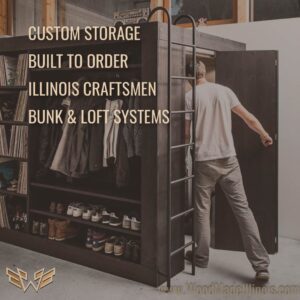
- Underused corners and alcoves. A carpenter can turn a dead corner into a floor-to-ceiling bookcase sized to the inch.
- Spatial flow. A built-in bench with integrated storage under a staircase removes clutter without consuming floor space.
- Visual cohesion. Matching trim profiles across rooms ties a home together in a way that mismatched stock moldings never achieve.
The design impact is cumulative. Each custom element reinforces the next, creating a room that reads as intentional rather than assembled from whatever was available at the home improvement store.
What key techniques ensure precision and seamless fit in custom carpentry?
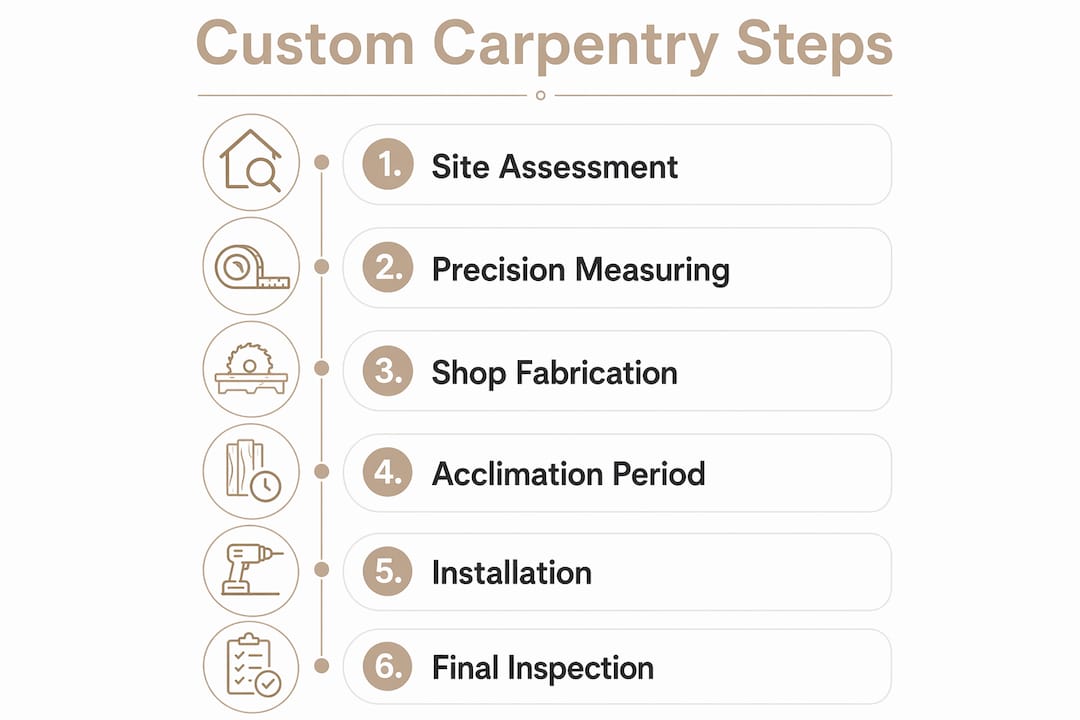
Precision in custom carpentry does not happen by accident. It follows a disciplined sequence of site assessment, material preparation, fabrication, and installation. Skipping any step introduces errors that compound through the project.
-
Site assessment and templating. A carpenter measures every surface the new woodwork will contact. Accurate templating reduces fabrication errors by 30–40% and enables fit tolerances under 1/32 of an inch. That level of precision means a built-in cabinet slides into place without shimming or gap-filling.
-
Story sticks. Experienced installers use story sticks, which are marked rods that transfer exact site dimensions directly to the fabrication shop. Story sticks enable joint tolerances tighter than 1/64 of an inch in shop fabrication. A tape measure introduces cumulative rounding errors; a story stick does not.
-
Material acclimation. Wood moves. Materials must acclimate for 7–14 days to the installation environment’s humidity before cutting. Skipping this step can cause dimensional instability exceeding 1/16 of an inch, which destroys tight joints after installation.
-
Moisture meters. A carpenter checks the moisture content of every board before it enters the shop. Wood delivered from a climate-controlled warehouse behaves differently in a drafty 1920s bungalow.
-
Dry fitting. Before any fastener is driven, a skilled crew assembles the full unit in place to confirm fit. Dry fitting catches problems when they are still easy to correct, not after the finish coat is applied.
Pro Tip: Never let a contractor skip the acclimation period to meet a deadline. A joint that looks perfect on installation day can open to a visible gap within one heating season.
What distinguishes custom carpentry from finish carpentry and modular systems?
The terms “finish carpentry,” “custom carpentry,” and “architectural millwork” are often used interchangeably, but they describe meaningfully different scopes of work.
Finish carpentry installs pre-made components such as stock door casings, base moldings, and pre-hung doors. The carpenter fits existing products to the space. Architectural millwork, by contrast, fabricates custom pieces to shop drawings and adheres to standards set by the Architectural Woodwork Institute (AWI). The AWI defines three grades of quality: Economy, Custom, and Premium, each with specific tolerances for joint gaps, surface preparation, and finish consistency.
| Feature | Finish carpentry | Architectural millwork |
|---|---|---|
| Fabrication source | Pre-made stock components | Shop-built to custom drawings |
| Fit tolerance | Dependent on stock sizing | Under 1/32 inch by AWI standards |
| Design flexibility | Limited to available profiles | Unlimited within material constraints |
| Durability | Varies by product quality | Engineered for specific load and use |
| Cost | Lower upfront | Higher upfront, lower long-term |
Modular systems occupy a middle ground. Flat-pack cabinetry from large retail suppliers offers speed and low cost, but the boxes come in fixed increments, typically 3-inch width steps. A kitchen that is 143 inches wide will always have a filler strip or an awkward gap. Custom carpentry eliminates that compromise entirely.
Architectural millwork adheres to stringent quality standards that differentiate it fundamentally from general finish work. Homeowners who want woodwork that lasts decades and holds its fit through seasonal humidity cycles should specify AWI Custom grade at minimum.
How do homeowners and designers collaborate on custom carpentry projects?
The single biggest predictor of a smooth custom carpentry project is crew continuity. A dedicated crew managing the full project lifecycle from initial measurements to final finishing reduces communication gaps and delays significantly. When the person who measured the space is also the person who builds and installs it, errors from handoffs disappear.
Practical collaboration follows a clear sequence:
- Lock dimensions before ordering materials. Changes after material is cut generate waste and cost. Finalize floor plans, appliance specs, and fixture locations before the carpenter takes a single measurement.
- Schedule carpentry within the larger renovation. Homeowners who integrate custom carpentry with kitchen or bathroom remodels achieve better scheduling synergy and cost efficiency. Rough-in plumbing and electrical must be complete before built-ins go in.
- Request written material specifications. Know the species, grade, and finish of every wood component before signing a contract. Vague specs lead to substitutions that change the final appearance.
- Plan for phased access. A carpenter needs clear, unobstructed access to walls and floors. Coordinate with other trades so the space is ready when the crew arrives.
Pro Tip: Ask your carpenter for a phased timeline that separates site assessment, shop fabrication, and installation into distinct milestones. This structure makes it easy to spot delays before they cascade.
Woodmadeillinois brings over 100 years of combined carpentry experience to projects across Central Illinois, which means the team has seen every scheduling conflict and material substitution problem that can derail a renovation. That depth of experience shapes how they structure every project from the first site visit.
What are popular custom carpentry options that add value to modern homes?
Custom carpentry is one of the highest-impact-per-dollar improvements for increasing home value and quality perception. The options below represent the most requested features among homeowners seeking both function and character.
- Floor-to-ceiling built-in shelving. Sized to the exact room height, these units eliminate the awkward gap above stock bookcases and create a library-quality wall that doubles as storage.
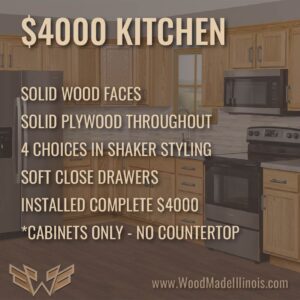
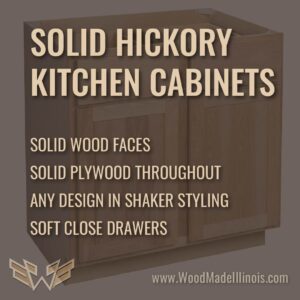
- Custom cabinetry. Kitchen and bathroom cabinetry built to shop drawings fits the room precisely, uses the full available height, and can incorporate features like pull-out pantry systems or integrated drawer organizers.
- Decorative moldings and paneling. Crown molding, wainscoting, and coffered ceilings add architectural depth to rooms that would otherwise feel flat. These are the details that make a house feel finished rather than functional.
- Integrated bench seating. A window seat with a hinged lid over a storage box solves two problems at once: seating and clutter. Built to the window’s exact width, it looks like it was always part of the house.
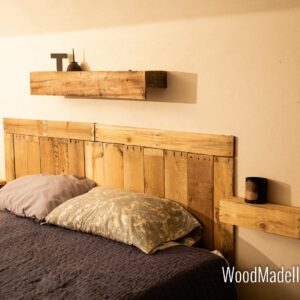
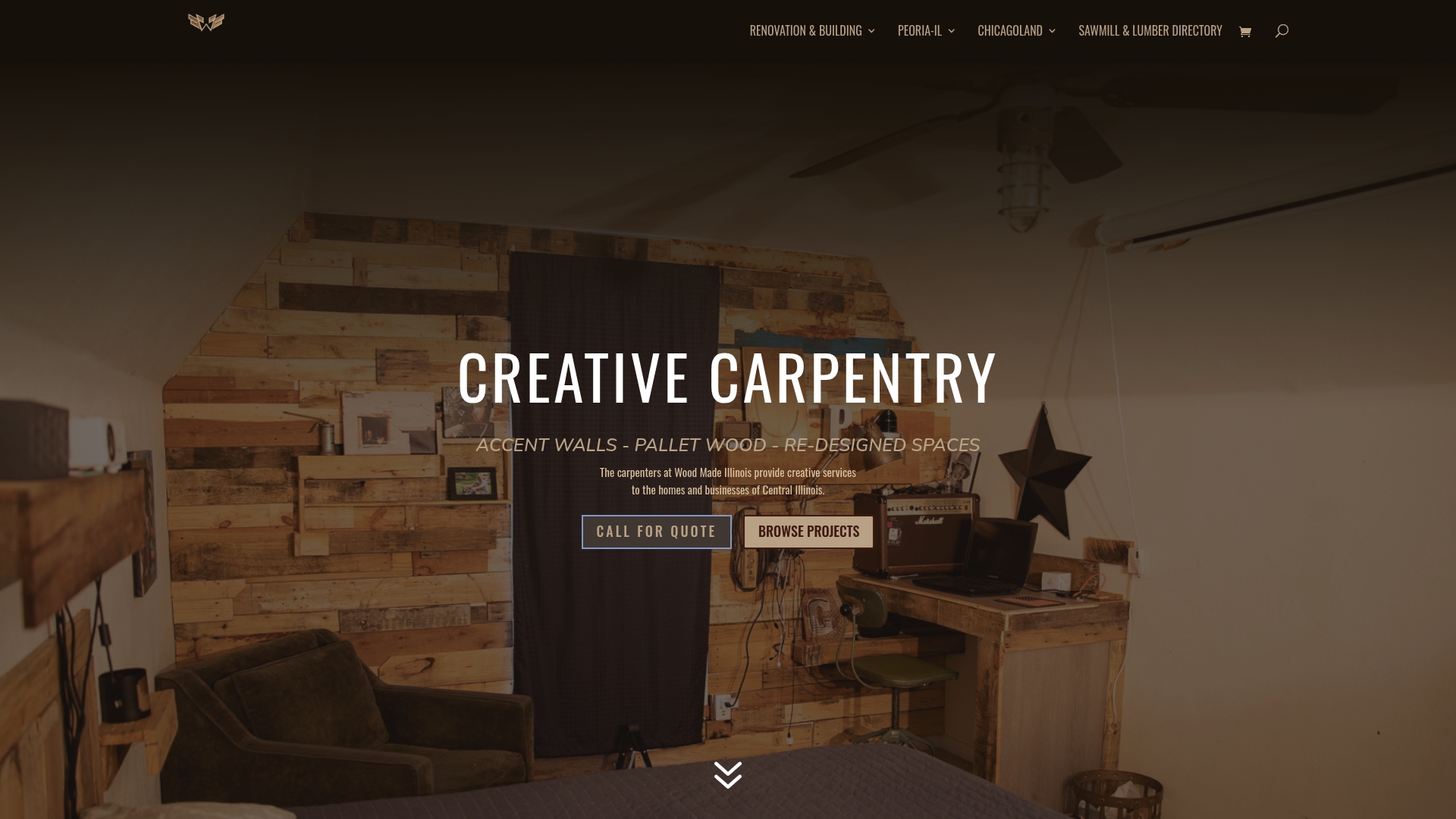
- Accent walls with distinctive materials. Barnwood and pallet wood accent walls bring texture and warmth to modern interiors at a fraction of the cost of stone or tile. Woodmadeillinois has built these features in homes across Central Illinois using reclaimed materials that carry their own history.
- Home office built-ins. A desk, overhead cabinets, and integrated cable management built to a specific wall turns an unused corner into a productive workspace without consuming floor space.
Each of these options gains its value from precision fit. A built-in that leaves a 1-inch gap at the ceiling or a visible seam at the wall reads as an afterthought. One that fits perfectly reads as architecture.
Key Takeaways
Custom carpentry forms the structural and visual backbone of a well-designed interior, and precision measurement is the single skill that separates lasting work from work that fails within a season.
| Point | Details |
|---|---|
| Carpentry anchors the room | Custom woodwork forms about 70% of a room’s permanent base layer, setting the tone for all other design choices. |
| Precision starts at site assessment | Accurate templating and story sticks reduce fabrication errors by 30–40% and achieve tolerances under 1/32 inch. |
| Acclimation prevents joint failure | Wood must acclimate for 7–14 days to ambient humidity before cutting to avoid post-installation movement. |
| Millwork outperforms modular systems | AWI-grade architectural millwork delivers tighter tolerances and longer durability than stock or flat-pack cabinetry. |
| Crew continuity protects quality | A single dedicated crew managing measurement through installation eliminates the communication gaps that cause rework. |
Wood’s take: custom carpentry is the design decision most homeowners make too late
The most common mistake I see is homeowners treating custom carpentry as a finishing touch rather than a foundational decision. They spend months selecting paint colors and light fixtures, then try to fit a stock cabinet into a space that was never measured for it. The cabinet is close enough, they think. Then they spend the next ten years looking at the gap.
Custom carpentry is not decoration. It is the structure that makes decoration possible. A room with precise built-ins, well-fitted trim, and thoughtful paneling does not need much else. The woodwork carries the space. Everything else is accent.
Homeowners also underestimate how much precision matters at the planning stage. The measurement taken on day one determines whether the finished piece fits or fights the room. I have seen projects where a single missed measurement added two weeks and significant cost to a job that should have been straightforward. The fix is not more skill at installation. The fix is more discipline at assessment.
My honest recommendation: budget for custom carpentry before you budget for furniture. Furniture can be replaced. Built-ins define the room for the life of the house. Prioritize the work that lasts.
— Wood
Woodmadeillinois: custom carpentry built for your specific space
Woodmadeillinois serves homeowners and businesses across Central Illinois with custom carpentry built to precise measurements and finished to last. The team brings over 100 years of combined experience to every project, from built-in shelving and cabinetry to decorative paneling and home office installations.
Every project starts with a personalized design consultation where the crew assesses the space, takes templated measurements, and discusses material options that fit the homeowner’s budget and style. Woodmadeillinois works with diverse materials, including reclaimed pallet wood, to deliver character-rich results at practical price points. Homeowners facing tight timelines or unusual room dimensions will find the team’s depth of experience directly useful. Reach Woodmadeillinois at woodmadeillinois.com to schedule a consultation.
FAQ
What is custom carpentry in interior design?
Custom carpentry in interior design is the practice of designing and fabricating woodwork precisely sized and built for a specific room. It covers built-ins, cabinetry, trim, paneling, and other structural wood elements tailored to a home’s exact dimensions.
How do carpenters assess interior spaces before building?
Carpenters use site templating, story sticks, and moisture meters to capture exact room dimensions and material conditions. Accurate site assessment reduces fabrication and installation errors by 30–40% and enables fit tolerances under 1/32 of an inch.
What is the difference between finish carpentry and architectural millwork?
Finish carpentry installs pre-made stock components, while architectural millwork fabricates custom pieces to shop drawings following AWI quality standards. Millwork delivers tighter tolerances and greater design flexibility than standard finish work.
Why does wood need to acclimate before installation?
Wood expands and contracts with changes in humidity. Allowing materials to acclimate for 7–14 days to the installation environment prevents joint failures caused by swelling or shrinkage after the work is complete.
Does custom carpentry increase home value?
Custom carpentry is one of the highest-impact-per-dollar home improvements, particularly in homes with outdated or missing trim details. Precise built-ins and quality millwork raise both the functional quality and the perceived value of a property.