Material choice is the single most controllable variable in any renovation budget. While labor rates are set by market demand and trade availability, the materials you select directly determine how much you spend upfront, how complex the installation becomes, and what you pay in maintenance over the next decade. The role of material choice in renovation cost extends far beyond the price tag on a product shelf. Homeowners who understand this connection make smarter decisions, avoid costly surprises, and stretch every dollar further. This guide breaks down exactly how material selection drives costs at every stage of a project.
How does material choice affect renovation cost?
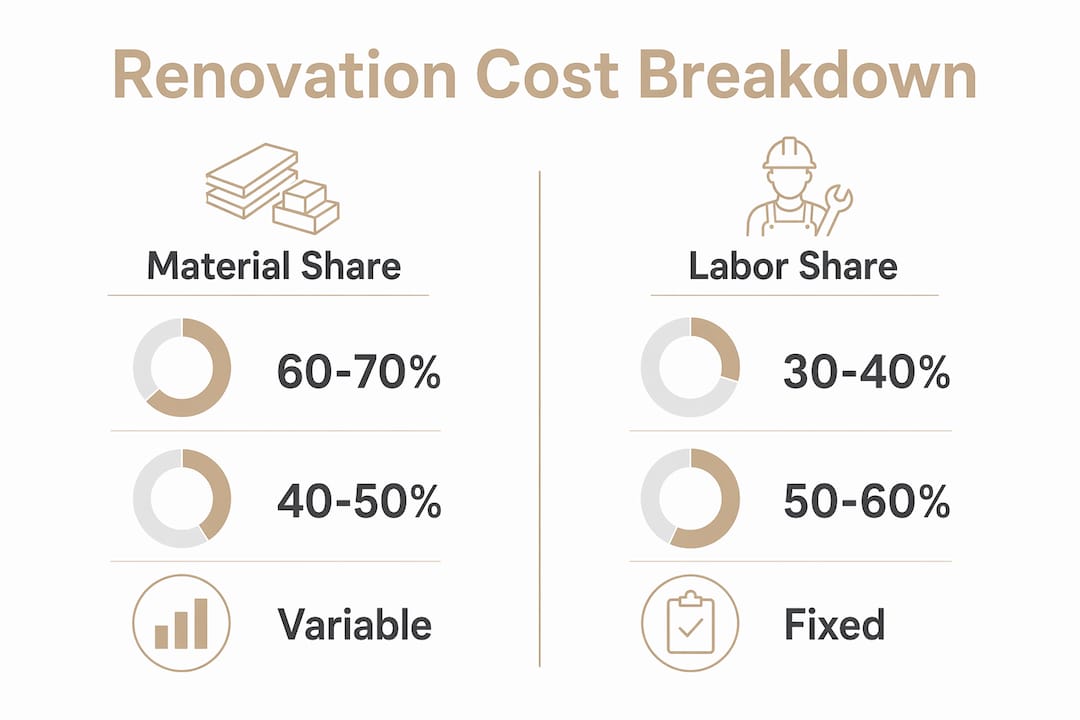
Material costs represent a significant portion of any renovation budget, and the way you select them shapes the entire financial picture of a project. Labor now accounts for 50–60% of total renovation costs, with materials covering the remainder. That means materials still represent a substantial share, and they are the portion you have the most power to control.
The impact of material selection goes beyond the unit price. A material that seems affordable in the store can drive up labor hours, require specialized installation, or demand frequent maintenance. Conversely, a higher-grade material installed quickly and cleanly can deliver better total value. Thinking about materials as a system, rather than individual line items, is the foundation of sound renovation budget planning.

Material prices also shift. Copper wire and pipe costs rose 8–14% year over year as of april 2026, while framing lumber prices fell 4–7% and stock cabinet prices rose 6–10%. These swings mean that locking in material quotes early and understanding price trends protects your budget from unexpected increases.
Labor vs. materials: where does your money actually go?
The cost balance between labor and materials varies significantly by project type. Flooring installations can carry up to 70% material cost versus 30% labor, making material grade the dominant budget driver. A full kitchen remodel, by contrast, often flips that ratio because of the skilled trades required for plumbing, electrical, and cabinetry installation.
Understanding this ratio by project type helps you decide where to focus your budget. For a flooring project, trading down one material grade saves real money. For a bathroom remodel where labor dominates, the same trade-down saves proportionally less. The strategy shifts depending on which side of the equation carries more weight.
Pro Tip: Focus your negotiating energy on material selection and sourcing rather than trying to reduce labor rates. Labor costs are largely fixed by local market demand, while materials offer genuine flexibility.
A mid-grade finish renovation for a 2,000 sq. ft. home typically costs $80,000–$160,000, with builder-grade materials running $20–$50 per sq. ft. and mid-range options at $60–$100. That spread illustrates how much material grade alone can shift your total project cost. Choosing mid-range over premium across an entire home renovation can save tens of thousands of dollars without sacrificing durability.
| Renovation Type | Typical Material Share | Typical Labor Share |
|---|---|---|
| Flooring installation | 60–70% | 30–40% |
| Kitchen remodel | 40–50% | 50–60% |
| Bathroom remodel | 35–45% | 55–65% |
| Exterior siding | 50–60% | 40–50% |
| Basement finishing | 45–55% | 45–55% |
Why total installed cost matters more than material price
The sticker price of a material tells you almost nothing about what it will actually cost to put in place. A $3 per sq. ft. tile can cost $18 per sq. ft. installed when a complicated pattern and substrate preparation are required. A $15 per sq. ft. tile in a straightforward format may install faster and cheaper, resulting in a lower total cost. This is the installed cost principle, and it changes how you should evaluate every material option.
Installation complexity drives total cost more than material unit price in many project categories. Specialty materials, intricate patterns, and surfaces requiring extensive preparation all add labor hours. Those hours add up fast when skilled tradespeople charge premium rates.
Pro Tip: Always ask your contractor for an itemized installed cost, not just a material quote. Request the cost broken down by material price, labor hours, and any required preparation work so you can compare options accurately.
The following factors determine whether a low-cost material actually saves money:
- Substrate preparation: Some materials require leveling, priming, or moisture barriers that add significant labor.
- Pattern complexity: Herringbone or diagonal tile layouts require more cuts, more time, and more waste material.
- Specialty tools: Certain materials require equipment that either the contractor rents or charges a premium to use.
- Skill level required: Natural stone, hardwood, and custom millwork require experienced installers who charge more per hour.
- Waste factor: Complex cuts and irregular shapes increase material waste, raising the effective cost per sq. ft.
Woodmadeillinois consistently advises homeowners to request total installed cost figures before making any final material decision. That single habit prevents the most common budget surprises in renovation projects.
How do material choices affect long-term maintenance costs?
Upfront cost is only the first chapter of a material’s financial story. Sustainable and high-durability materials often carry higher upfront costs but deliver a better lifecycle economic balance by reducing maintenance and replacement expenses over time. This lifecycle cost thinking is the difference between a budget that looks good on paper and one that holds up over years of real use.
Consider the difference between a sealed concrete floor and a budget vinyl plank. The vinyl plank costs less upfront but may need replacement within 7–10 years in a high-traffic area. The sealed concrete, maintained properly, can last decades. The lifecycle cost assessment approach accounts for both the initial investment and the ongoing cost of ownership.
High-use areas demand the most attention when it comes to material durability:
- Kitchen floors and countertops: These surfaces take daily abuse. Investing in harder, more stain-resistant materials here pays off over time.
- Bathroom tile and grout: Cheap grout deteriorates quickly in wet environments, leading to water damage and costly repairs.
- Exterior cladding: Low-grade siding may need repainting or replacement within a decade, while fiber cement or quality wood siding lasts far longer.
- Cabinetry: Builder-grade cabinets with particleboard boxes swell and fail in humid kitchens. Plywood-box construction costs more upfront but holds up for 20 or more years.
Prioritizing durable materials in high-use zones while choosing more economical options in low-traffic areas is a proven approach to balancing upfront cost with long-term value. A selective renovation strategy applies exactly this logic across an entire project.
Common mistakes homeowners make when selecting materials
Most renovation budget overruns trace back to a small set of predictable errors. Recognizing these mistakes before you start saves money and frustration.
-
Choosing materials individually without a system. Selecting materials without considering compatibility leads to hidden downstream costs and mid-project corrections. A floor tile that clashes with a baseboard profile, or a countertop that requires a non-standard sink cutout, creates expensive rework. Plan materials as a cohesive set from the beginning.
-
Using outdated quotes. Six-month-old labor quotes are often outdated in high-demand trades. Labor markets move fast, especially for electricians, plumbers, and finish carpenters. Always confirm quote currency before finalizing your budget.
-
Evaluating materials only on initial price. Choosing the cheapest option without considering total installed cost or durability is the most expensive mistake a homeowner can make. A material that costs less per sq. ft. but requires twice the labor hours ends up costing more.
-
Skipping the contractor conversation on material specs. Many homeowners buy materials before consulting their contractor. This leads to incompatible products, voided warranties, and installation delays. Get specifications first, then source materials.
-
Ignoring the supply-your-own-materials option. Supplying your own materials after getting specifications from contractors can save 15–25% on material markups. This works best for straightforward items like tile, lumber, and fixtures where the contractor’s markup is significant.
Practical strategies for choosing cost-efficient materials
Smart material selection is a skill, and it follows a repeatable process. These strategies help homeowners get the most from every dollar spent on renovation materials.
-
Set budget tiers before shopping. Define your budget, mid-range, and premium thresholds for each material category before you walk into a showroom. This prevents scope creep and keeps decisions grounded in financial reality.
-
Shop manufacturer-direct or through alternative suppliers. Retail showrooms add significant markup. Manufacturer-direct purchasing, trade suppliers, and liquidation outlets often carry the same materials at 20–30% less. This is one of the most effective cost-saving renovation tactics available to homeowners.
-
DIY non-critical tasks. Demolition, painting, and basic prep work are tasks most homeowners can handle safely. Removing these from the contractor’s scope reduces labor hours without affecting quality.
-
Concentrate your budget on elements that are hard to change later. Cabinets, countertops, and structural flooring are expensive to replace once installed. Invest more here and economize on easily swapped items like light fixtures and hardware.
-
Use mid-grade materials in most areas. Mid-grade durable materials offer the best balance of cost, longevity, and appearance for most residential applications. Labor rates are less negotiable; materials are where the real savings live.
-
Get multiple bids using identical material specifications. Comparing bids only works when every contractor is pricing the same materials. Standardizing specifications across bids reveals true labor cost differences and prevents apples-to-oranges comparisons.
-
Apply value engineering to your material list. Review each material choice and ask whether a one-grade-lower option would perform adequately in that specific location. An affordable stylish renovation does not require premium materials everywhere.
Key Takeaways
Material choice determines both the upfront cost and the long-term financial performance of any renovation, making it the most powerful budget lever a homeowner controls.
| Point | Details |
|---|---|
| Materials are your budget lever | Labor costs are largely fixed; material grade and sourcing offer the most flexibility to reduce total cost. |
| Installed cost beats sticker price | A cheap tile with complex installation often costs more than a pricier tile that installs quickly and cleanly. |
| Lifecycle thinking saves money | High-durability materials in high-use areas reduce maintenance and replacement costs over time. |
| Outdated quotes cause overruns | Confirm all labor and material quotes are current before finalizing your renovation budget. |
| Supply your own materials | Getting contractor specs and sourcing materials yourself can save 15–25% on material markups. |
What I’ve learned about materials after years of renovation work
After years of working on homes across Central Illinois, the pattern I see most often is this: homeowners spend weeks agonizing over which countertop color to choose, but they never ask what that countertop costs to install. The material price gets all the attention. The installed cost gets none.
The projects that stay on budget are the ones where material decisions happen as a system. Every surface, every finish, every structural element gets evaluated together before a single purchase order goes out. That integrated approach catches incompatibilities early, when they cost nothing to fix. Catching them mid-project costs real money and real time.
I also believe strongly in lifecycle thinking. A homeowner who spends an extra $800 on plywood-box cabinetry instead of particleboard will not replace those cabinets in 12 years. The homeowner who saved that $800 upfront will. Over a 20-year horizon, the “expensive” choice was the cheap one.
The most underused strategy I see is homeowners supplying their own materials. Once you have detailed specifications from your contractor, you can source tile, lumber, and fixtures directly and cut out the markup entirely. It takes more effort, but the savings are real and consistent.
Material decisions are the bones of a renovation budget. Get them right, and everything else follows.
— Wood
How Woodmadeillinois helps you get material choices right
Woodmadeillinois brings over 100 years of combined carpentry experience to every project in Central Illinois, and that experience shows up most clearly in the material planning phase.

The team at Woodmadeillinois works with homeowners from the first design consultation through final installation, helping you match material quality to your actual budget rather than a showroom fantasy. Whether you are planning a custom built-in, a pallet wood accent wall, or a full room transformation, the team can guide your material selections to maximize durability and minimize total installed cost. Reach out to Woodmadeillinois’s trusted local carpentry experts to start a conversation about your project. You can also browse custom carpentry project ideas matched to a range of budgets for inspiration before your consultation.
FAQ
How much of a renovation budget goes to materials?
Materials typically account for 40–50% of total renovation costs, with labor covering the remainder. The exact split varies by project type, with flooring jobs skewing higher toward materials and bathroom remodels skewing higher toward labor.
What is total installed cost and why does it matter?
Total installed cost is the combined price of a material plus all labor, preparation, and finishing required to put it in place. A $3 per sq. ft. tile can reach $18 per sq. ft. installed when complex patterns and substrate work are required, making the installed cost figure far more useful than the material price alone.
Can supplying my own materials actually save money?
Supplying your own materials after receiving detailed specifications from your contractor can save 15–25% on material markups. This works best for standard items like tile, lumber, and plumbing fixtures where contractor markups are consistent.
Why do renovation budgets go over when material quotes seem accurate?
Outdated labor quotes are a leading cause of budget overruns. Six-month-old quotes in high-demand trades no longer reflect current market rates, and material prices for items like copper pipe can shift 8–14% within a year.
Which areas of a home deserve the highest-quality materials?
High-use areas including kitchen floors, countertops, bathroom tile, and cabinetry benefit most from durable material investment. These surfaces take the most daily wear and are the most expensive to replace once installed.