A good built-in bookcase is designed around three things: the wall it sits on, the weight it will carry, and the way you actually use the room. Get those right and the choice of style is the easy part. This guide covers the layouts homeowners ask about most, including shelves that wrap a doorway, then proportions, lighting, anchoring and what a realistic quote includes.
TL;DR
- Start with the wall, not the style. Measure for out-of-plumb corners, outlets, vents and studs, because a built-in is scribed to the room, not dropped into it.
- Wrapping shelves around a doorway is one of the best ways to turn a dead wall into a library wall, and it works with or without a door.
- Custom built-in bookcases in the US typically run $2,306 to $17,745, driven mostly by labor, finish and whether you add cabinet bases.
- Plan lighting and any outlets before drywall is closed. Light the books, not the wall.
- Anchor every tall unit to the framing and keep heavy items low.
Table of Contents
- What makes a bookcase truly built in
- Layouts that earn their place
- Proportions and details
- Lighting the books, not the wall
- Making it comfortable to use
- Safety and anchoring
- What a built-in bookcase costs
- Our perspective
- Plan your build with us
- Frequently asked questions
- Sources
What makes a bookcase truly built in
A built-in is attached to the room and fitted to the surfaces you actually have. One cabinet-shop guide describes the usual method: several cabinet boxes carried in, set on a level base, then fastened together and to the house. The trim, filler strips and paint then make the seams disappear.
That last part is where the difference lies between a built-in and a freestanding bookcase pushed against a wall. Houses settle. Walls lean. Floors slope toward the old chimney. A carpenter scribes the edges so the case meets the plaster or drywall without a gap, and shims the base until the shelves read level even when the floor does not.
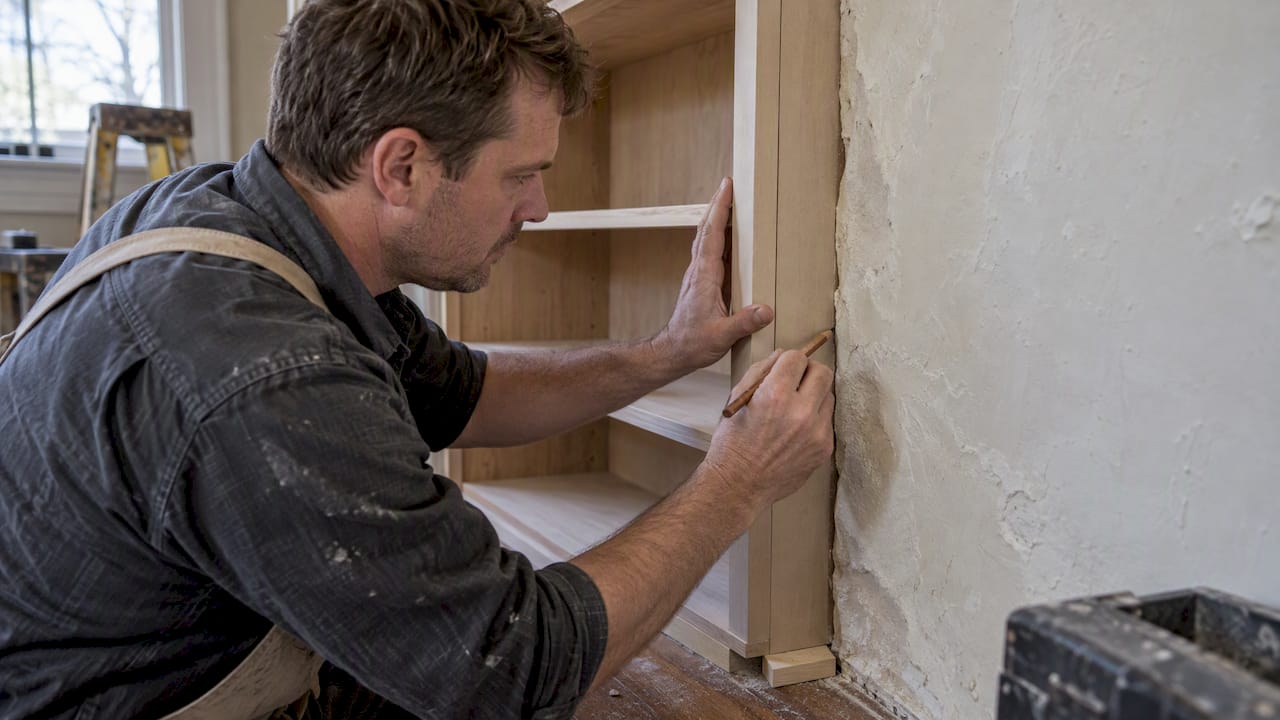
In older Central Illinois homes, with plaster walls, original baseboards and floors that have moved for a century, this fitting work is most of the craft. Think of the finish as the skin and the carcass as the bones: you want both to last.
Layouts that earn their place
Shelves around a doorway
Wrapping a bookcase around a doorway or a wide cased opening is the layout readers search for most, and for good reason. It uses the wall space beside and above a door that otherwise holds nothing, and it frames the opening like a deliberate architectural feature.
There are three common versions:
- Flanking units with a connected top shelf. Cases on both sides of the door joined by a header shelf above it. Design examples often leave that top shelf for a few objects or a simple row of books.
- A wide opening with no door. Shelving wraps the cased opening. The wider the opening, the more grand the result, and removing the door makes the room feel more open.
- A door that stays. The door swing must still clear the shelving, and the trim must still be reachable for hinges and latch. This is where a measured drawing matters more than any photo.
Two details separate a good doorway built-in from a clumsy one. First, keep the casing visible or deliberately rebuild it, so the shelves look like they belong to the opening. Second, check the header span. A shelf running over a door opening is a long span, so it needs a thicker front edge, a center support or plywood construction to keep it from sagging under books.
The library wall
A full wall of shelving, floor to ceiling, suits a living room, den or office with at least one uninterrupted run. Break it into vertical sections of about 30 to 36 inches so shelves stay stiff and so the wall can be built as boxes that fit through your doors. Vary the opening heights: tall shelves for art books and oversize volumes, shorter ones for paperbacks.
If the wall has a window, the classic answer is a window seat with shelving on either side. This Old House notes that built-ins are flexible enough to fit nearly anywhere, and that the location you choose shapes the design of the case itself.
Flanking a fireplace or filling alcoves
Mirrored units on either side of a fireplace remain the most familiar built-in. One cost guide puts this setup at roughly $1,000 to $8,000, which tells you how wide the range is. The spread comes from height, wood species and whether the lower portion is open or closed.
Bookshelves with a workstation
If the wall has to serve a remote worker too, build a desk surface into the middle bay and let shelving surround it. We often pair this with a home office renovation so wiring, task lighting and storage are planned together. Our guide to custom carpentry for remote work covers that side in more depth.
Proportions and details
Depth, spans and shelf thickness
Most book shelves work at 10 to 12 inches deep. Go deeper only for a lower cabinet bank or where you want to display larger objects. Shallow shelving keeps the room from feeling crowded and keeps books from disappearing into the back.
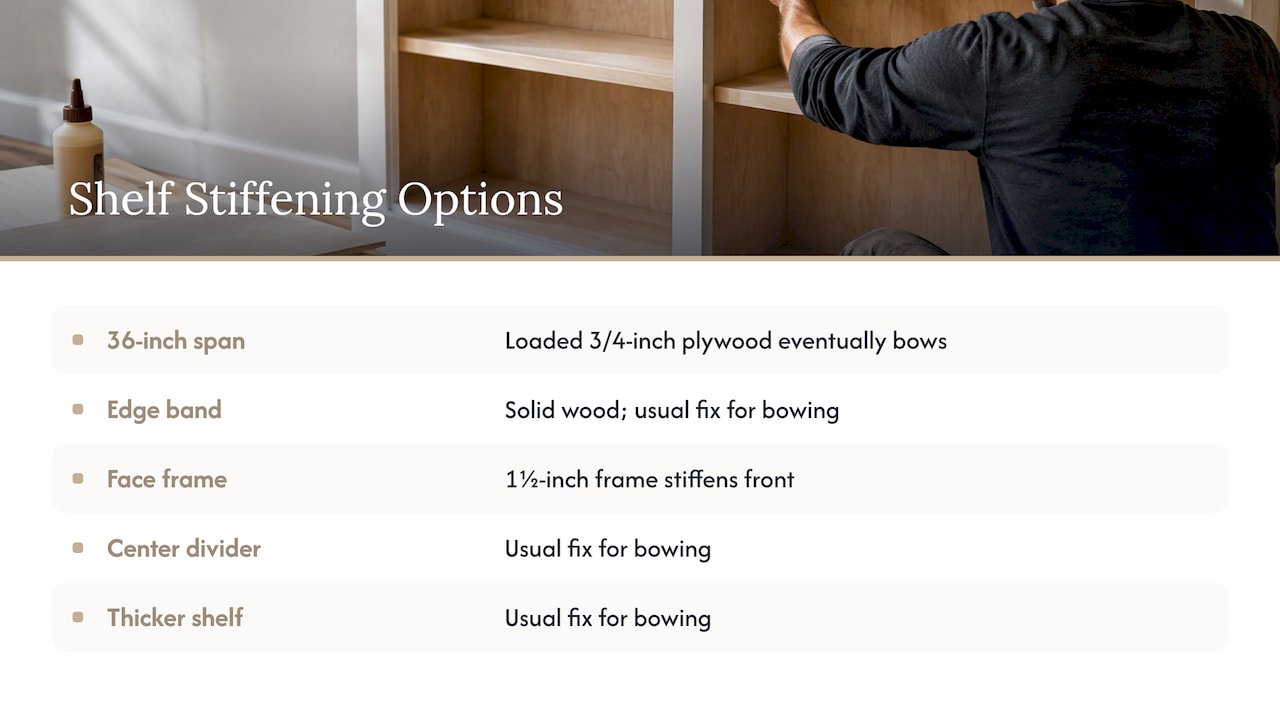
Shelf thickness and span go together. A 3/4-inch shelf in plywood is comfortable for a short span, but a 36-inch run loaded with hardcovers will eventually bow. The usual fixes are a solid wood edge band (a 1 1/2-inch face frame also stiffens the front), a center divider, or a thicker shelf. Hardwoods hold up better than softwoods when shelves bear a lot of weight, as LegalClarity points out.
Open shelves or a cabinet base
Adding doors or drawers on the lower third makes the unit look finished and hides the clutter, such as games, files and cables. It also changes the labor. Doors need hinges, reveals, pulls and alignment. HonestCasa estimates base cabinets add $300 to $700 per linear foot compared with open shelves. For many families, this is still the best money spent, because the closed storage keeps the open shelves looking intentional.
Wood movement
Solid wood swells and shrinks with the seasons, and Illinois has plenty of seasons. Face frames and solid shelves need room to move, and finish should be applied to every face. We wrote up the basics in our piece on seasonal wood movement.
Materials and finish
Painted cabinet-grade plywood and MDF are the practical choice for a clean, modern look. HonestCasa describes the lower end as MDF or cabinet-grade plywood with simple shelves, no doors and no integrated lighting, and notes it can work well in a hallway, kids’ room or home office. Stained oak or walnut costs more and shows grain, which suits a study or library.
For homes that lean rustic or want something less expected, reclaimed or pallet wood can back the shelves or accent a single bay. Used sparingly it adds texture without a hardwood price tag. See our pallet wood wall work for what that looks like.
Lighting the books, not the wall
Overhead lighting tends to cast shadows into shelves, which leaves spines dim and the wall bright. Lighting guidance recommends 2700K to 3000K LED strips or picture lights at shelf level for a warm look, and a dimmer so the light never feels clinical.
The catch is timing. Lighting needs power, and power needs a plan before drywall is patched or the case is set. Concealed routing inside the carcass is possible, but it has to be designed in. If you are also thinking of a bar or display wall nearby, the same principles are in our guide to home bar lighting and wiring.
Making it comfortable to use
If the built-in includes a reading nook or desk, two ergonomic numbers matter. One design source suggests keeping side tables or shelves within 18 inches of your dominant hand and keeping seat depth to 22 inches or less, since deeper seating tends to lock the knees over long sittings. A beautiful nook that is awkward to sit in does not get used.
For the books themselves, a few habits help:
- Group spines by color across the whole wall, not shelf by shelf, so they read as pattern.
- Leave 20 to 30 percent of the shelving for objects, art or empty space.
- Put your most-used books between knee and shoulder height.
Safety and anchoring
A tall bookcase is a heavy, tipping hazard if it is not fixed to the house. Every tall built-in should be fastened into wall studs, not just drywall. In older plaster-and-lath walls, a single stud hit may not be enough, and a carpenter may add a continuous backer board or toggle bolts for support. Our carpenters verify what is behind the wall before fastening anything.
Place heavy items on the lowest shelves. Ready.gov advises moving heavy objects to lower shelves to reduce risk. If you have small children, ask your carpenter about anchoring, shelf lips and closed lower storage before the design is final.
What a built-in bookcase costs
The range is wide because the variables are wide. HomeCostCalc reports US custom projects at roughly $2,306 to $17,745, averaging about $635 per linear foot, with high-end floor-to-ceiling hardwood library walls reaching $1,200 to $2,500 per linear foot. The same source says labor makes up 70 to 80 percent of the total, and that painting and finishing can add $500 to $1,500.
| Factor | Effect on price |
|---|---|
| Height (4 feet vs. floor to ceiling) | Large: more material, more fitting |
| Material (MDF or plywood vs. hardwood) | Large |
| Cabinet base with doors or drawers | Roughly $300 to $700 per linear foot more than open shelves |
| Lighting and electrical | Moderate, and cheaper if planned early |
| Paint or stain finish | $500 to $1,500 depending on complexity |
| Crooked walls, trim removal, wall repair | Moderate, often missing from low quotes |
Be wary of a very low quote. HonestCasa warns that cheap bids often leave out demolition, wall repair, electrical, finishing or the time to scribe and shim crooked walls. The assembly is usually the fastest part. Preparation, fitting and finishing are where quality and cost live.
We publish a more detailed breakdown in our guide to carpenter prices for built-in shelves.
Our perspective
We have built enough shelving in Central Illinois homes to say this plainly: the design that looks best in a photo is rarely the design that suits your wall. A client with a 1920s plaster wall and a client with a new-build drywall wall need different construction, even when they point to the same picture.
Our approach begins with a design consultation. We measure, check the walls, and talk about what the shelves will hold, because a case for a record collection is built differently from one for paperbacks. Then we look for ways to keep the budget honest: a painted plywood carcass with a solid face frame, a single statement bay in reclaimed wood, closed storage only where it counts.
With more than 100 years of combined carpentry experience on our team, we have learned that maintenance and fit are a marathon, not a sprint. A built-in should look right in year one and still be tight and level in year twenty.
— Wood
Plan your build with us
If you are in Central Illinois and want a bookcase fitted to your walls, we offer built-to-order built-ins and design consultations for homes and small businesses. We do not publish a flat price for built-ins, since each is quoted by the project after we see the space. See also our custom shelving projects for examples of finished work.
Bring your wall measurements, a few photos and a sense of what will live on the shelves. That is enough for a useful first conversation.
Frequently asked questions
Can I build shelves around a door and still use the door?
Yes. The shelves must leave room for the door to swing and for the trim and hardware to be reached. Many homeowners find it easier to remove the door altogether for a wide cased opening. Measure the swing before choosing the shelf depth beside the door.
How deep should a built-in bookcase be?
For books, 10 to 12 inches is typical. A deeper lower section, often 16 to 24 inches, suits a cabinet base or a desk. Keep the upper shelves shallower so the room does not feel crowded.
Is a built-in bookcase worth the cost?
It is a fixed fitting that uses the whole wall and often adds storage a freestanding piece cannot. Costs range widely, from about $2,306 to $17,745 on average nationally. A quote that spells out finishing, lighting and wall repair is a better guide than the lowest number.
Do I need to plan electrical before building?
If you want lit shelves or outlets inside the unit, yes. Rough-in work is much simpler before drywall is closed, and concealed wiring inside the case has to be designed with it. A warm 2700K to 3000K LED with a dimmer is a common choice.
Sources
- Built-In Bookshelf Cost Calculator (HomeCostCalc)
- Custom Built-In Bookcase Cost: What the Quote Should Include (HonestCasa)
- Built-In Bookcase Renovation Cost vs. Alternatives (HonestCasa)
- Reading Nook Bookcase Wall (Little Nook Home)
- Built-In Bookcase Around Door Ideas (Design Studio 210)
- Built-In Bookshelves: Ideas, Sizes and Costs (Cabinet Shop)
- Built-In Bookcase Renovation Cost (LegalClarity)
- Bookcase Basics (This Old House)
- Earthquake Preparedness (Ready.gov)