Crown molding enhances a room by framing the ceiling line, smoothing the harsh joint between wall and ceiling, hiding drywall imperfections, and tricking the eye into reading a taller, more finished space. Angi’s contractor data pegs returns on that investment between 50% and 80%, and outlets like Elle Decor treat it as a staple of finished, sellable rooms.
- Visual payoff: ceilings look taller, walls look more intentional.
- Resale payoff: buyers read it as a signal of quality construction.
Key Takeaways
Crown molding enhances a room by framing the ceiling line, hiding construction flaws, and drawing the eye upward to make ceilings feel taller than they are.
| Point | Details |
|---|---|
| Scale to ceiling height | Use 2 to 4 inch profiles under 9 feet; save built-up crowns for 12 foot ceilings and above. |
| Match material to room | Choose PVC or polyurethane for bathrooms, MDF for budget rooms, solid wood for statement spaces. |
| Cope corners, don’t just miter | Coped joints handle the uneven corners common in older homes far better than mitered cuts. |
| Expect strong ROI | Crown molding returns 50% to 80% of installed cost, with the highest returns in move-in-ready markets. |
| Hire for complexity | Wood Made Illinois handles vaulted ceilings, built-up profiles, and cabinet caps that go beyond basic DIY. |
Table of Contents
- How Crown Molding Enhances a Room, Room by Room
- How Does Crown Molding Change a Room’s Proportions?
- What Profile and Material Should You Choose?
- How Do You Choose Size, Color, and Handle Tricky Installs?
- Where Does Crown Molding Make the Biggest Visual Difference?
- What Does Crown Molding Cost, and Is It Worth It?
- How Do You Maintain and Modernize Existing Crown Molding?
- What Do Carpenters Say About Crown Molding ROI?
- Sources
How Crown Molding Enhances a Room, Room by Room
Molding does more work than most homeowners assume. It’s not just a decorative cap. It’s a transition device, and transitions are where rooms either look finished or look unfinished.
- Frames the room. A continuous line at the ceiling perimeter gives the eye a boundary, the same way a picture frame tells you where the art stops and the wall begins.
- Raises perceived height. By drawing the eye upward at the wall’s edge, crown molding makes standard ceilings look taller than they are.
- Hides construction gaps. Uneven drywall corners, minor gaps, and settling cracks disappear behind a well-scribed profile.
- Extends beyond the ceiling. Contractors use the same trim language to cap cabinets, dress fireplace surrounds, and finish window and door casings.
- Signals finished construction to buyers. Elle Decor’s designer roundups show the detail working in everything from ornate Victorians to stripped-down modern lofts.
Some of these benefits are purely visual, like the height illusion. Others are functional, like covering the gap where a stock cabinet falls short of the ceiling.
How Does Crown Molding Change a Room’s Proportions?
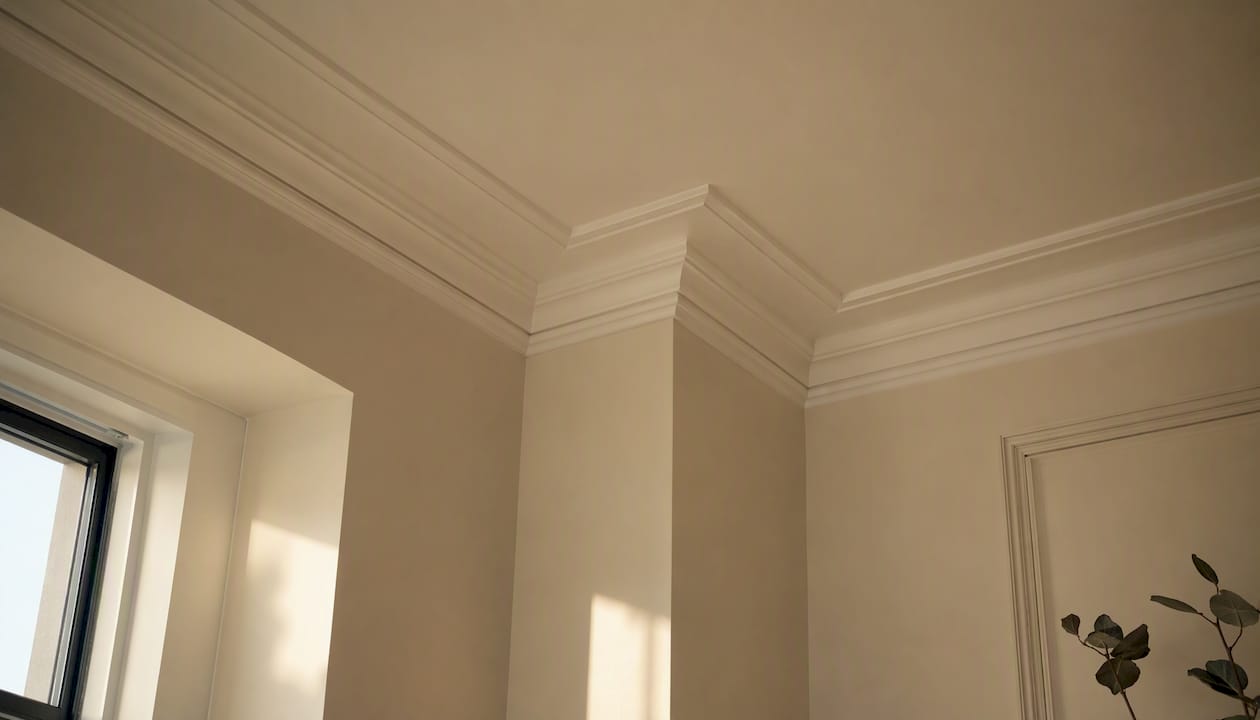
Crown molding works on the eye the same way a well-tailored jacket works on a frame: it directs attention to where the lines are cleanest. The shadow line it casts pulls your gaze up and along the ceiling perimeter, which stretches the room visually even though the square footage never changes.
Profile size matters more than most homeowners expect. A profile that’s too large for the ceiling height crowds the room instead of opening it up.
- On standard 8-foot ceilings, a modest 2 to 4 inch profile keeps proportions balanced.
- On 9 to 10 foot ceilings, mid-scale profiles read well without competing with light fixtures.
- On ceilings 12 feet or higher, built-up or layered crowns are often necessary just to be visible from floor level.
Pro Tip: If your ceiling is under 8 feet, resist the urge to go big. An oversized crown on a low ceiling visually lowers it further, which is the opposite of what most homeowners want.
What Profile and Material Should You Choose?
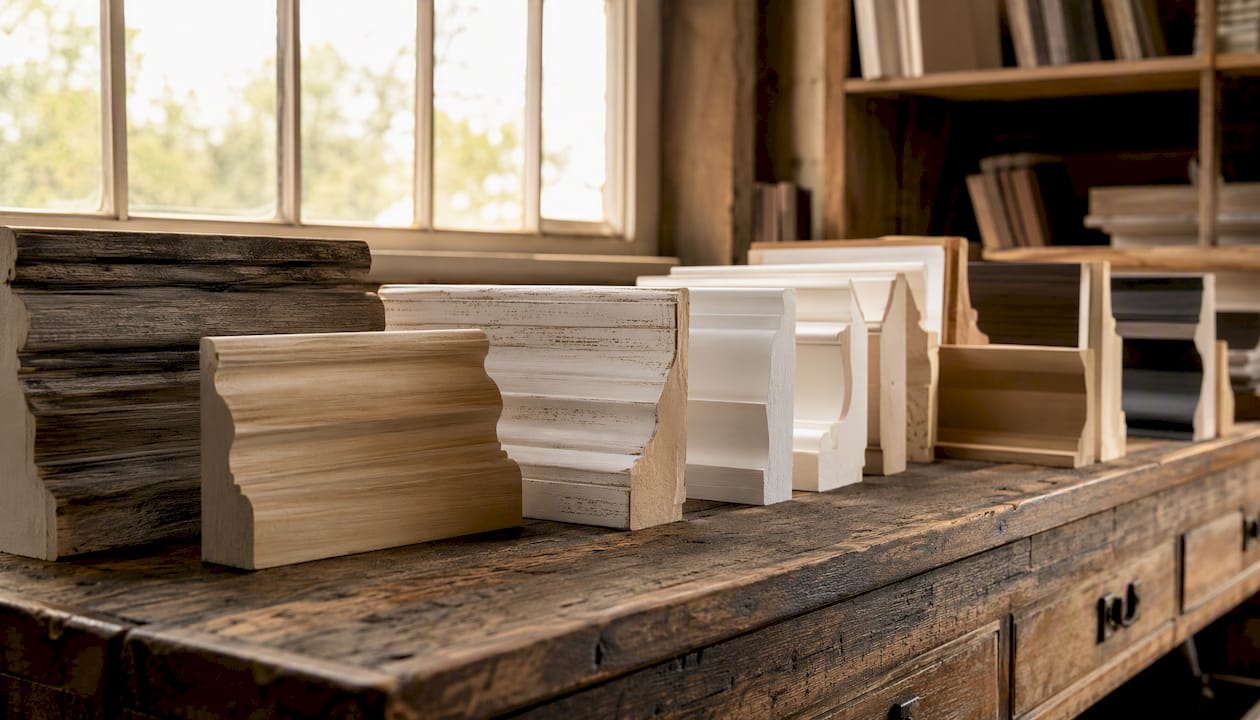
The profile shape sets the personality of the room before you even pick a paint color. Cove profiles curve gently and read as soft and traditional. Ogee profiles use an S-curve that reads more formal and detailed. Compound or built-up crowns stack two or three separate pieces to create depth and shadow that a single-piece profile can’t achieve on its own.
Material choice is just as consequential as shape:
- Solid wood takes stain and paint beautifully and holds up for decades, but costs more and requires tighter joinery.
- MDF is affordable, paints smoothly, and is the most common choice for budget-conscious rooms, though it’s vulnerable to moisture.
- Polyurethane or foam is lightweight, pre-primed, and forgiving for DIY installs, but it can’t take a stain finish.
- PVC resists humidity and works well in bathrooms or kitchens near cooking moisture.
Reserve built-up, multi-piece crowns for tall ceilings or formal rooms where the extra shadow depth earns its cost. A single-piece profile usually serves bedrooms, hallways, and smaller rooms just fine.
How Do You Choose Size, Color, and Handle Tricky Installs?
Selecting the right molding comes down to matching scale to the room, not just picking what looks good in a showroom photo.
- Measure ceiling height first, then size the profile to it (see the scaling guidance above).
- Match the trim style to your home’s architecture: simple cove for a modern build, ornate ogee for a historic one.
- Decide on color: white trim against a colored wall reads crisp and traditional, while trim painted the same color as the wall (a monochrome treatment) reads quiet and modern.
- Confirm ceiling and wall flatness before committing to a profile, since uneven surfaces show through thin, flat trim more than deep profiles.
Installation has its own set of headaches. Corners rarely meet at a clean 90 degrees in older homes, which means coping joints (cutting one piece to fit the profile of the other) usually outperform simple mitered corners. If you’re planning indirect lighting, the crown often needs to sit an inch or two below the ceiling to create a lighting channel.
- DIY works for straightforward rooms with square corners and a single-piece foam or MDF profile.
- Hire a finish carpenter for vaulted ceilings, built-up profiles, or any room with visible corner irregularities.
- Budget a full day for a single average room; multi-piece crowns and integrated lighting can stretch that to two or three days.
Where Does Crown Molding Make the Biggest Visual Difference?
Every room asks something different of crown molding, and the smartest installs treat it as a design tool rather than a default finish.
- Living rooms benefit from a mid-scale profile that frames the main gathering space without overwhelming furniture sightlines.
- Dining rooms handle more ornate, formal profiles well, especially paired with a ceiling medallion.
- Kitchens often use crown to cap cabinets that stop short of the ceiling, closing the gap and making stock cabinetry read as custom built-ins.
- Bathrooms need moisture-resistant PVC or polyurethane rather than raw wood or MDF.
- Hallways and small bedrooms look best with slim, simple profiles that don’t compete with limited wall space.
- Fireplace surrounds gain formality when trim wraps the mantel and continues into the ceiling line.
Modern treatments push past the classic white cap: flush low-profile trim, two-tone paint that separates crown from ceiling, or a lowered crown with LED strip lighting hidden behind it for a soft upward glow.
What Does Crown Molding Cost, and Is It Worth It?
Cost tracks almost directly with material and complexity. Economy MDF profiles installed by a handy homeowner run cheapest; solid wood or built-up, multi-piece crowns installed by a finish carpenter cost considerably more but deliver a noticeably richer look. A single average-sized room typically takes one to three days depending on profile complexity and corner conditions.
Statistic Callout: Crown molding returns 50% to 80% of its installed cost on resale on average, with the top end of that range showing up most reliably in high-end finishes and move-in-ready markets where buyers expect polish.
- The strongest resale signal comes from main living areas, kitchens, and the primary bedroom, since those are the rooms buyers spend the most time evaluating.
- Trim upgrades are consistently cited as one of the most cost-effective finishing details a homeowner can add before listing a house.
For a deeper look at how trim choices shift buyer perception, see how trim upgrades affect home value.
How Do You Maintain and Modernize Existing Crown Molding?
Crown molding needs less upkeep than most trim, but neglect still shows. Dust it with a soft brush attachment every few months, fill hairline gaps at seams with paintable caulk, and plan on repainting every five to seven years depending on sun exposure and household wear.
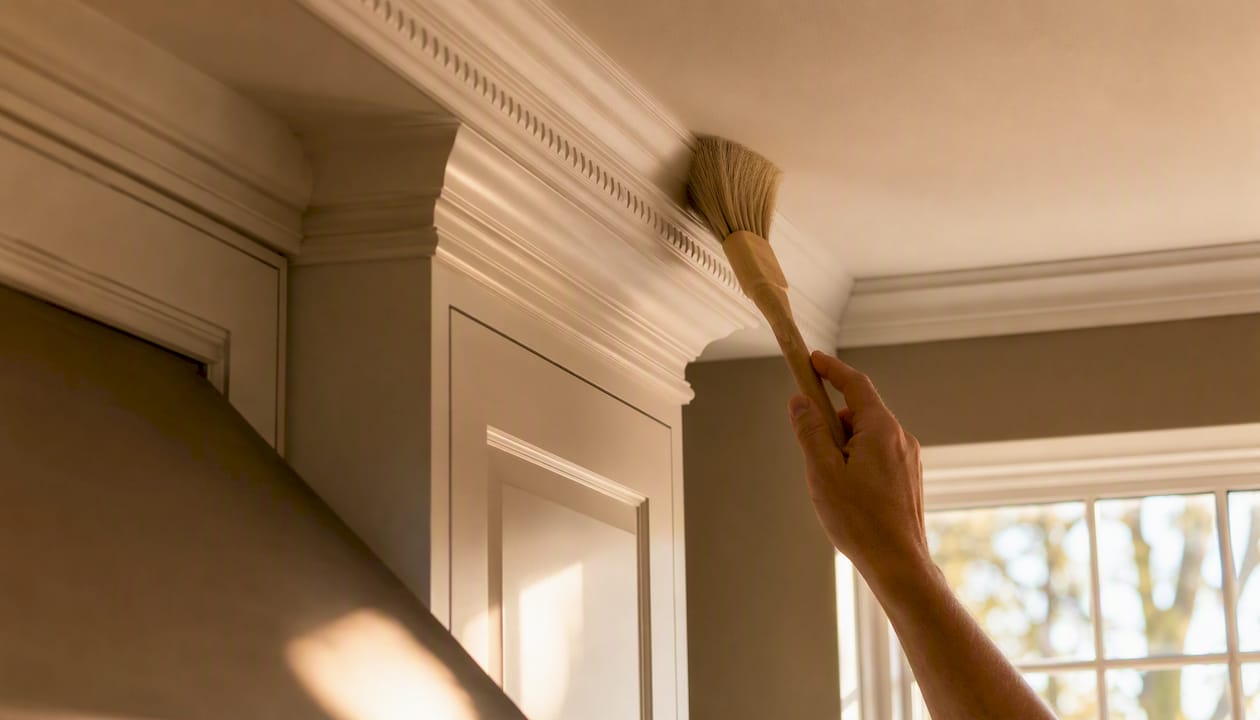
Modernizing old molding doesn’t require replacing it. A fresh coat in a contrasting or monochrome scheme changes the whole feel of a room, and adding a second, narrower trim strip beneath an existing crown creates depth without a full teardown.
Pro Tip: Run a thin bead of caulk along every seam before painting, not after. Painting over an uncaulked seam leaves a visible line the moment the house settles even slightly.
What Do Carpenters Say About Crown Molding ROI?
Scaling rules aren’t guesswork for a working carpenter. Metrie’s guidance on matching profile size to ceiling height lines up with what shows up on job sites constantly: oversized crown on a low ceiling reads as a mistake, not a feature.
The most requested job in Central Illinois kitchens is capping stock cabinets to fake a built-in look, which is one of the highest perceived-value moves for the labor involved.
- Buyers notice trim before they notice paint color.
- A crown cap on cabinets costs less than replacing cabinetry entirely.
Pro Tip: If your budget only stretches to one room, put crown molding where buyers linger longest: the kitchen or the primary bedroom.
Why We Recommend Crown Molding on Almost Every Remodel
Wood Made Illinois has watched crown molding turn budget-stock cabinets into pieces that look custom built, and we recommend it on nearly every interior remodel where ceiling height allows it. Our custom carpentry design work reflects that same philosophy: proportion first, ornament second.
Get a Custom Crown Molding Plan for Your Home
Store-bought profiles and DIY kits only get you so far, especially on uneven walls, vaulted ceilings, or cabinets that need a built-in look. Wood Made Illinois handles the design consult and the install in one relationship, so you’re not measuring ceiling height off a YouTube video and hoping the miter cuts hold.

- A design consultation covers profile selection, material, and color strategy specific to your ceiling height and architecture.
- Custom installation includes coped corners, built-up profiles, and integrated lighting channels where you want them.
If you’re ready to see what a proper crown treatment looks like in your own rooms, start with a local carpentry consultation and get a plan built around your actual walls, not a generic template. For budget-friendly staging ideas across an entire home, One Day Doors & Closets breaks down how trim details affect resale value in ways that echo what we see on our own job sites.
Sources
- What is Crown Molding | What is Crown Molding Used for In a House | Angi
- Crown molding isn’t just for the ceiling (The Spruce)
- Crown molding ideas and inspiring rooms | Elle Decor
- Crown molding for low ceilings (Metrie)
- Kitchen cabinet and molding ideas (The Home Depot)