Interior window shutters are hinged panels with adjustable louvers, mounted inside the window frame or around it, that control light, privacy and airflow. Most U.S. homeowners choose between full-height, café and tier-on-tier layouts, and between real wood and composite. Expect to pay roughly $20 to $45 per square foot, depending mostly on material. This guide covers each decision in the order you will face it, so you can settle on a design before you call anyone.
TL;DR
- Full-height shutters cover the whole window, café shutters cover the lower half, and tier-on-tier shutters have top and bottom sections that open separately.
- Real wood suits living rooms, dining rooms and bedrooms. Composite is the safer choice for bathrooms, kitchens and laundry rooms, where humidity can warp wood.
- Typical U.S. pricing is $20 to $45 per square foot, with real wood at the top of that range and vinyl or PVC at the bottom.
- Measure every window yourself at three points, use the smallest figures for an inside mount, and check whether the frame is square before you order.
- Older or out-of-square windows are where a carpenter earns the fee: the frame, trim and sash behind the shutter decide how well it fits.
Table of Contents
- What interior shutters actually do
- Interior shutter styles compared
- Wood interior shutters: species, finish and moisture
- What interior shutters cost in the U.S.
- Light, privacy and energy
- Measuring and mounting
- Interior window shutter ideas by room
- Perspective: why the frame matters more than the louvers
- Hiring a carpenter for the window work around your shutters
- FAQ
- Sources
What interior shutters actually do
An interior shutter is a rigid frame holding panels, usually with tilting louvers, fixed to the window opening from inside the room. Unlike a fabric treatment, it stays part of the architecture. You can close it for privacy, tilt the louvers to bounce daylight toward the ceiling, or fold the panels back and see the whole window.
That permanence is the main reason people pick them. A well-built shutter reads as millwork rather than as an accessory. Designer Michael Ferzoco, quoted in Houzz, describes shutters as giving a solid, custom-treated feel and being historically appropriate for certain architectural styles, Craftsman homes among them. That matters in Central Illinois, where bungalows, foursquares and Craftsman houses are common and a rigid wood panel looks like it belongs.
The trade-offs are real, and it helps to know them early:
- Louver size changes the light and the privacy. According to the British Blind and Shutter Association’s product guidance, larger louvers let in more light, while smaller louvers give better privacy when open.
- Panels can sag slightly. The same guidance notes that panels hinged together may dip a little when opened because of their unsupported weight, so you lift them slightly when closing. That is normal behavior for a wide folding set, not a defect.
- Fit is unforgiving. There is no fabric to take up a gap. A shutter that is off by an eighth of an inch shows it.
Interior shutter styles compared
Three layouts cover most homes. The names vary by retailer, but the geometry does not.
| Style | What it covers | Best for | Watch out for |
|---|---|---|---|
| Full-height | The entire window, optionally with a mid-rail so upper and lower louvers move independently | Bedrooms, living rooms, tall windows | Heavier panels, more hinge stress |
| Café | The bottom half only | Kitchens, street-facing rooms, dining rooms | Top of the window stays uncovered, so no full blackout |
| Tier-on-tier | Whole window, with top and bottom panels that open independently | Bedrooms, rooms with strong afternoon sun | More hinges and a higher cost than a single-panel design |
The café and tier-on-tier definitions match Angi’s guide to choosing interior shutters: café shutters admit natural light at the top while keeping ground-level privacy, and tier-on-tier shutters give maximum control of light and privacy because each section opens on its own.
Plantation, the louver size most people mean
“Plantation” refers to wide louvers, usually 3.5 inches or more, rather than to a layout. You can have plantation louvers on a café, full-height or tier-on-tier frame. Wide louvers give a clean, modern look and a better view out when open. Narrower louvers feel more traditional and give more privacy at the same tilt angle, which is worth remembering on a ground-floor window facing a sidewalk.
Specialty shapes
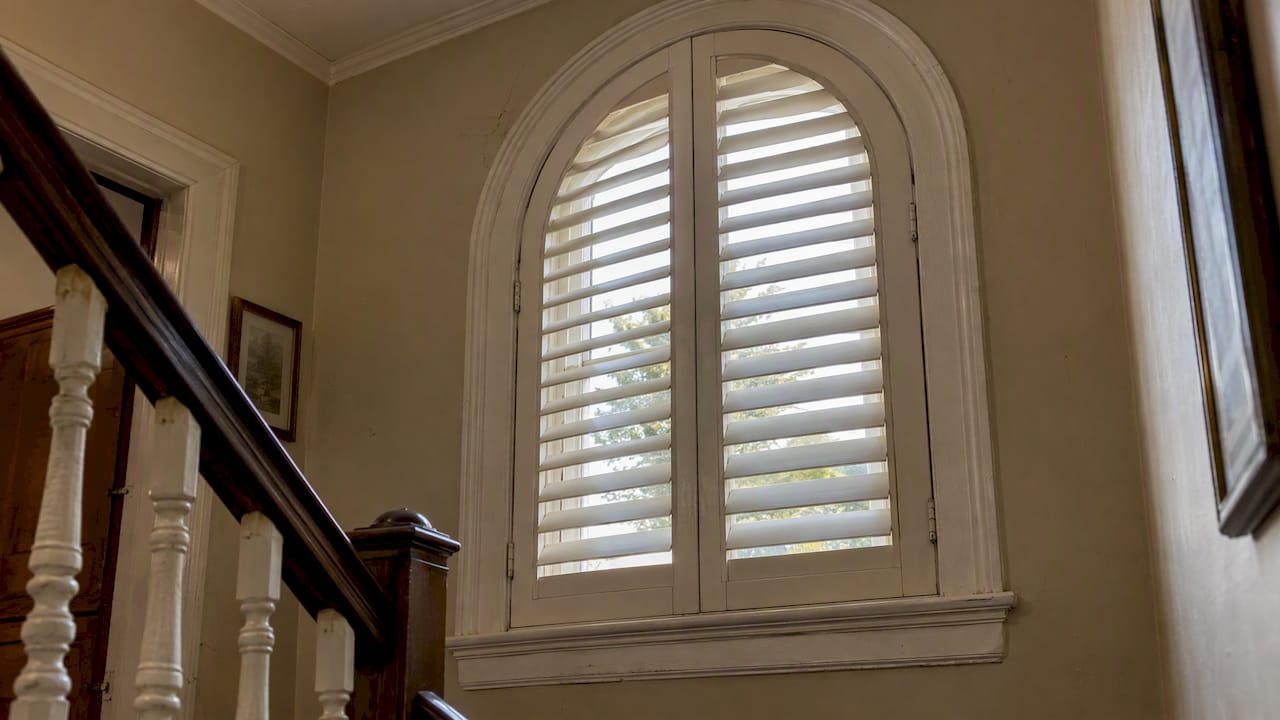
Arches, angles and other non-rectangular windows can be fitted with shutters too, though they are usually built to a template rather than from a stock size. These are the windows where a carpenter’s pattern work pays off.
Wood interior shutters: species, finish and moisture
Most real-wood shutters sold in the U.S. are basswood, a light, stable, fine-grained hardwood that takes paint very well and holds a stain evenly. Hardwood options such as poplar are also common. Basswood is classic in both painted and wood-grain finishes.
Three practical points about wood:
- Humidity is the enemy. Real wood is a good fit for living rooms, dining rooms and bedrooms. In bathrooms, laundry rooms and kitchens over a busy range, steam and splashes can cause warping and finish failure. Composite or PVC is the better choice there.
- Clean wood with a dry or barely damp cloth. Standing water at the bottom rail is how finishes lift. Dust the louvers with a soft brush or microfiber cloth.
- Paint hides, stain reveals. Paint covers joints and slight grain variation. Stain shows every board, so the grain match matters more, and the cost is typically higher.
If you want a wood-grain look in a humid room, ask for a composite with a wood-grain finish instead of forcing real wood into a space where it will struggle.
A note on windows that are not new
Shutters hang from the window frame. If the jamb is out of square, the sash is sticking, or the casing is rotted at the sill, the shutter inherits every one of those problems. In older homes, the sensible order is repair first, shutters second. Our historic window restoration work and wooden window repair exist for exactly this situation, and a sound frame is what lets an inside-mount shutter close with even gaps.
What interior shutters cost in the U.S.
Prices vary by region, but the national numbers are consistent across sources. This Old House puts plantation shutters at $20 to $45 per square foot, with these ranges by material:
| Material | Typical cost per square foot |
|---|---|
| Vinyl / PVC | $20 to $30 |
| Composite | $25 to $35 |
| Faux wood | $30 to $40 |
| Real wood | $35 to $45 |
HomeAdvisor’s 2026 cost guide reports an average of about $2,200 for interior shutters, a total range of $1,000 to $3,400 for custom shutters, and installation labor commonly at $60 to $100 per hour. It names size, style, labor, maintenance and repairs as the factors that move the final figure.
A worked example
Take a bedroom window measuring 36 by 60 inches. That is 15 square feet. At $20 per square foot the shutter lands near $300, and at $45 near $675, before installation. A whole-house job with a dozen windows of similar size multiplies accordingly, which is how totals reach the thousands.
A few things push the price up:
- Real wood or a custom stain rather than white paint
- Tier-on-tier or mid-rail construction, which adds panels and hinges
- Arched or angled windows
- Out-of-square openings that need shimming or custom trim
- Repairs to the window itself before anything is mounted
What tends to pull it down is a simpler layout, composite material, and fewer windows done as a single order. Get itemized quotes, so you can compare material, labor and trim line by line.
Light, privacy and energy
Shutters are as much a performance product as a design one. You adjust the louvers through the day: tilted up to throw daylight deep into the room, closed against low afternoon sun, shut for privacy at night.
On energy, be careful about promises. The U.S. Department of Energy’s report on energy savings from window attachments found that every attachment studied saved energy in cooling-dominated climates, while in heating-dominated zones the best results come from balancing insulation and solar control. It also stresses that how occupants operate the attachment, and the local climate, shape the outcome. In Illinois, with hot summers and cold winters, that means closing shutters on sun-facing windows on summer afternoons and opening them on winter days to take in free warmth.
If your room feels dark after the shutters go in, the fix is often a lighting one, not a louver one. A good overview of choosing ceiling lighting helps you plan for evenings and overcast days when you have the louvers tilted for privacy.
Measuring and mounting
Accurate measuring is where most custom shutter orders succeed or fail. A made-to-measure shutter cannot be trimmed in the field the way a stock product can, and a wrong number often means re-fabrication.
Inside mount or outside mount
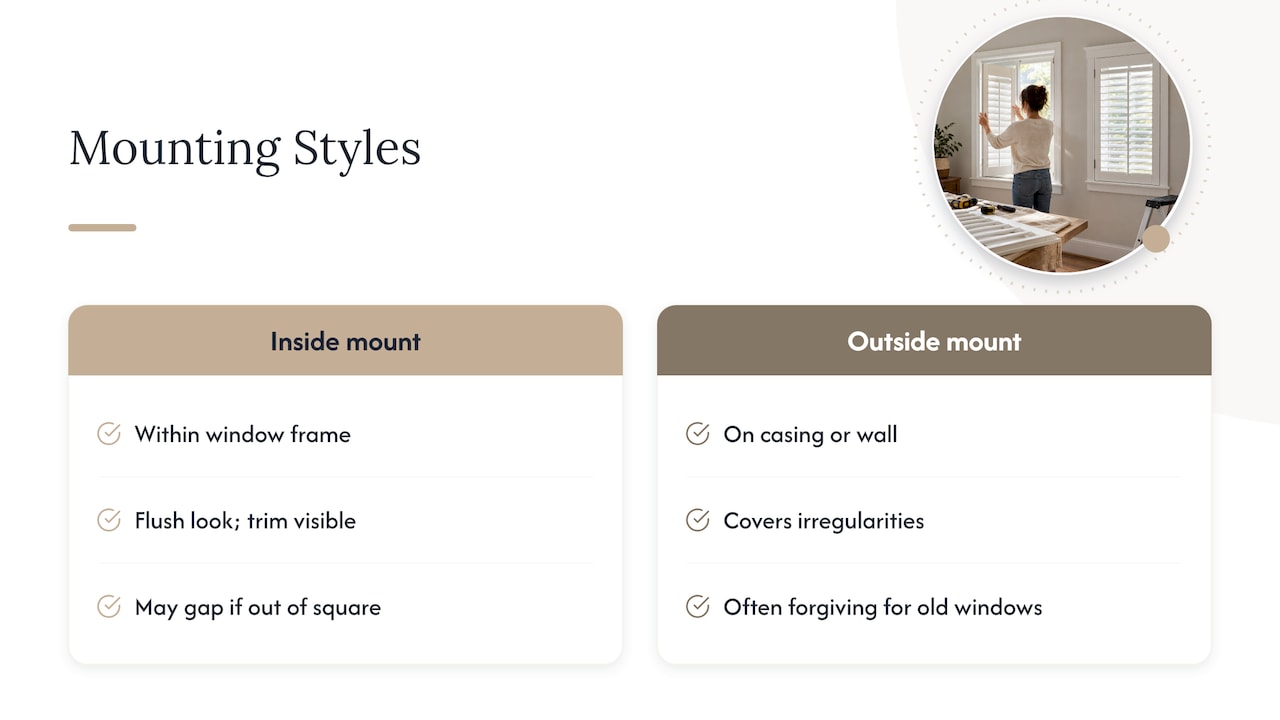
An inside mount sits within the window frame, for a flush look that leaves the trim visible. It can leave gaps if the window is out of square. An outside mount sits on the casing or wall around the opening and can hide irregularities. If your windows are old, an outside mount with a carpenter-built frame is frequently the more forgiving route.
Measuring steps
The approach recommended by This Old House is straightforward:
- Measure the width between the jambs at three points: top, middle and bottom.
- Measure the height at three points: left, center and right.
- For an inside mount, use the smallest of each set of numbers.
- Check the depth of the casing so the panels clear the glass, handles and any crank hardware.
- Use a folding rule with a sliding extension if you have one, because it gives a more rigid inside measurement than a flexible tape.
Write the numbers down per window and label them, since windows in the same room are rarely identical.
For outside mounts, the logic flips: use the widest width and longest height, then add the overlap you want on each side. Also confirm the mounting surface is flat, and that nothing such as a crank handle, a curtain rod or a protruding sill blocks the panels from swinging.
Installation by hand
A typical install runs as follows: assemble the frame, center and level it, fasten it through pre-drilled holes, hang the panels on their hinge pins, check the gaps and clearance, then add the remaining screws and the catch hardware. Blinds.com estimates 20 to 40 minutes for a single window in a straightforward case, and says the work gets tricky when windows are not perfectly square.
That is the honest dividing line between DIY and hiring out. A square, modern, standard-size window is a reasonable weekend task. A century-old double-hung with a bowed jamb, painted-shut sash or plaster return is not.
Interior window shutter ideas by room
Living room. Full-height plantation shutters in white or a warm off-white keep the window architectural. On a large bay, consider panels that fold fully clear of the glass.
Bedroom. Tier-on-tier panels let you close the top for privacy and keep the bottom open for light, or the reverse. Add a tight-fitting frame if you want to reduce streetlight at night.
Home office. Glare on a monitor is the problem to solve. Tilt the louvers up so daylight bounces off the ceiling rather than hitting the screen, and keep the lower section closed if the window faces a neighbor. Shutters are a good fit here because they will not rattle or sway like a roller shade.
Kitchen and dining room. Café shutters keep the upper window open to daylight while hiding the lower half from the street. In a kitchen, choose composite near the sink.
Bathroom and laundry. Composite or PVC only. Skip real wood in rooms where steam is routine.
Craftsman and older homes. Stained wood shutters in a flat or low-sheen finish, mounted with trim that matches the existing casing profile, look original rather than added on.
Small rooms. Café shutters or panels that fold completely to the side stop the window from eating floor and wall space, which is the same logic behind built-ins and wall-hung storage.
If you are choosing shutters partly with resale in mind, the point to take from this piece on natural light and home value is that buyers respond to bright, well-controlled rooms, and adjustable louvers let you present a room at its best.
Perspective: why the frame matters more than the louvers
People shop for shutters by looking at louvers, color and price per square foot. In our experience as carpenters, the outcome is decided by something less visible: the condition of the opening.
Our team brings more than 100 years of combined carpentry experience to Central Illinois homes, and a lot of that time has been spent in older houses where nothing is quite plumb. A shutter ordered to a sloppy measurement or hung in a twisted jamb will never close evenly, no matter how good the panel is. So we start with the window: is the sash sound, is the sill dry, is the casing tight to the wall, and will the finished depth clear the hardware?
For that reason, our advice is simple. Decide on layout and material first, measure three times, and have a carpenter look at any window that is original to the house before you commit. Paint is the skin of a house, but the frame is its bones, and shutters hang from the bones. If the bones are right, the shutters will last decades. If they are not, you will notice every gap.
We also like custom wood where it makes sense: a stained hardwood panel and matching finish trim in a Craftsman living room, or a built-in window seat beside a shuttered bay. When the casing, the shutter and the surrounding millwork all come from one coherent plan, the room looks designed rather than assembled.
— Wood
Hiring a carpenter for the window work around your shutters
If you are in Central Illinois and the windows in your home need repair, new trim or custom millwork before shutters go up, we can help. We handle finish carpentry, wooden window repair and historic window restoration, along with built-ins and other custom woodwork, and we begin with a design consultation so the work matches your budget and your house. See what we do on our main site, or read how carpenters personalize standard designs to fit a particular home. Projects are quoted per job.
FAQ
What do interior shutters cost?
Most U.S. projects run $20 to $45 per square foot, according to This Old House, with vinyl at the low end and real wood at the high end. HomeAdvisor reports an average near $2,200 and a custom range of $1,000 to $3,400. Your total depends on window count, size, style and the condition of the openings.
Are wood interior shutters a good choice for every room?
No. Real wood is a traditional fit for living rooms, dining rooms and bedrooms, but steam and splashes can warp it in bathrooms and laundry rooms. In those spaces, use composite or PVC, which come in wood-grain and painted finishes.
Should I choose an inside mount or an outside mount?
Choose an inside mount if your frames are square and deep enough, because it gives a clean, flush look. Choose an outside mount if the window is out of square or the frame is shallow, because the shutter frame hides the irregularities.
Can I install custom interior shutters myself?
Often yes, on square, modern windows. A single window can take 20 to 40 minutes, according to Blinds.com, but out-of-square or older windows make both measuring and fitting harder. In those cases, a carpenter or professional installer lowers the risk of a costly reorder.
Do interior shutters save energy?
They can, but the effect depends on climate and how you use them. The Department of Energy’s study found savings in cooling-dominated climates, while colder zones need a balance of insulation and solar control.
Sources
- British Blind and Shutter Association: Product Characteristics, Internal Shutters
- Angi: Tips for Choosing the Perfect Interior Shutters
- This Old House: How Much Do Estate Shutters Cost?
- HomeAdvisor: How Much Does Shutter Installation Cost?
- U.S. Department of Energy: Energy Savings from Window Attachments
- This Old House: How to Hang Interior Shutters
- Houzz: What to Know About Window Blinds and Shutters
- Blinds.com: When to Hire a Pro vs DIY for Window Treatments