A spice rack pullout is a narrow, full-height cabinet insert or a shallow drawer that slides out so every jar is visible from the front. It works because it replaces the dark back corner of a cabinet, where jars disappear, with a single row you can read at a glance. The right version depends on three things: the clear opening you have, where the unit sits relative to the stove, and whether it is bought off the shelf or built to fit. This guide covers all three, then looks at two neighbors that readers often plan at the same time: the pull-out trash cabinet and the built-in wine rack.
TL;DR
- A pullout turns dead cabinet depth into visible storage. Narrow base or tall units and shallow drawers are the two main styles.
- Measure the narrowest clear width, the usable depth and the clear height, and check hinges, face frames and door inserts before anything is ordered or built.
- Place spices near the stove or main prep counter, but out of direct heat, light and moisture.
- A custom build makes sense when your opening is an odd size, when you want the unit to match existing cabinet doors, or when you are combining spices, trash and other storage in one run.
- Built-in wine storage depends on the appliance or rack you choose. Get the exact opening dimensions from the specification before the carpentry starts.
Table of Contents
- Why a pullout beats a shelf
- Styles of spice storage that work in a cabinet
- Where the spice pullout should go
- How to measure for a spice rack pullout
- What size should a spice drawer be?
- Buy ready-made or build to fit
- Construction details that decide how long it lasts
- Pull-out trash cabinets: planning the other busy pullout
- Built-in wine racks: what to settle before the carpentry
- Our perspective: plan the whole cabinet run
- Having a spice pullout built in Central Illinois
- FAQ
- Sources
Why a pullout beats a shelf
A standard cabinet shelf is deep and the jars are small. The jar you need is always in the second row, behind two others, and you pull half the shelf out to find it. Over time the cabinet fills with duplicates because nobody can see what is already there.
A pullout fixes the geometry rather than the habits. Instead of reaching into the cabinet, the cabinet comes to you. Jars sit in one or two rows facing outward, and the label is the first thing you see. On a tall, narrow unit, gravity and glides do the rest.
There is also a plain space argument. Many kitchens have an 8 or 9 inch gap beside the range or between a base cabinet and the wall, too slim for a standard door cabinet and too useful to waste. A slim pullout is built for exactly that kind of opening.
Styles of spice storage that work in a cabinet
Professional organizers and home magazines agree on a short list of approaches. Better Homes & Gardens suggests a shallow drawer with dividers or an angled organizer, an expandable riser, a lazy Susan, a narrow pull-out cabinet often placed near the stove, or jars mounted inside a cabinet door. Here is how those compare when a carpenter is involved.
| Style | Best for | Typical opening | Watch for |
|---|---|---|---|
| Tall, narrow pull-out cabinet | Large collections, kitchens with a gap beside the range | A slim base or tall opening | Hinge swing and face frame can block the path |
| Shallow spice drawer | Kitchens with an under-counter drawer to spare | A standard drawer box | Needs liners or an angled insert so jars do not roll |
| Pull-out inside a door cabinet | Replacing an existing shelf cabinet | A standard 12 to 18 inch base | Door-mounted units reduce clear width |
| Drop-down or door-mounted rack | Small collections, rentals | Inside an upper cabinet door | Limited weight, shallow jars only |
| Lazy Susan | Corner or deep upper cabinets | Corner cabinet | Back jars still sit behind front jars on large trays |
Tall and narrow versus shallow and wide
A tall pull-out holds the most jars per square foot of floor space and keeps everything at hand height if the shelves are spaced correctly. A shallow drawer holds fewer jars but shows every label from above, which many cooks prefer. Martha Stewart’s organizing advice notes that shallow drawers suit tiered racks that hold jars at a slight angle for visibility, and that textured liners can stop jars from rolling.
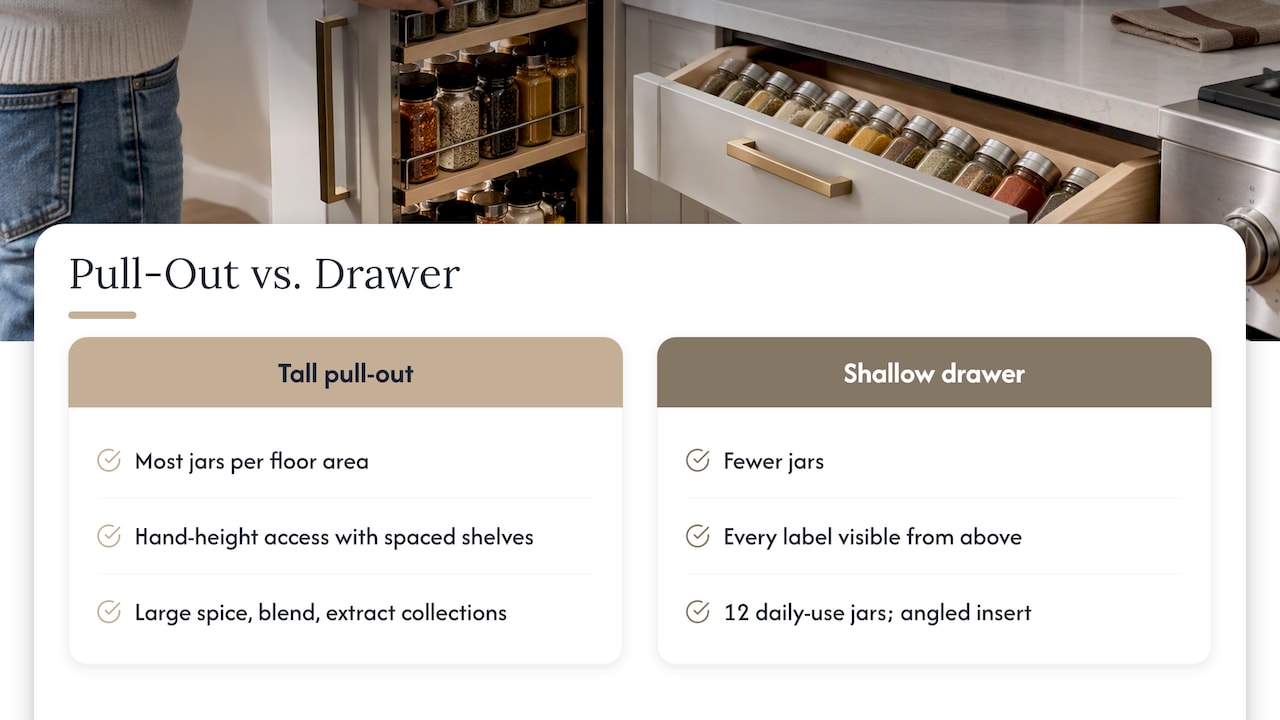
If you cook from a large collection of whole spices, blends and baking extracts, the tall pull-out usually wins. If you keep a dozen jars you reach for daily, a drawer with an angled insert is faster.
Where the spice pullout should go
Location matters as much as the hardware. Martha Stewart, citing professional organizer Lisa Zaslow, recommends keeping spices near the stove or main prep counter but away from heat, light and moisture. Those two instructions pull in opposite directions, and a good layout resolves them.
A pullout beside the range is convenient, but if the range is a high-output model, the cabinet wall facing it can run warm. Spices lose color and flavor with heat and light, so a pullout one cabinet away from the range, or on the prep side of the counter, often serves better than the one that touches the burner. Keep it clear of the dishwasher vent and the sink base, where steam and splashes collect.
A simple test: stand where you chop. If you can reach the pullout in one step and the door of the cabinet can open fully without hitting the refrigerator or an island, the location is workable. Leave room for the cook to stand beside the open unit rather than in front of it.
How to measure for a spice rack pullout
Most failed installs come down to a measurement taken at the wrong place. Pullout makers who publish guides agree on the same method: measure the narrowest clear width, the usable depth and the clear height, then check what can interfere. Vertical Spice’s measuring guide says to measure depth from the back of the cabinet to the inside of the closed door, and to pick the largest unit that can move without striking frames, hinges or other obstructions. We agree with that approach, and here is the full list we use on site.
- Width. Measure at three heights, top, middle and bottom, and take the smallest number. Cabinet boxes are rarely perfectly square, and a face frame adds a lip that narrows the opening.
- Depth. Measure from the back wall to the inside face of the closed door, not to the front edge of the frame. Subtract anything protruding on the door, like a hinge plate or a door-mounted rack.
- Height. Measure from the cabinet floor to the underside of the shelf or top. If there is a fixed shelf, check whether it sits level.
- Hinges. Check how far the hinge arm intrudes when the door is open to 90 degrees. A standard hinge can block a slim unit unless the door opens wider.
- Obstructions. Look for rear blocks, plumbing or wiring in the back of the cabinet and for any shelf pins or brackets.
- The path. Pull a tape from the front of the cabinet outward. The unit needs its own length of free floor to travel, plus room to stand.
Write the numbers down with the narrowest value circled. A pullout should clear the smallest measurement by a small margin, not the average.
Face-frame versus frameless cabinets
Face-frame cabinets have a solid wood border around the opening. That border is useful for mounting hinges, but it reduces the clear width by the thickness of the frame on each side. Frameless (European-style) cabinets give you the full interior width, which allows a slightly larger unit in the same box. A carpenter will usually tell you which you have in the first minute of a site visit, and that single fact can change which unit fits.
What size should a spice drawer be?
The question comes up for every drawer-style plan, and the answer starts with the jars. An old but still practical rule comes from Oregon State University’s cabinet guide, which lists 7 inches as a suitable overall drawer height for spices up to 8 ounces. The same guide advises assigning the items you intend to store before estimating cabinet dimensions, which is the right order for any custom piece.
In practice, that means three steps. Line up your actual jars on a counter, from tallest to shortest, and measure the tallest. Decide whether jars will stand upright with dividers or lie at an angle in tiers. Then size the drawer to the jar, not the other way around. A drawer with a tilted insert needs less height but more depth, while upright storage needs height and can be shallower.
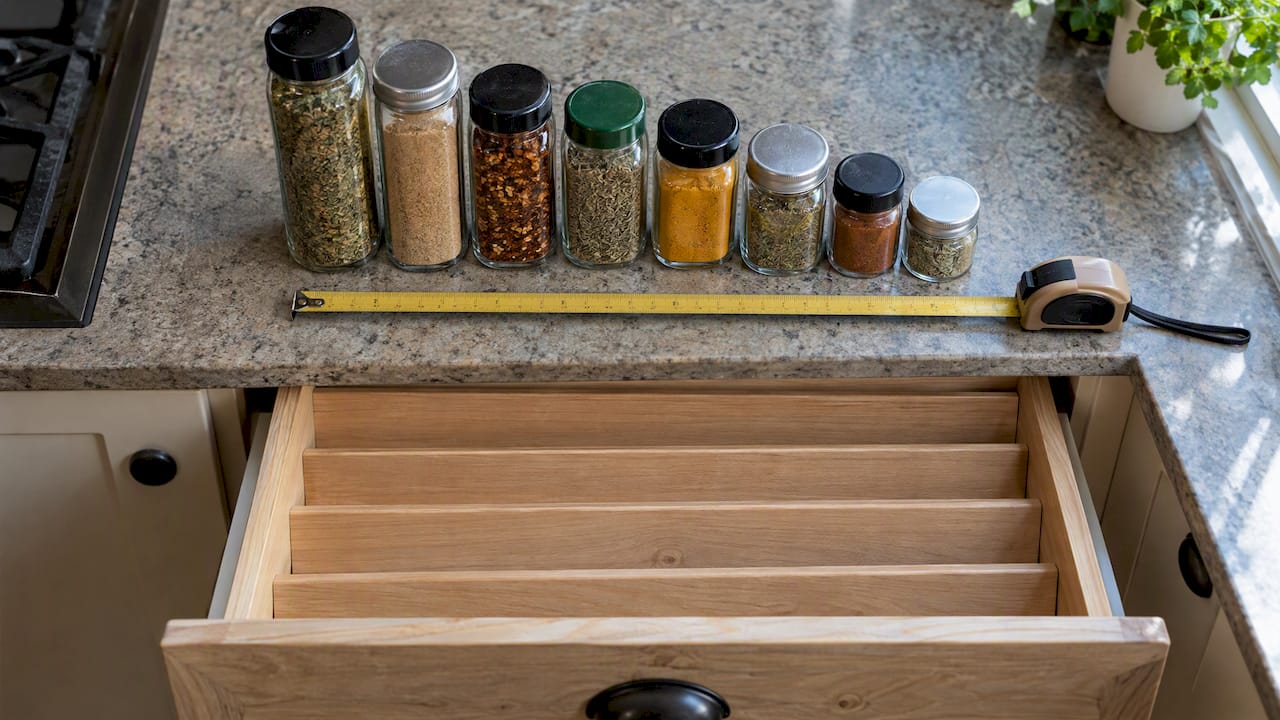
Standard jars vary, so write down which shapes you own. Square jars waste less space than round ones. If you buy in bulk and refill, plan for taller refill bags in a separate bin.
Buy ready-made or build to fit
Ready-made pullouts are sold in standard widths and heights. They are a good answer when your opening matches a catalog size, when you are comfortable installing hardware and when your cabinet face is plain enough that a visible unit does not matter. Many people like the look of a pull-out they can drop into an existing cabinet and hang a door in front of.
Custom carpentry starts to pay off in a few situations:
- Odd openings. Older homes and remodeled kitchens often have a gap that is a fraction short of any catalog size. A built-to-fit unit uses every inch rather than leaving a gap beside it.
- Matching fronts. A pullout whose face matches your cabinet doors looks like part of the kitchen rather than an add-on.
- Combined storage. A tall unit can have spices at eye level, oils below and a cutting-board slot above, all in one cabinet.
- Real hardwood. Maple, oak or walnut boxes outlast thin laminate and can be repaired and refinished.
If you want to see how that thinking applies to a larger pantry, our page on what a pull-out pantry cabinet is goes through the same logic for a full-height unit.
Construction details that decide how long it lasts
A pullout is a moving part, and moving parts fail at the same few points.
Glides. Full-extension, soft-close slides let you reach the back row without the unit slamming. Choose glides rated well above the load of full jars, since glass is heavier than it looks. A dozen full glass jars adds up quickly.
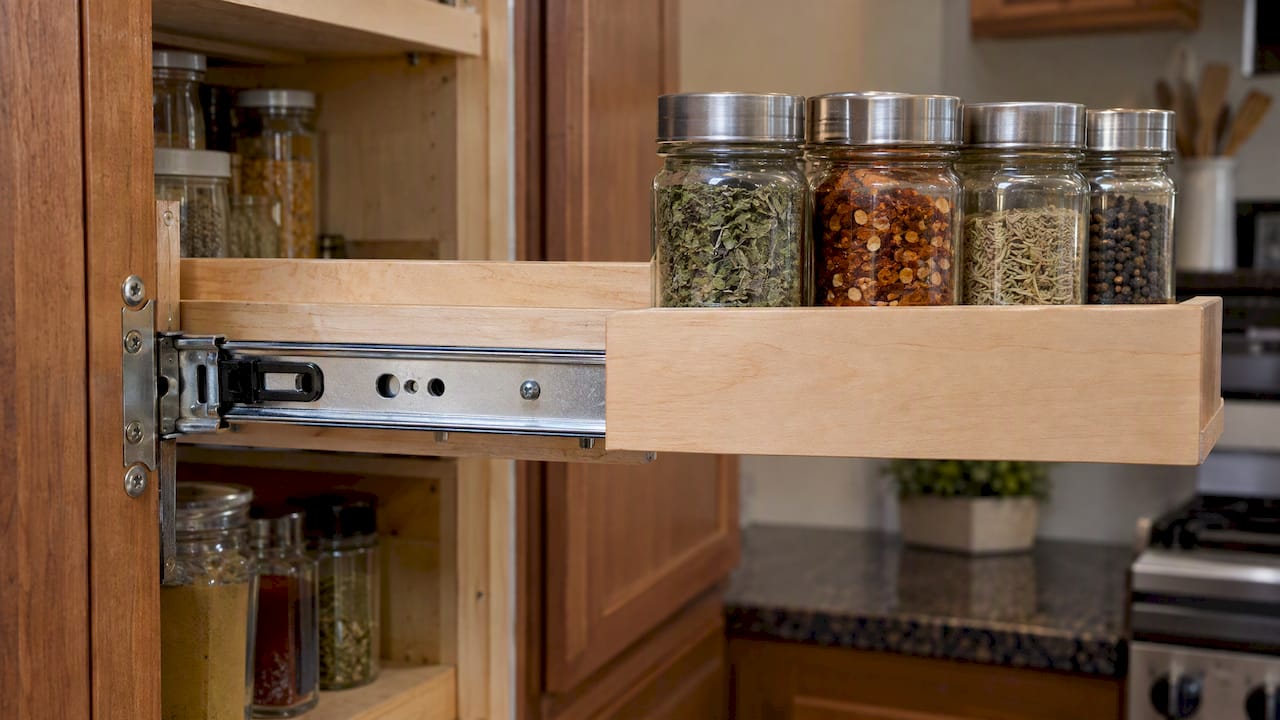
Shelf lips. A 1/2 inch lip at the front of each tier keeps jars from sliding out when the unit stops. Taller lips hide labels, so most builders keep them modest and use a shallow ramp or an angled shelf instead.
Rails and mounting. A tall pullout is mounted to the cabinet floor and the door or top, depending on the design. Both points need solid blocking behind the thin panels, not just screws into a veneer.
Finish. Kitchens are humid. A sealed finish on the inside of the cabinet protects the wood from splashes and cooking steam. Unfinished interiors absorb odors, and a spice cabinet should never smell of last month’s curry.
Lighting. Adding a small LED strip inside the cabinet or on the side makes the jar labels easy to read, particularly in a deep, narrow cabinet where overhead light does not reach.
Pull-out trash cabinets: planning the other busy pullout
Many readers who search for spice pullouts also search for a pull-out trash cabinet, because both belong in the same planning conversation. A trash pullout stores one or two bins on full-extension slides, often with the door attached to the unit so one pull opens everything. You get a hidden bin without a swinging lid or a bin on the floor.
A few planning points:
- Location. Put it between the sink and the prep area so scraps move in a short path. A cutting-board drawer above a trash center is a classic pairing, and cabinet makers like Bertch recommend integrating trash and recycling for that reason.
- Width. Two bins need a wider cabinet than one. Decide whether you want separate trash and recycling before choosing a width.
- Clearance. For comfortable use, the University of Arkansas Cooperative Extension suggests 30 to 48 inches in front of appliances and work surfaces, and 42 to 48 inches for aisle width in a universally accessible kitchen. A pullout needs that same standing room.
- Weight. Full bins of wet waste are heavy. Insist on heavy-duty glides.
A trash pullout and a spice pullout can sit on opposite sides of a range or run in one cabinet bank. Planning them together keeps the kitchen consistent and avoids paying for two separate site visits.
Built-in wine racks: what to settle before the carpentry
Wine storage comes in two broad forms, and they need different planning.
A rack or cubby. A built-in rack is a carpentry job: diamond lattices, horizontal cubbies, or a slim pullout column next to the refrigerator. Bottles lie flat so corks stay moist, and a rack can be a few inches deep or run the length of a wall. Most are open and decorative, with no cooling.
A cooled unit. A built-in wine cellar or beverage center is an appliance, and the opening has to match the appliance. Read the manufacturer’s specification first. One U.S. brochure for a shallow built-in cellar lists a unit 23.5 inches wide, 71.75 inches high and 18 inches deep, with a recommended opening of 72 by 24 by 20 inches and front-breathing installation, meaning it vents through the front rather than the sides or back. Another integrated beverage center lists a 23 5/16 inch width and says it fits flush with 3/16 inch gaps. These are specific products, but they show the point: the surround is built around the appliance, and the tolerances are small.
A rack beside a pantry, a cabinet bank with a cutout for an undercounter cooler, or a wine drawer under a bar top all work. Whatever you choose, leave ventilation where the specification asks for it, never close in a front-vented unit with a solid panel, and keep wine away from a hot range or a sunny window.
For a bar or butler’s pantry, we often pair a wine rack with a solid wood top and open shelving. Our custom shelving work covers the shelving side of that, and a bar is one of the projects we build in solid wood.
Our perspective: plan the whole cabinet run
We have spent a long time in kitchens that were built decades ago and altered several times since. What we see again and again is a collection of cabinets that don’t talk to each other: a deep corner nobody can reach, a narrow gap filled with a bin, and a trash can in the middle of the floor. The fix is rarely a single product. It is a short plan.
Start with what you cook and what you throw away. Put spices where the prep happens, trash where the scraps move, and the wine or bar items at the edge of the room where guests gather. Then look at the openings you already have before changing the cabinets. Often a pullout in an existing cabinet solves the problem for much less than a new run, and if the cabinets are sound, a refresh of the doors and hardware is cheaper than replacement. Where the cabinets are worn out, cabinet replacement is the moment to specify the pullouts from the start, because they cost far less to build in than to retrofit.
We also like to use what a home already gives us. Solid wood from a project, reclaimed boards or pallet wood can become the sides and shelves of a small pullout for a modest price, and a custom piece built to your exact opening fits better than something forced into place. Our team has more than 100 years of combined carpentry experience, and most of what we do is solve this kind of small-space problem one cabinet at a time.
— Wood
Having a spice pullout built in Central Illinois
If you would rather have it measured, built and installed than do it yourself, that is what we do for homes and small businesses across Central Illinois. We offer design consultations, built-ins made to order and kitchen work, from a single pullout to a full renovation. We have not published a price for a spice pullout, since the cost depends on the opening, the material and whether it matches existing doors. You can see our built-to-order services and send us your measurements, or look at the kitchen renovation page if the project is bigger than one cabinet.
FAQ
What are some good ideas for storing spices in a cabinet?
A shallow drawer with dividers or an angled insert, a narrow pull-out cabinet near the stove, a lazy Susan, an expandable riser and jars mounted on the inside of a door all work. Choose by the size of your collection and the openings you have. A tall pull-out suits a large collection, and a drawer suits daily-use jars.
What size should a spice drawer be?
Size it to your tallest jar. An older Oregon State University cabinet guide lists an overall drawer height of 7 inches for spices up to 8 ounces, and it advises deciding what you will store before setting dimensions. Line up your own jars and measure before cutting anything.
Can a spice pullout fit in a very narrow gap?
Often yes. Slim units are made for openings of only a few inches, but the clear width after the face frame and hinges is what counts, not the gap measured on the outside. Measure the narrowest point and check how the door or hinge swings. A custom-built unit can use the exact space you have.
Where is the best place for a pull-out spice rack?
Near the stove or main prep counter, but out of direct heat, light and moisture. A cabinet one step from the range is often better than the one touching it. Make sure the unit can open fully without hitting an appliance or an island.
Should I plan a pull-out trash cabinet at the same time?
Yes, if you are working on the cabinets anyway. Both need full-extension glides, clear floor space and a position along the prep path. Doing them in one project saves time and keeps the fronts matching.
Sources
- How to Store Spices, According to a Professional Organizer, Better Homes & Gardens
- How to Store Spices to Keep Them Organized, Martha Stewart
- Measure Your Space, Vertical Spice
- Cabinets, Oregon State University
- Aging in Place: Kitchens and Meal Preparation, University of Arkansas Cooperative Extension
- Must-Have Kitchen Cabinet Accessories, Bertch Cabinet
- Product Brochure SDHWC98PNR, Summit Appliance
- 24" Series 9 Integrated Beverage Center, Fisher & Paykel