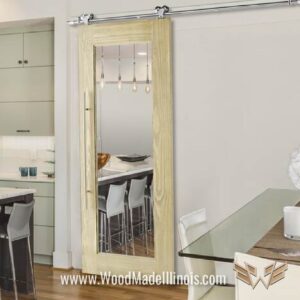
Accoya is a radiata pine that has been chemically modified so it takes on far less moisture than ordinary lumber, which makes it stable, rot-resistant and a strong candidate for custom millwork such as trim, wall cladding, window parts and built-ins. For an Illinois homeowner, the practical questions are what the material can do, how it has to be specified and installed, and how to plan a custom job around it. This guide covers all three, so you can walk into a conversation with a carpenter knowing what to ask for.
TL;DR
- Accoya is acetylated wood: the process swaps water-attracting groups in the wood’s cell walls for ones that repel moisture, so the wood swells and shrinks very little.
- It carries the highest durability rating (Class 1) and shrinks only 0.4% radially and 0.8% tangentially between wet and normal indoor humidity.
- It machines with ordinary tools, but glue, end-grain sealing, coatings and fasteners all have specific requirements.
- The manufacturer’s warranty depends on following its written instructions, so the specification matters as much as the board.
- Good millwork starts with a measured plan: a design consultation before any material is ordered.
Table of Contents
- What Accoya actually is
- The numbers that matter for interior millwork
- Where Accoya makes sense inside a house
- How millwork in Accoya should be made
- Warranty: read the conditions before you order
- Durability beyond the interior
- What to settle before commissioning custom millwork
- Older homes and Accoya
- Perspective: how we approach custom millwork
- Plan your project with us
- FAQ
- Sources
What Accoya actually is
Accoya is made by acetylation. According to the manufacturer’s Wood Information Guide, the process introduces acetyl groups into the wood’s cell walls, replacing hydroxyl groups that attract water. The result is a wood that is less hygroscopic, meaning it absorbs less moisture from the air, and that is more dimensionally stable and more resistant to biological attack. The liquid left over after treatment is reprocessed into new acetic acid.
Think of it this way: ordinary pine is a sponge, and Accoya is a sponge that has been taught to ignore water. Most of the trouble that wood gives a homeowner, from gaps opening at miter joints to doors that stick in August, comes from moisture moving in and out of the cell walls. Reduce that movement and you remove the cause of much of the trouble.
The manufacturer also states that the process adds nothing to the wood that was not already there and adds no toxic elements that could later leach out. A producer of Accoya millwork has described the process in a trade magazine as basically vinegar or alcohol, and credits the product with Cradle-to-Cradle Gold certification. For households that care about what goes into their walls and trim, that is a meaningful part of the appeal.
The numbers that matter for interior millwork
A specification is only as good as the figures behind it. These come straight from the manufacturer’s technical documents.
| Property | Accoya value | Why it matters in a home |
|---|---|---|
| Durability class | Class 1 (EN 350), the highest rating, per the technical information page | Resists the fungal decay that ruins ordinary trim near moisture |
| Shrinkage, wet to 65% RH at 20°C | 0.4% radial, 0.8% tangential, per the datasheet | Tight joints and flat panels through the seasons |
| Equilibrium moisture content | 3 to 5% at 65% RH and 20°C | Less movement as indoor humidity changes |
| Average density | 515 kg/m³ (range 400 to 600) | Light enough to handle and install comfortably |
| Interior suitability | Use Category UC1 (interior, dry) and UC2 (interior, damp) under AWPA U-1, per the US information guide | Fits living spaces, kitchens, mudrooms and baths |
One line in that table deserves a second look. The 0.4% and 0.8% figures describe the move from wet to normal room conditions. The same datasheet gives 0.7% radial and 1.5% tangential from wet to oven dry, which is a far harsher range than any house will ever see.
Where Accoya makes sense inside a house
Most people associate Accoya with decking, siding and exterior windows, and it was built for those jobs. Indoors it earns its place where wood meets moisture, temperature swings or heavy daily use.
- Accent walls and ceilings. A retailer lists a 5/4×6 Accoya 45-degree V-groove board for interior accent walls, decorative wall coverings, ceilings and soffits, priced at $12.83 per unit when we checked. Prices change, so confirm with the seller.
- Kitchen and bath trim. Baseboards, casings and shelving near sinks, dishwashers and tubs face steam and splashes. A moisture-stable material is a sensible choice here.
- Mudrooms. Benches, cubbies and wall panels take wet boots and snow in an Illinois winter.
- Window and door parts. Sills, casings and stops live where condensation forms on cold mornings.
- Built-in storage and home office pieces. Long shelves and desk surfaces stay flat when the material moves very little.
Companies that process Accoya can supply a wide range of standard and custom profiles from sawn sizes, so custom moulding shapes are realistic, not a special-order fantasy.
How millwork in Accoya should be made
The wood is friendly to work with, but it is not the same as pine or oak, and the differences are where jobs go wrong. The manufacturer’s guide says no special tools are needed. Beyond that, these are the points a careful shop pays attention to.
1. Check moisture before you cut or glue
The equilibrium moisture content is 3 to 5%, yet the wood can still hold free water. A reading of 8% or more may indicate it, and the guide says to let the wood dry before processing, gluing or coating. A moisture meter reading on delivery is a basic step, not an optional one.
2. Machine it first
When planing, knives must be aligned and sharp. If a job mixes species, the guide advises machining the Accoya first to avoid dulling issues, and feed speeds comparable to durable hardwoods are common.
3. Choose the right adhesive
PU, EPI and PRF adhesives give the best results, and the guide says to avoid MUF resins. For laminating, work on a flat surface and avoid excessive pressure, because the smoother surface can squeeze adhesive out of the glue line.
4. Seal the end grain
Accoya can absorb a high amount of water through its end grain. For coated work the guidance is to seal it effectively, and to start with a surface that is clean, dry (below 8% moisture) and free of dust and grease. Clear coatings are best avoided, so plan on paint or an opaque finish rather than a clear varnish.

5. Use the right hardware
Where moisture or condensation is possible, the guide calls for high-quality stainless steel, corrosion-resistant aluminum or naval brass fasteners. Ordinary plated screws can corrode in the wood, so this is worth getting right the first time.
Warranty: read the conditions before you order
The manufacturer’s US and Canada certificate of warranty, dated November 2024, covers material damage for 50 years above ground and 25 years at or below ground. Material damage means fungal decay, or swelling or shrinkage of more than 2.5% in one direction during normal use that prevents the wood from doing its job.
The conditions are what a homeowner should know. Storage, installation and use must follow the manufacturer’s written instructions and local building codes, and failing to follow the printed instructions invalidates the warranty. Claims must be made in writing within 30 days of discovering suspected damage. Keep your invoices, finish specifications and installation records somewhere safe. Read the current certificate yourself before ordering, since terms can be updated.

Durability beyond the interior
One reason people choose Accoya is the wood rot that plagues exterior trim, fascia and soffits. Rot behind a board often begins with water that has nowhere to go, and a roofer’s explanation of fascia board rot repair shows why gutters and flashing need attention before any new board goes on. A more stable board helps, but it does not replace good drainage. The manufacturer’s explanation is that the modified cell walls leave most rot fungi unable to live and grow in the wood, and most termites do not recognize it as food.
What to settle before commissioning custom millwork
A question we hear often is how to turn an idea into something a carpenter can price. Work through these before the first meeting.
- The room and its moisture. Is it a dry living room, a damp mudroom or a kitchen? That determines the use category and the finish.
- The finish. Paint, opaque stain or a clear look? Remember the guidance against clear coatings, and decide early.
- The profile. Standard trim shapes are cheaper. A custom profile for a historic house costs more but matches what is already there.
- The hardware. List hinges, brackets and fasteners so corrosion-resistant choices are priced in from the start.
- The paper trail. Ask who will keep the delivery, storage and installation records the warranty relies on.
- The budget. Compare the full installed cost of the project, not the price of a board.
Home office, storage and design-led projects
For a home office, think about the surfaces your hands and elbows touch daily: desktop edges, shelving that carries monitors and books, cable pass-throughs. A stable material keeps long shelves flat. For storage in small spaces, think of mudroom benches, under-stair drawers and wall-to-wall built-ins where fit matters to the quarter inch. Seasonal movement makes a tight fit loosen or bind, which is exactly what a dimensionally stable board is designed to limit.
For design-led rooms, an accent wall in V-groove or plank profile can be painted a deep color and stay crisp. If you want to understand how plank walls go up, our guide to plank wall installation explains nailing into studs and when to hire out the job. If a reclaimed look suits you better, see our barnwood wall work in Central Illinois.
Older homes and Accoya
Historic houses in Peoria and across Central Illinois have trim and windows that have been through a hundred winters. Paint is the skin that protects the bones of such a house, and moisture is the thing that most often gets past it. Any replacement piece should respect the original profile, the original proportions and the building’s way of shedding water. Maintenance is a marathon, not a sprint, and the choice of material is only one leg of it.
Where the original wood can be saved, restoration usually comes first. Our pages on wood window restoration and historic home maintenance show how we approach that kind of work. Where a piece is beyond saving, a carefully milled replacement is the next conversation.
Perspective: how we approach custom millwork
We have more than 100 years of combined carpentry experience on our team, and the lesson that keeps repeating is that a good room starts with a good plan, not a good board. Material is one decision among many: the fit, the profile, the finish, the hardware and the way the piece will be used every day.
When a homeowner in Central Illinois asks us about a high-performance wood, we begin with the room. Is it a home office where a desk has to hold up for years? A mudroom where wet boots land every day? A small kitchen where every inch of storage counts? Our design consultations are built to answer those questions before anyone orders lumber.
We build accent walls, built-in storage, ergonomic home offices, mudroom organization, kitchens, solid wood bars and small creative renovations, and we like to keep the work quick and cost-effective without making the finished piece look like a compromise. Style and utility belong together, and a careful plan is how you get both inside a budget.
Wood
Plan your project with us
If you are weighing custom millwork, built-ins or a wall treatment for your home or small business in Central Illinois, we offer personalized design consultations and custom installations. Our Pallet Wall Accents start from $500, and our team also takes on home office renovations and built-to-order storage, with pricing set per project.

Tell us the room, the use and your budget, and we will help you decide what to build. Start at woodmadeillinois.com, or look through our home office builds for ideas.
FAQ
Is Accoya safe to use inside a home?
The manufacturer states that acetylation adds nothing to the wood that was not already there and no toxic elements that could leach out. A producer of Accoya millwork has also called it a food-grade product usable in nearly any setting. For specific health concerns, such as sensitivities, talk to your physician and read the manufacturer’s current safety documents.
Can Accoya be stained or finished clear?
The manufacturer’s guidance is to avoid clear coatings, and to seal end grain on coated applications. Paint and opaque finishes are the usual route, applied to wood that is clean, dry and below 8% moisture content. Ask the finisher to follow the manufacturer’s coating guidance in writing.
How long does Accoya last?
The manufacturer’s technical page gives a service life of 60 years, and the warranty covers material damage for 50 years above ground when its conditions are met. Those conditions include proper storage, installation and use, and a written claim within 30 days of discovering suspected damage.
What glue works best for Accoya millwork?
PU, EPI and PRF adhesives give the best gluing results, while MUF resins should be avoided. When laminating, work on a flat surface and avoid heavy clamping pressure, since the smooth surface can push adhesive out of the joint.
Sources
- Accoya Wood Information Guide (US), January 2026
- Accoya Wood Information Guide US, 2020
- Accoya Wood Information Guide, coating preparation
- Accoya Datasheet
- Technical Information on Accoya Wood
- What makes Accoya so special?
- Accoya UK: Acetylated Wood
- Accoya Wood Certificate of Warranty, US and Canada
- Benefits of High-Quality Wood, GBD Magazine
- 5/4×6 Accoya 45° V-Groove, Advantage Lumber
- Fascia board rot repair