A custom wooden front door in Illinois comes down to five decisions: the design, the wood species, the finish, the glass or carving details, and the precision of the measurements and installation behind it. Get those right and the door will carry your home’s character through freeze, thaw, humid summers and decades of daily use. Get one wrong, usually the finish or the fit, and even a beautiful door starts to fail within a few seasons.
This guide walks through each decision in the order you will face it, with the Illinois climate in mind. It is written for homeowners who want an entrance that is personal, well built and properly fitted, not a catalog door with a different color.
TL;DR
- Start with the design: style, panel layout, glass, carving and hardware decide the look, and the opening decides what is possible.
- For Illinois weather, white oak, western red cedar, ipe and genuine mahogany are the species most often recommended for exterior doors.
- Clear-coated doors need a marine-grade, UV-blocking finish; cedar needs fresh UV-protective sealer every 2 to 3 years.
- Measure the rough opening, jamb width, handing and swing, and check that the opening is square and level before anything is ordered.
- Permits, safety glazing and energy ratings vary by municipality, so confirm with your village or city building department first.
Table of Contents
- What you can customize on a wooden front door
- Choosing wood for Illinois weather
- Finishes that protect the door
- Decorative glass, carvings and other details
- Measure before you order anything
- Permits, safety glazing and energy rules in Illinois
- Installation: where a custom door succeeds or fails
- Keeping a wooden front door beautiful
- Our perspective: fit and finish decide how long a door lasts
- Plan your entry with us
- FAQ
- Sources
What you can customize on a wooden front door
A custom door is a set of choices, and it helps to see them as layers. Each one changes the look, the cost and the maintenance the door will need.
1. Style and proportion. Traditional raised-panel, Craftsman, farmhouse plank, Tudor arch-top, modern slab and double doors with sidelights are all common starting points. Proportion matters as much as style. A door that suits a 1920s Peoria bungalow, with its narrower opening and deep porch, looks wrong on a wide, modern ranch entry.
2. Species and grain. Species controls color, grain pattern and, most importantly, how well the door handles moisture. We cover that below.
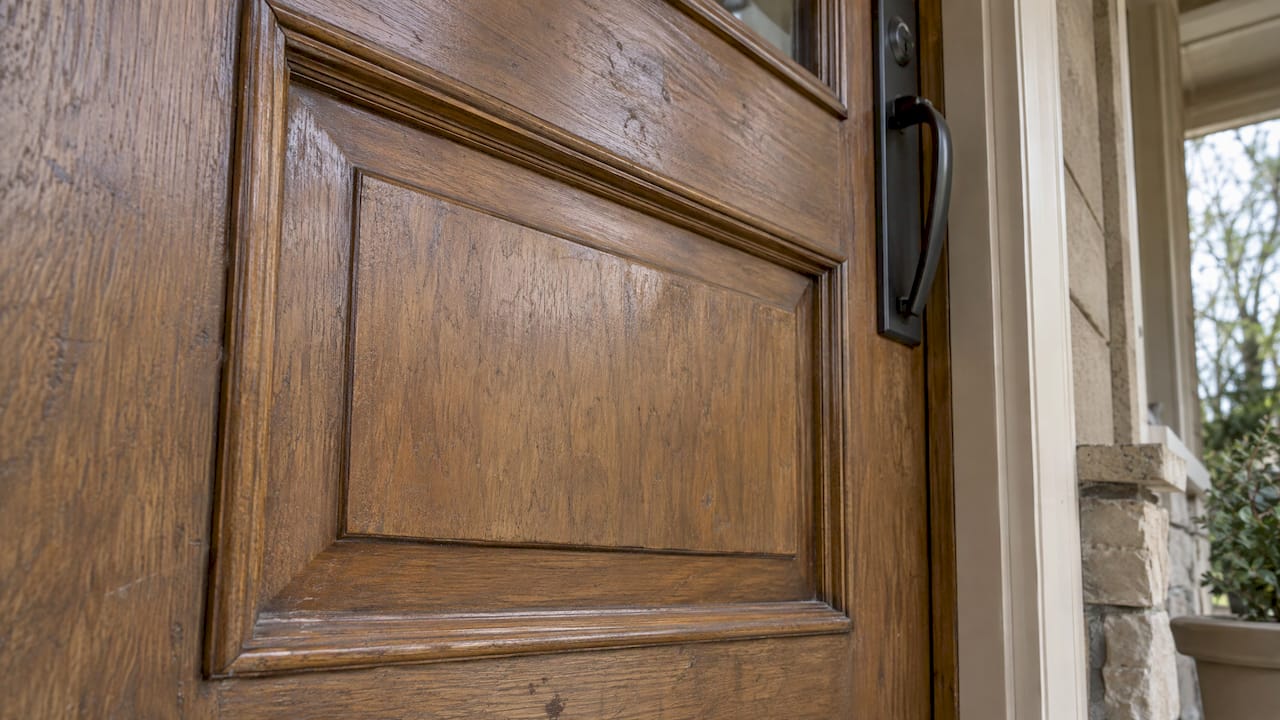
3. Panel layout and thickness. Stile and rail widths, the number of panels and the profile of the moldings give a door its shadow lines. Heavier moldings read as traditional; flat panels read as modern.
4. Glass. A door can carry a small window (a lite), a half-glass layout, a transom above or sidelights beside it. The glass type changes privacy and light.
5. Carvings and details. Hand-carved panels, applied moldings, decorative clavos (nail heads), speakeasy grilles and custom hardware backplates all add personality.
6. Finish and color. A natural stain shows the grain; paint hides it and gives a bold color. Both work, with different upkeep.
7. Hardware. Hinges, handle sets, deadbolts, kick plates and a house number are part of the design, not afterthoughts. Finish hardware to match other fixtures on the porch.
A useful exercise before you talk to anyone: photograph your house from the street, note the dominant lines (horizontal, vertical, arched) and the materials already present (brick, siding, stone). The door should answer those lines, not fight them.
Choosing wood for Illinois weather
Central and northern Illinois give a door a hard job. Winters bring freeze and thaw, summers bring humidity, and a south or west-facing entry takes direct sun for hours. Wood swells and shrinks with moisture, so species choice is really about stability and rot resistance.
A Chicago lumber supplier’s species guide names white oak, western red cedar and ipe as strong performers for Chicago weather, and genuine mahogany as excellent for entry doors. The same guide credits genuine mahogany with excellent dimensional stability and rot resistance. Craftsmen interviewed by This Old House echo the point: one says mahogany holds up even if its finish fails, and Spanish cedar and redwood are also favored for natural rot resistance.
Here is how those options compare in practice.
| Species | Look | Why it suits Illinois | Keep in mind |
|---|---|---|---|
| White oak | Tight, straight grain, warm tan | Named among the better performers for Chicago weather | Takes stain well; looks best with a clear or tinted finish |
| Western red cedar | Light reddish tone, fine texture | Naturally resistant to decay | Needs UV-protective sealer every 2 to 3 years |
| Ipe | Dense, dark brown | Named among the better performers for Chicago weather | Very hard, so it demands skilled machining and fitting |
| Genuine mahogany | Rich red-brown, even grain | Excellent dimensional stability and rot resistance | Carries a premium look and often a premium price |
| Spanish cedar, redwood | Warm, lighter reds | Favored by craftsmen for natural rot resistance | Availability varies |
Species is only half of the story, though. A door that sits under a deep porch roof lives a very different life from one facing a driveway with no overhang. We wrote about this on our own site: why species alone are not enough for humidity in Central Illinois. Sealing all six faces of the door, including the top and bottom edges, is the habit that separates a door that lasts from one that wicks moisture through its end grain.
Finishes that protect the door
Think of the finish as the skin and the wood as the bones. When the skin fails, the bones take the weather.
For a clear-coated or stained door, This Old House recommends marine-grade finishes with UV blockers to get the longest life, with exterior-grade paint and spar varnish as other options. Sunlight breaks down the finish first and the wood second, so UV protection is not optional on an entry that gets afternoon sun.
A few practical points follow from that:
- Clear or natural finishes show off the grain but need the most frequent attention, especially on a sunny exposure.
- Paint gives a solid, protective film and a free choice of color, and it hides small color differences between boards.
- Clear varnish or polyurethane gives a protective layer while showing the natural texture of the wood, according to This Old House’s guide to wooden front doors.
- Finish every edge before the door is hung. Once it is in the frame, the top and bottom edges are almost impossible to seal properly.
If you are planning other exterior updates at the same time, a look at current remodeling material trends can help you coordinate door finishes with siding, trim and hardware choices.
Decorative glass, carvings and other details
Glass is where a front door gets most of its personality, and also where most of the trade-offs live. Window + Door’s guide to decorative glass says homeowners can use acid-etched or sandblasted glass and ceramic-frit coatings, and should weigh privacy, light transmission, exterior suitability and structural integrity. In short, the look you want has to be balanced against what the door has to do every day.
Common decorative glass options include clear, frosted, stained, leaded and textured glass, as listed in the This Old House buying guide. Here is how to think about each one at a front entry:
- Frosted or acid-etched: soft light, strong privacy, a clean modern or traditional look depending on the pattern.
- Textured: hides the view in while letting daylight into the hall.
- Leaded or stained: the most traditional and the most visually rich. For ideas on how colored glass panels work in a home, see these stained glass decorating ideas.
- Clear: maximum light, minimum privacy; best with a transom or sidelight placed above eye level or paired with a screen.
Two questions settle most glass decisions. Who can see in from the street or the neighbor’s yard? And how dark is your entry hall without it? Answer those and the glass type usually chooses itself.
Carvings follow the same logic. A deeply carved panel is beautiful, but every recess holds water and dust. On a covered porch that is fine. On an exposed entry, a shallower carving or applied molding with a well-sealed finish is the more durable choice.
Glass placed near a door often needs to be safety glazing as well. We cover that in the next section.
Measure before you order anything
Most custom door problems start with the opening, not the door. Older Illinois homes in particular rarely have openings that are perfectly square, because houses settle over a century. A custom door gives you the chance to build for the opening you actually have.
This Old House’s guide says to measure the rough opening and jamb width, confirm the door’s handing and swing, and check whether the opening is square and level. Turn that into a short checklist:
- Rough opening width and height. Measure at the top, middle and bottom, and at both sides. Record the smallest numbers.
- Jamb width. This is the wall thickness from interior finish to exterior finish, and it determines how the frame and trim fit.
- Handing and swing. Stand outside. If the hinges are on your left and the door swings toward you, that is a left-hand door. Note whether it opens in or out, and what it clears when open.
- Square and level. Check the diagonals of the opening and the level of the sill. Differences tell the carpenter how much shimming and scribing the install needs.
- Threshold and sill condition. Soft or stained wood under the old threshold is a sign of water damage that should be repaired before the new door goes in.
- Clearances. Note storm door swing, porch railings, light fixtures and the interior wall behind the door.
Take photos of each measurement with the tape in view. They help when you review the order with a carpenter and prevent arguments about numbers later.
Permits, safety glazing and energy rules in Illinois
Illinois does not have a single front door rule that applies in every town. Building requirements are adopted and enforced locally, so the village or city where you live sets what you need to do. The Village of Westmont is a useful example of what a municipality may ask for. Its window and exterior door guidelines require a permit application and manufacturer specification sheets showing energy data.
The same document says that U-factor or SHGC must comply with the adopted IECC (International Energy Conservation Code) requirements. It also requires safety glazing in specified locations, including windows less than 5 feet above the walking surface and within 2 feet of either side of a door swing.
What that means for a custom door project:
- Call your building department first. Ask whether a replacement door needs a permit, what documents they want, and which energy code edition applies.
- Get the specs in writing. A custom door with glass should come with performance data (U-factor and SHGC) for the glass package, since an inspector may ask for it.
- Plan safety glazing early. If you want a sidelight or a decorative window beside the door, its glass may need to be tempered or laminated. Decorative glass can usually be made in safety glazing, but it has to be specified at the start, not after the design is approved.
- Historic districts add a layer. If your home sits in a locally designated district, there may be design review for visible exterior changes. Check before ordering.
These requirements are examples from one Illinois municipality and may differ where you live. Your local building department is the authority on yours.
Installation: where a custom door succeeds or fails
A well-made door hung badly will bind, leak or let in drafts. Installation is its own craft, and it is where finish carpentry experience pays off.
The work involved typically includes:
- Removing the old door, frame and casing without damaging the surrounding siding, brick molding or interior plaster.
- Repairing any rot or water damage in the sill and framing.
- Setting the frame plumb and level, with shims in the right places so the door does not bow when the weather changes.
- Flashing and sealing the sill and head so water runs away from the opening.
- Fitting the door with an even reveal on all sides, so it swings freely and closes without rubbing.
- Installing the lockset and strike plate securely into solid framing.
- Trimming the interior and exterior to match, and painting or finishing the trim.
We handle custom door installation and the finish carpentry around it, and you can see more about our door installation work for homes in the Peoria area. For a historic home, the trim and casing often matter as much as the door. Our historic home maintenance work reflects the same approach: repair and match what is there rather than replace it with something generic.
Keeping a wooden front door beautiful
Maintenance is a rhythm, a marathon, not a sprint. According to This Old House, wood entry doors need periodic cleaning, refinishing with stain or paint, and inspection for damage or wear. A simple annual routine keeps small problems small.
Each spring and fall
- Wash the door with mild soap and water, and rinse well.
- Inspect the finish for chalking, dull spots, cracks or peeling, especially on the lower rails and any sun-facing surface.
- Look at the bottom edge, the threshold and the lower corners for dark staining or soft spots.
- Check weatherstripping and the door sweep, and replace them if they have flattened.
Every few years
- For cedar, renew UV-protective sealer every 2 to 3 years, as the Chicago species guide advises.
- For any clear-coated door, refresh the topcoat before the finish breaks through to bare wood. Recoating a sound finish is far easier than stripping a failed one.
When to call a carpenter
- The door sticks in humid weather and swings freely in winter, which suggests the frame has moved or the door has absorbed moisture.
- You see gaps of light around the frame.
- The finish has peeled to bare wood.
Early attention is almost always cheaper than waiting for the finish to fail.
Our perspective: fit and finish decide how long a door lasts
We have more than 100 years of combined carpentry experience on our team, and the lesson that repeats is this: the door itself is rarely what fails first. The opening, the flashing, the trim and the finish on the edges nobody sees are where problems begin.
That is why we treat a custom front door as a small carpentry project, not a delivery. A good design consultation starts with the house: its age, its proportions, the porch, the light and the materials around the entry. From there we help you choose a design, a species and a finish that suit Central Illinois weather, and we plan the fit so the door opens cleanly for years.
We work on historic homes and on newer builds, and we approach both with the same respect for the structure. If the sill needs repair or the casing needs to be matched to the existing trim, we handle it as part of the job. Quick turnaround and sensible budgets matter to our clients, and a carefully planned install is the best way to deliver both.
Wood
Plan your entry with us
If you are planning a custom wooden front door in Central Illinois, we can help with the design consultation, the door installation and the finish carpentry that makes the entry look finished. Tell us about your house, your style and your budget, and we will walk through the options.

See our custom door installation services or start from our main page to describe your project. Prices are quoted per project, so the best first step is a conversation about your opening.
FAQ
What is the best wood for a front door in Illinois?
White oak, western red cedar, ipe and genuine mahogany are the species recommended for Chicago-area weather in a regional species guide. Mahogany is singled out as excellent for entry doors because of its stability and rot resistance. The right choice also depends on how much shelter your porch gives the door and whether you prefer a natural or painted finish.
How often does a wooden front door need to be refinished?
It depends on the species, the finish and the sun exposure. Cedar needs fresh UV-protective sealer every 2 to 3 years, according to the same species guide. For any door, spring and fall inspections will show whether the finish is dulling, so you can recoat before bare wood is exposed.
Do I need a permit to replace a front door in Illinois?
It depends on your municipality. Westmont, for example, requires a permit application and manufacturer specification sheets with energy data for windows and exterior doors. Call your local building department before you order so the door and its glass meet local requirements.
What measurements do I need for a custom front door?
Measure the rough opening, the jamb width, the handing and swing, and check that the opening is square and level, as outlined in this buying guide. Record several measurements across the opening and use the smallest. A carpenter should confirm them on site before the door is built.
Can a decorative glass door still be private?
Yes. Frosted, acid-etched, textured, leaded and stained glass all let in light while limiting the view, and Window + Door’s guide says privacy and light transmission are the key trade-offs to weigh. Glass near the door may also need to be safety glazing under local code.
Sources
- Wood species guide: choosing the right lumber for Chicago
- Wood Entry Door Materials and Finishes, This Old House
- A Guide to Wooden Front Doors: Cost, Safety, and Buying, This Old House
- At Home with Decorative Glass, Window + Door
- Window and Exterior Door Specifications, Village of Westmont
- Artful home decorating ideas using stained glass panels
- Remodeling material trends