Inset cabinets set each door and drawer front inside the face frame, so the frame stays visible and everything sits flush. Overlay cabinets put the doors in front of the frame, covering part of it (partial overlay) or nearly all of it (full overlay). Inset is the tailored, period look and asks the most of the builder. Full overlay is the clean, modern look with more usable interior and more forgiveness in the fit. Partial overlay is the traditional, practical middle of the road. Which one is right depends on your kitchen’s size, your budget and the house around it, and the right carpenter will tell you so before a single board is cut.
We build and install cabinetry for homes and small businesses across Central Illinois, so this guide is written the way we would explain it at your kitchen table.
TL;DR
- Inset: doors sit flush inside the face frame. Timeless and precise, but it takes the tightest fit and a little interior space.
- Full overlay: doors cover almost the whole frame, leaving narrow, even gaps. Clean lines, more usable storage, more forgiving of small errors.
- Partial overlay: doors cover only part of the frame, leaving a band of it showing. The traditional, practical choice for many budgets.
- Reface or replace: if your cabinet boxes are sound and the layout works, new doors and drawer fronts can change the style without a full tear-out.
- Fit decides the look: whichever style you choose, even gaps and square boxes are what make it read as custom.
Table of Contents
- What each style actually looks like
- Side-by-side comparison
- Why inset costs more: the fit
- Storage space: what you gain and lose
- Maintenance and day-to-day living
- Which style suits your home
- Do full overlay cabinets look cheap?
- Reface, replace or paint?
- What to ask before you sign
- Talk to a carpenter about your kitchen
- FAQ
- Sources
What each style actually looks like
Start with the part of the cabinet you cannot change easily: the box. Many American cabinets are built with a face frame, a narrow wooden border across the front of the box. Others are frameless, with no border, and the doors attach to the box sides. The door style you pick is really a question of how the door relates to that front edge.
Inset
An inset door sits inside the frame opening, like a window in a wall. When closed, the door face is level with the frame, and the frame shows as a border around every door and drawer front. Hinges are often visible, either decorative surface hinges or barrel-style knuckles, though concealed inset hinges exist too. Because the door lives inside the opening, inset is only possible on face-frame cabinets.
This is the oldest way of building cabinetry in the American home. Inset suits Shaker, farmhouse, Georgian, Federal, and Colonial interiors, and it is the usual answer when a kitchen needs to feel like it belongs to a historic house.
Full overlay
A full-overlay door sits on the front of the cabinet and covers nearly all of the frame, or the whole box front on frameless cabinets. What you see is a nearly continuous plane of doors and drawer fronts separated by narrow, even reveals. A reveal is the visible gap between two doors or between a door and the cabinet edge. This is the look most people picture when they say “modern” or “transitional” kitchens, and it works with either framed or frameless boxes.
Partial (standard) overlay
A partial-overlay door covers only part of the frame, so a band of frame shows around and between the doors. According to a kitchen designer interviewed by House Beautiful, it is the style common in American kitchens and the only type that can be opened without hardware, because you can get your fingers behind the door edge. Kitchens built before the 1990s very often use it, which is worth knowing if you plan to refresh one without rebuilding.
Side-by-side comparison
| Inset | Full overlay | Partial overlay | |
|---|---|---|---|
| Door position | Inside the face frame, flush | Covers nearly all of the frame | Covers part of the frame |
| Frame visible? | Yes, as a border | Barely | Yes, a clear band |
| Works on | Face-frame boxes only | Framed or frameless | Framed boxes |
| Interior opening | Smallest | Largest | In between |
| Fit tolerance | Very tight | Forgiving | Most forgiving |
| Typical character | Classic, tailored, period | Clean, modern, transitional | Traditional, practical |
| Relative cost | Highest | Middle | Lowest |
The cost row reflects how much labor and precision each style asks for, not a price list. Your actual numbers depend on the wood, the finish, the number of drawers and the hardware.
Why inset costs more: the fit
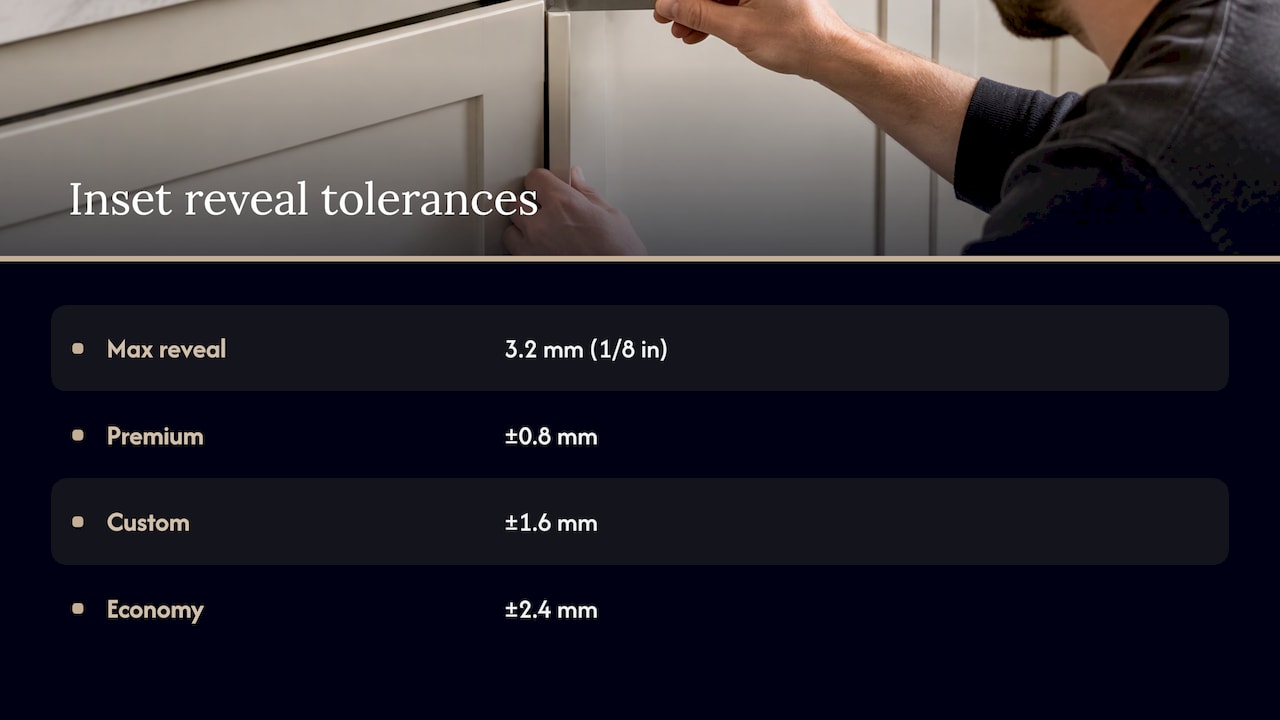
The price difference starts with tolerance, the amount of error a design can absorb. The Architectural Woodwork Institute, the trade body that publishes woodwork quality standards in the United States, sets a maximum uniform reveal for inset face-frame work at 1/8 inch (3.2 mm), with allowable variance that narrows as the grade rises: plus or minus 0.8 mm for premium work, 1.6 mm for custom and 2.4 mm for economy. That is a hair’s width. Every door must be cut square, hung square and sit in an opening that is square, in a house where floors and walls are rarely perfect.
Here is what that means in your kitchen. With a full-overlay door, a slight error disappears because the door covers the joint. With an inset door, the gap itself is the design. If one side is a sixteenth of an inch wider than the other, your eye finds it immediately across a row of identical doors. If the door is cut slightly too wide, it will not close at all.
That is why inset takes more hand-fitting, more careful machining and a builder who is comfortable adjusting on site. It is also why a well-made inset kitchen looks so good: the consistent gaps, the visible hinges and the flat plane are exactly the marks of craftsmanship people notice without being able to name.
Seasonal movement
Solid wood swells in humid summers and shrinks in dry winters. In the Midwest, that swing is real. Inset doors have very little room to move, so you may see a door that rubs in August and gapes in January. A good installer plans for it with proper gaps, finish on all sides of every door and hinges that can be adjusted. Overlay doors hide the same seasonal movement behind the frame, which is part of why they feel so easygoing.
Storage space: what you gain and lose
If you are trying to fit a family’s worth of pots, small appliances and pantry goods into a modest kitchen, this is the section to read twice.
A face frame narrows the opening of any cabinet box. With inset doors, the door also sits inside the opening rather than in front of it, so it takes a little depth from the interior. House Beautiful’s designer source notes that full overlay adds about an extra inch of interior space because the doors do not close into the cabinet the way inset doors do.
In practice:
- Drawers are where you notice it most. Inset drawer boxes must be narrower than the opening, so a drawer holds less than a full-overlay drawer in the same cabinet width.
- Wide items like sheet pans, large pots and platters may or may not clear the frame. Measure your largest pieces before you commit.
- Pullouts such as spice racks and trash bins fit more easily behind full-overlay doors where the opening is larger. If you like the idea, see our guide to spice rack pullouts: sizes, styles and built-in options.
The loss is modest in a large kitchen. In a small one, the extra inch matters. If storage is your main problem, full overlay with well-planned drawers usually gets you further than inset, and our carpenters can add interior organizers that make better use of the space you have.
Planning clearances around the cabinets
Whatever style you choose, doors and drawers need room to open. If your plan includes an island, check aisle widths and door swing before you finalize anything; a guide on kitchen island dimensions and clearances shows how aisle widths and heights are worked out. Full-overlay doors swing slightly wider than inset ones, and drawers need to open fully without catching an appliance handle.
Maintenance and day-to-day living
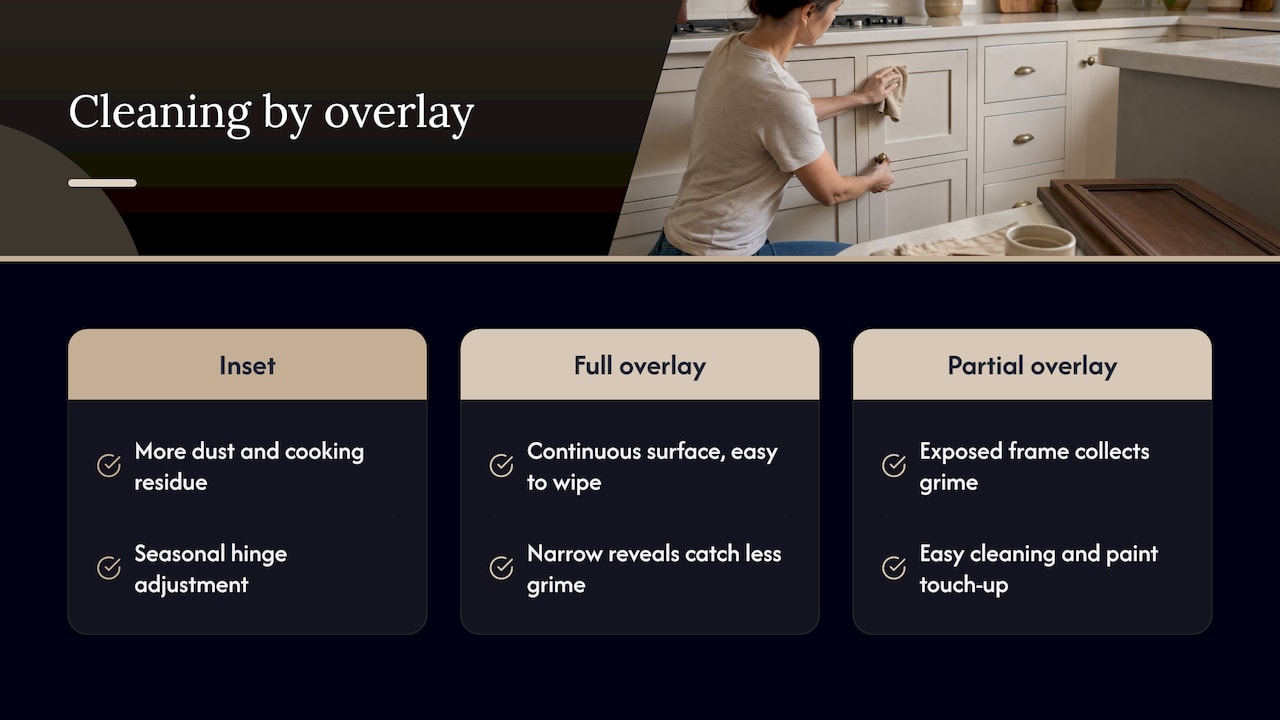
Inset: the recessed edges and visible frame collect a little more dust and cooking residue, so they need an occasional wipe with a soft cloth. Hinge screws may need a small adjustment with the seasons.
Full overlay: a continuous surface is simple to wipe and tends to be the lowest-fuss option. The narrow reveals have less to catch.
Partial overlay: the exposed frame is a place for grime to settle, but it is easy to clean and easy to touch up when painted.
Wood tone and finish matter more for daily life than the overlay type. A painted finish shows chips at the edges; a stained hardwood door hides wear better. When we talk through finish with a homeowner, we are picturing the kids, the dog and the Saturday pancake breakfast, not just a showroom photo.
Which style suits your home
Choose inset if
- Your house is a historic one, or a Shaker-, farmhouse- or Colonial-influenced home, and you want the kitchen to feel original.
- Your kitchen is large enough that a small loss of interior space is easy to absorb.
- You want the flush, furniture-like look and your budget includes the extra precision it needs.
Choose full overlay if
- You want a modern or transitional kitchen with clean lines.
- Storage is a priority, especially in a small or galley kitchen.
- You prefer a forgiving fit, particularly in an older house with walls that are out of square.
Choose partial overlay if
- You want a traditional look at the lowest cost.
- You are updating a kitchen on a budget and the existing boxes are in good shape.
- You like the farmhouse feel of a visible frame without paying for inset precision.
A useful test: stand in your kitchen and picture the rest of the room. If the trim, windows and floors are traditional, inset or partial overlay will feel at home. If the room is minimalist and open, full overlay will usually look more natural.
Do full overlay cabinets look cheap?
No. Full overlay is a style, not a quality grade. What makes cabinets look inexpensive is uneven gaps, thin doors that warp, hardware that sags and finishes that wear through at the edges. Solid wood doors, evenly hung, with consistent reveals, look excellent in either style. For a full-overlay kitchen the thing to watch is how evenly the doors line up, because the reveals are narrow and any wandering shows. The fit and the materials make the kitchen, not the overlay type.
Reface, replace or paint?
Many people searching for inset and overlay doors are really asking a larger question: do I need new cabinets at all? Here is the honest way to think about it.
Refacing keeps your existing cabinet boxes and swaps the doors, drawer fronts and hardware, with new veneer or finish on the visible frames. It works best when the boxes are solid and the layout already suits you. It is also the moment you can change overlay style, for example moving from a dated partial overlay to a cleaner full overlay look. It is less disruptive than a rebuild, because your countertops, plumbing and appliances usually stay where they are.
Replacing makes sense when the layout does not work, the boxes are damaged or sagging, or you want inset construction, which requires a face frame built to tight tolerances. Replacement is also the time to rethink storage: deeper drawers, a pantry pullout, a better corner solution. New boxes often mean adjustments to countertops and other trades, so plan for that in your timeline.
Painting is the lightest touch. If your doors are sound and you simply dislike the color, a professional paint job changes the room’s feel at the lowest cost. It does not change the door style, so a partial-overlay kitchen stays partial overlay.
A quick way to sort it out:
- Open the doors and drawers. Do they work smoothly, with boxes that are square and solid? If yes, refacing or painting is on the table.
- Look at the layout. Can you cook, store and move easily? If not, replacement is the path.
- Decide on the look. If you want inset, plan on new face-frame boxes or custom work.
- Set your budget, then ask for a written scope so you can compare apples to apples.
We offer cabinet refacing, cabinet replacement and cabinet painting in Central Illinois, so the recommendation can follow your kitchen rather than a one-size answer.
What to ask before you sign
A short list keeps any cabinet project on track:
- Which overlay or inset style, and what reveal size, is in the written scope?
- What species and thickness are the doors? Solid wood handles seasonal movement differently from sheet goods.
- Which hinges and drawer slides are included, and are the hinges adjustable?
- How will the installer deal with walls and floors that are out of square?
- What is the timeline, and who handles removal and finish work?
If a quote reads as a single number with no scope, ask for it in writing. Clear scope protects your budget more than any style choice does.
Our view on inset vs. overlay
We build custom carpentry for Central Illinois homes, and we are often asked which door style is best. Our answer is that the best cabinet is the one that fits your house and how you live in it.
Older homes in Peoria and Bloomington often have walls and floors that are not quite square. In those rooms a full-overlay door can give you clean lines without every gap having to be perfect, while inset rewards careful hand-fitting. We pair that with over 100 years of combined carpentry experience on our team, and we would rather talk through the room with you than push one style.
Storage matters just as much as looks. Families trying to get more from a small kitchen often do better with a layout built around their own items, drawers where they cook and pullouts where they reach. That is the kind of custom detail our design consultations are for.
Wood
Talk to a carpenter about your kitchen
If you are weighing styles for a kitchen in Central Illinois, we can walk through your cabinets, explain which options suit the room and give you a written plan. Our kitchen cabinet services in Peoria and Bloomington cover everything from new solid wood cabinets to refacing, and our kitchen renovation page shows how we work. Ask for a design consultation and bring photos, measurements and a list of what you store.
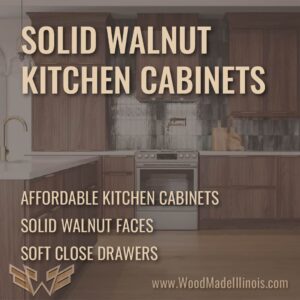
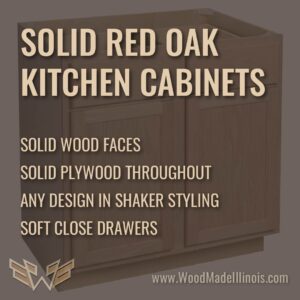
If you want to see solid wood options first, we build with red oak, hickory and walnut-faced shaker styles, such as our solid red oak kitchen cabinets.
FAQ
What is the main difference between inset and overlay cabinets?
Inset doors sit inside the face frame so they are flush with it, and the frame shows as a border. Overlay doors sit in front of the frame and cover part of it or nearly all of it. Inset needs a face frame and very precise fitting, while overlay is more forgiving.
Do inset cabinets lose storage space?
Yes, a little. The frame narrows the opening and the door sits inside it, so drawers and shelves are slightly smaller than in full overlay, which adds about an extra inch of interior space. In a large kitchen you will hardly notice. In a small kitchen, measure your biggest pots and pans first.
Can I change my cabinets from partial overlay to full overlay?
Often you can. Refacing replaces the doors and drawer fronts on boxes you already have, and full-overlay fronts can be used on framed boxes. A carpenter needs to check that the boxes are square and sound and that the hinges and drawer clearances will work. Inset is different, since it relies on a precisely built face frame.
Are inset cabinets worth the extra cost?
If you love the flush, furniture-like look and your home suits it, many homeowners feel they are. The higher cost comes from the tight tolerances the trade standard asks for, around 1/8 inch for the reveal. If budget is tight, partial or full overlay can look excellent in solid wood.
Should I reface or replace my kitchen cabinets?
Reface when the boxes are solid and the layout works and you want a new look. Replace when the layout, the boxes or the storage need to change, or when you want inset construction. Painting is the lightest option if you only dislike the color.
Sources
- ANSI/AWI 0620-2018 Finish Carpentry/Installation, Architectural Woodwork Institute
- Inset Cabinets vs. Full Overlay vs. Partial Overlay Cabinet Doors, House Beautiful