Hire a preservation-minded carpenter, not a general contractor, and require three things before any quote: a documented inspection of boards and framing, a written scope that separates salvage from replacement, and a clear plan for moisture and drainage. Repair comes first per National Park Service guidance, with replacement reserved for boards beyond saving, as explained in detail by One Day Doors & Closets. A contractor who skips lumber storage and acclimation details is skipping the step that determines whether your new floor lasts.
TL;DR:
- A thorough inspection must check framing, drainage, and moisture sources before any repair or replacement begins, as hidden rot influences the project scope and cost.
- Proposals should clearly document salvage priorities, material specifications, scope of framing repairs, and a detailed schedule, with missing elements warranting caution.
- Custom tongue-and-groove porch boards require time for milling, acclimation, and proper shipping, making schedule adjustments essential for project success.
- Warranties should explicitly cover materials and workmanship, with written terms that reflect a repair-first approach and ongoing maintenance needs.
- Contractors with historic restoration experience tend to deliver more reliable results through detailed documentation, matching profiles, and a proven preservation-oriented mindset.
Table of Contents
- What to Look for in a Historic Porch Tongue and Groove Supplier
- What Happens During an Inspection and What the Scope Should Include
- Comparing Proposals and Scheduling the Work
- Overview of Leading Historic Porch Tongue and Groove Suppliers and Their Specialties
- Pricing and Cost Factors for Historic Porch Tongue and Groove Materials
- Ordering Process and Lead Times From Suppliers
- Shipping Options and Considerations for Historic Tongue and Groove Lumber
- Warranties and Guarantees Offered by Suppliers
- An Experienced Carpenter’s Approach to Historic Porch Work
- Request a Site Visit From Wood Made Illinois
- Sources
- FAQ
What to Look for in a Historic Porch Tongue and Groove Supplier
A porch floor is one of the most exposed wood surfaces on a historic house. It takes weather from four directions and often sits on framing nobody has inspected in decades. That makes the contractor selection process different from hiring someone to install a hallway floor, and it is worth screening candidates before you ever discuss pricing.
Look for these traits before you invite anyone to bid:
- A preservation-first philosophy, with working familiarity with National Park Service guidance on when historic wood flooring can be repaired versus replaced.
- A visible portfolio of historic porch, millwork, or window restoration work, plus references you can actually call.
- An inspection process that covers framing and drainage, not just the visible boards.
- A written scope that lists salvage candidates, replacement sections, documentation steps, and what happens to the original material.
- A materials strategy that names the species, grain orientation, and whether boards will be reclaimed, new, or treated.
The table below breaks these criteria into what a strong proposal actually documents.
| Criterion | What a strong proposal documents |
|---|---|
| Preservation approach | Repair-first, with replacement scoped only where boards fail inspection |
| Experience | Named historic porch or millwork projects, with references |
| Inspection & scope | Written report covering boards, joists, and drainage, delivered before pricing |
| Materials & matching | Species, profile, vertical-grain option, reclaimed vs. new stated explicitly |
| Moisture & framing | Drainage source identified, framing repairs scoped separately from decking |
| Warranty & maintenance | Written terms on workmanship and a maintenance schedule |
| Timeline | Site-dependent estimate, not a flat national number |
A proposal missing more than one of these rows is worth a second look before you sign anything.
What Happens During an Inspection and What the Scope Should Include
A real inspection is slower than most homeowners expect, and that is the point. Preservation Brief 45 lays out why: replacing boards without fixing the cause of their failure just restarts the decay clock, according to National Park Service guidance. A contractor who only measures square footage and quotes a price is skipping the work that protects your investment.
Expect the inspection and scope to cover, in order:
- A framing and joist check to confirm the structure under the boards is sound, since hidden rot changes the entire job’s cost and sequence.
- A board-by-board assessment marking each piece as salvageable, a candidate for localized repair, or due for full replacement.
- Documentation, including labeled photographs and a measured pattern, so removed boards can serve as a template for replacements.
- Temporary stabilization notes for porch posts or columns if the framing work requires it.
- A moisture history review, identifying drainage sources and flagging whether further structural investigation is warranted.
If your proposal skips the photographs and labeling step, ask why. It is standard practice among preservation-minded crews and costs almost nothing to include.
Comparing Proposals and Scheduling the Work
Line up bids side by side and check that each one addresses the same scope items: salvage versus replacement, materials specification, framing repairs, finish work, and disposal of removed material. A lower number that skips framing repair is not actually a lower price. It is a smaller job.
No legitimate contractor will give you a firm number without seeing the porch. Historic framing conditions vary too much for a flat national rate, and a site visit is what turns a rough estimate into an accurate one.
- Request that each bid separate salvage work from replacement work, with unit pricing where possible.
- Confirm the schedule allows lumber to acclimate on site, since equilibrium moisture content shifts with storage conditions and rushing this step causes joints to fail later.
- Ask how the contractor stores lumber before installation and whether that storage matches your climate.
- Before signing, confirm the contract includes payment milestones, a change order process, proof of insurance, and written warranty language.
Overview of Leading Historic Porch Tongue and Groove Suppliers and Their Specialties
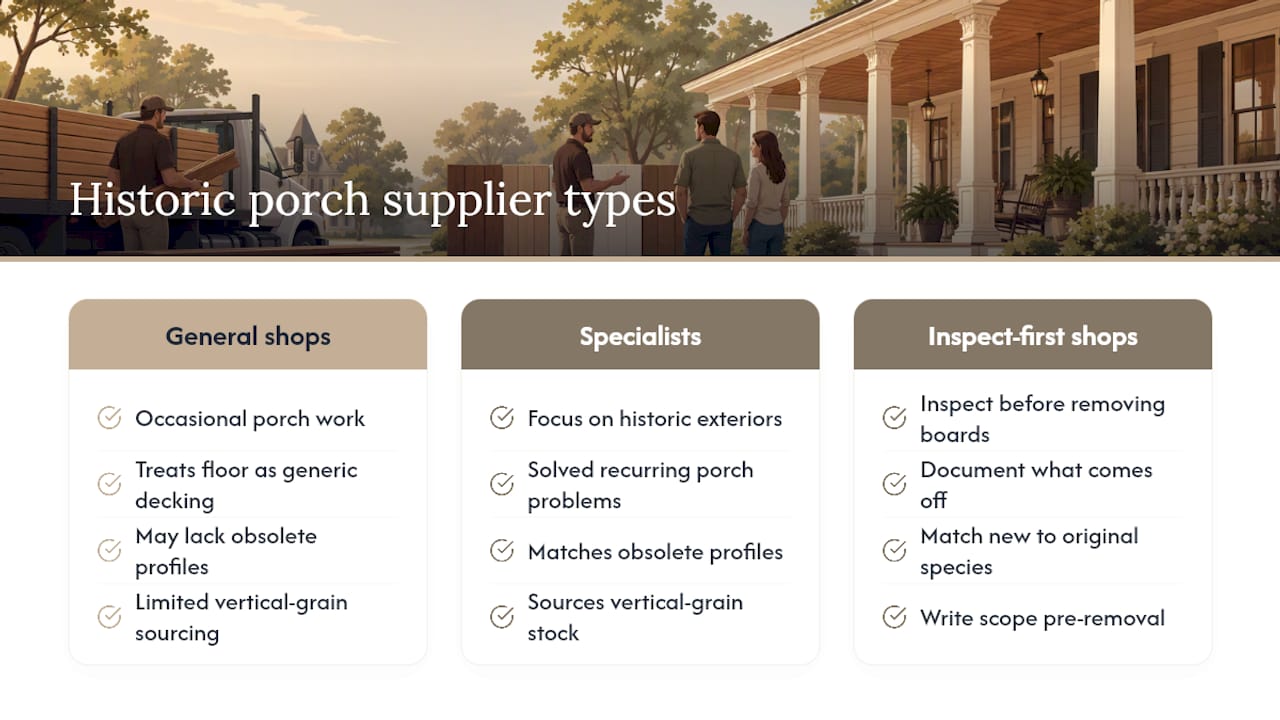
Contractors working in this niche tend to split into two groups: general millwork shops that occasionally take on porch restoration, and specialists who focus almost entirely on historic exteriors. The second group usually brings more value, because they have already solved the recurring problems, matching an obsolete profile, sourcing vertical-grain stock, and diagnosing why a floor failed in the first place.
Regional differences matter here. A contractor in a humid coastal market will have more experience with drainage-driven decay, while one working inland may see more UV and thermal-cycling damage. What matters most is not geography but whether the contractor can show you a completed porch restoration and explain the decisions behind it, not just the finished photos.
Some specialized carpentry services approach porch and millwork projects by inspecting first, documenting what comes off, and matching new material to the original profile and species wherever the boards are sound enough to inform that match. That is a different posture than a shop that treats a porch floor like a generic decking job, and it shows in how the scope gets written before a single board is pulled.
Pricing and Cost Factors for Historic Porch Tongue and Groove Materials
There is no flat national price for this work, and any contractor who quotes one over the phone is guessing. Costs shift based on how much of the original framing survives inspection, how many boards need custom milling to match an obsolete profile, and whether the project calls for reclaimed stock, treated lumber, or a decay-resistant species substitution allowed under NPS 2025 guidance.
Material choice is the biggest cost lever after labor. New vertical-grain fir or pine milled to match a historic profile costs more per board foot than standard decking stock, but it holds paint and resists cupping better over time. Reclaimed lumber can look right immediately, but it requires inspection for powderpost beetle activity and often kiln-drying before reuse, both of which add cost that a low bid may be quietly skipping.
Framing repair is the other variable that swings a price up fast. A porch that only needs decking replaced is a modest job. One where joists have rotted from years of trapped moisture turns into a structural repair project first and a flooring project second. That is exactly why a site inspection has to happen before pricing, not after.
Ordering Process and Lead Times From Suppliers
Custom-profile porch boards are not a shelf item. Once your contractor’s inspection identifies the exact tongue-and-groove profile, width, and species needed, that specification typically goes to a mill for custom-run production, which takes longer than picking up standard decking at a lumberyard.
Lead time depends on whether the match requires custom milling knives to reproduce an obsolete profile, whether the species is readily available, and how much volume the mill is running. Reclaimed material can sometimes ship faster if a supplier already has matching stock in inventory, but verified, treated reclaimed lumber is less predictable to source on short notice.
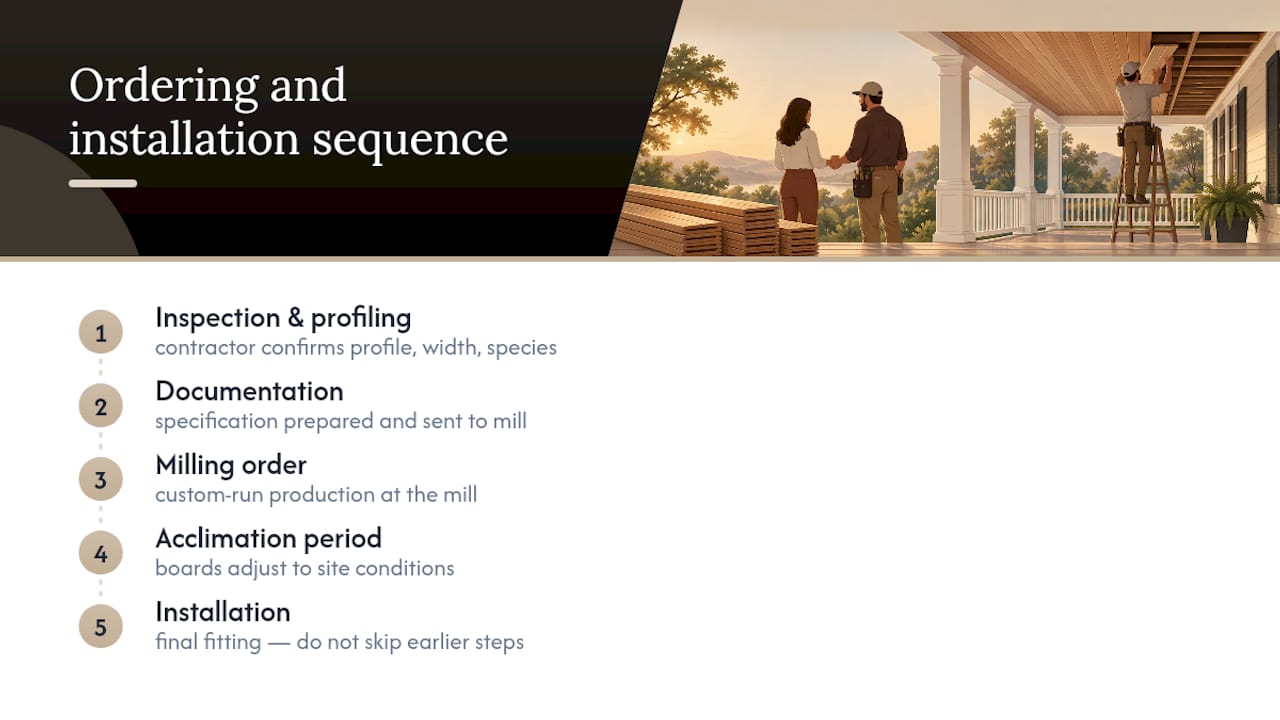
Build ordering time into your project schedule from the start. A contractor who tells you decking will be ready in a week, before the profile has even been confirmed by inspection, is setting an expectation they may not be able to meet. The realistic sequence is inspection, documentation, milling order, acclimation period, then installation, and skipping steps to compress that timeline is where problems start.
Shipping Options and Considerations for Historic Tongue and Groove Lumber
Long, custom-milled boards need careful handling in transit. Tongue-and-groove stock is more vulnerable to edge damage than flat dimensional lumber, since a dinged tongue or groove can make an entire board unusable for a tight historic fit.
Climate exposure during shipping matters as much as the physical handling. Lumber that reaches your site with the wrong moisture content will move after installation regardless of how carefully it was milled, which is why equilibrium moisture content has to factor into how material is packaged and transported, not just how it is stored once it arrives.
Ask your contractor how shipped material will be protected from rain and temperature swings between delivery and installation, and how long it will sit on site before the acclimation period even starts. A vague answer here usually signals the same gap you would find if you asked about storage.
Warranties and Guarantees Offered by Suppliers
Warranty language on historic porch work should cover two separate things: the materials and the workmanship. A lumber warranty typically addresses manufacturing defects, not moisture-related movement caused by poor storage or a rushed acclimation schedule, so read the fine print before assuming coverage extends further than it does.
Workmanship warranties vary more by contractor than by supplier, and this is where a preservation-focused crew tends to differentiate itself. A contractor confident in a repair-first approach will typically stand behind that work in writing, often with a maintenance schedule attached, since porch floors need periodic attention regardless of how well the original installation was done.
Ask for warranty terms in writing before signing, not as a verbal assurance during the sales conversation. If a contractor cannot produce written language on workmanship coverage, that omission tells you something about how the rest of the project will be documented.
An Experienced Carpenter’s Approach to Historic Porch Work
Experienced carpentry teams bring extensive combined carpentry experience to projects, which shows up most clearly in how documentation gets handled before a single board comes off a porch. Custom milling to match an existing profile, careful board-by-board assessment, and a repair-first mindset are not extra steps tacked onto a job. They are the job.
Homeowners considering historic home maintenance work benefit from a contractor whose portfolio already includes historic renovation and hardwood floor repair, because that history lowers the number of surprises mid-project. A personalized consultation before work begins means the scope gets written around your actual porch, not a generic template.
— Wood
Request a Site Visit From Wood Made Illinois
Woodmadeillinois offers on-site inspection and a written scope for porch restoration, which means you get a documented repair-first plan before any commitment to full replacement.
To request a visit, send along a few photos of the porch, its approximate dimensions, and anything you know about its age or past repairs. That information lets the team scope the framing and drainage questions ahead of time instead of discovering them on site. If framing damage turns out to be part of the picture, related work like storm damage repair can be scoped in the same visit rather than as a separate project later. Reach out through Woodmadeillinois to schedule an inspection and get a written scope started for your porch.
Sources
- Historic wood flooring and the use of substitute flooring materials — National Park Service
- Understanding equilibrium moisture content — Penn State Extension
FAQ
Should a historic porch floor be repaired or replaced?
Repair is preferred whenever boards can be reasonably saved, with replacement reserved for material beyond repair, according to National Park Service guidance. A qualified contractor documents this decision board by board rather than defaulting to full replacement.
What should be in a written scope before hiring a contractor?
A solid scope separates salvageable boards from replacement sections, documents framing and drainage findings, and specifies the species and profile for any new material. It should also state what happens to boards that come off the porch, since labeled originals often serve as the pattern for replacements.
How long does historic porch restoration take?
Timelines are site-dependent, since framing condition, board matching needs, and lumber acclimation all vary by project. A contractor cannot give an accurate schedule without a physical inspection first.
Why does lumber need to acclimate before installation?
Wood adjusts to its surrounding humidity to reach equilibrium moisture content, and skipping this step causes boards to shift or joints to fail after installation, per Penn State Extension. A contractor should explain how material will be stored and for how long before work begins.
Does Woodmadeillinois handle historic porch restoration?
Woodmadeillinois provides historic home maintenance and hardwood flooring services across Central Illinois, including inspection and documentation for porch and millwork projects. Pricing depends on project scope, and current details are available directly through Woodmadeillinois.