For most shoppers, a multi-slot wooden rack or a floating picture ledge covers nearly every display need, and the choice between them comes down to three considerations: slot width against your plate diameters, mounting method against your wall type, and finish against your room. Before you buy, confirm the mounting height sits near 57 to 60 inches at eye level, space plates about 2 inches apart, and anchor into studs rather than drywall alone.
TL;DR:
- Measure actual plates before buying, and choose slots wide enough for each piece to slide out without scraping its neighbors.
- Set the visual center 57 to 60 inches above the floor, leave about 2 inches between plates, and test layouts with paper cutouts before drilling.
- Anchor wall racks into framing, not drywall alone; use a backing plate when hardware misses, and seek professional installation for metal frames or plaster.
- Choose wooden slots for kitchen use, with a sealed or painted finish near moisture; ledges allow easy rearrangement, while metal holders suit heirloom plates.
- Custom carpentry suits unusually wide walls, trim conflicts, heavy stoneware, or oversized platters when standard racks do not fit; pallet wood accents start at $500.
Table of Contents
- Popular plate rack styles and materials to consider
- Sizing, slot spacing, and how to measure your plates and wall
- Mounting, anchors, and safety essentials for wall-mounted racks
- Where to buy, typical price bands, and what to check before purchase
- Plate wall templates and composition rules to copy
- Why consider a custom carpentry solution rather than an off-the-shelf rack
- How Wood Made Illinois helps with custom plate racks and built-in displays
- FAQ
- Sources
Popular plate rack styles and materials to consider
Walk into any home goods aisle and you will find several basic families of plate display hardware, each suited to a different kind of kitchen or wall.
- Open multi-slot wooden racks hold a row of plates upright in grooved slots; they suit everyday use in rustic or farmhouse kitchens and hold up well with an occasional wipe and a yearly coat of oil or wax.
- Floating picture ledges let you lean plates against the wall alongside art or photos, which makes them easy to rearrange and a natural fit for a dining room gallery wall rather than a working kitchen.
- Wrought-iron or metal single-plate holders cradle one plate at a time on a small stand or wall bracket, a traditional choice for heirloom china or a vintage-style collection wall.
- Tiered wall racks and hanging hooks adapt to oddly shaped plates, platters, or saucers that will not sit flat in a standard slot.
Wood holds up best away from steady moisture, so a plate rack near a sink or stove benefits from a sealed or painted finish rather than raw wood. Metal holders need only occasional dusting but can mark softer plaster walls if the bracket shifts, so a secure, level mount matters even for lightweight pieces. Ledges are the lowest-maintenance option of the group since there is no hardware gripping the plate itself.
Sizing, slot spacing, and how to measure your plates and wall
Before ordering a rack, measure the actual plates you plan to display rather than guessing from the box label. Plate sizes vary, and the rack’s slot width needs to match whichever size dominates your set.
- Allow enough slot width per plate so each piece slides out without scraping its neighbor.
- For a wall display rather than a slotted rack, size your layout using plate diameter plus a 2-inch gap, multiplied by the number of plates in a row.
- Keep the visual center of the arrangement near 57 to 60 inches from the floor, the same eye-level guideline decorators use for framed art.
Pro Tip: Cut paper circles matching your plate diameters and tape them to the wall in your planned layout before you drill a single hole.
Mounting, anchors, and safety essentials for wall-mounted racks
A rack only looks good as long as it stays on the wall, and that comes down to what is behind the drywall, not the drywall itself. Drywall alone, even with heavy-duty anchors, was never built to carry the structural load of a full rack loaded with plates; carpentry and mounting experts recommend anchoring into studs or adding a backing plate instead.
For wood-framed walls, lag bolts driven into studs give the most reliable hold, and professional installation guidance for heavy wall fixtures recommends a 3/4-inch plywood backing plate across studs when needed. Concrete or masonry walls call for Tapcon-style anchors sized to the manufacturer’s bolt diameter. Metal stud framing or plaster-and-lath walls, common in older homes, often need a backing plate or a professional install rather than a standard anchor kit.
- Locate studs with a stud finder and mark their centers.
- Measure and mark your mounting height at 57 to 60 inches.
- Check the rack’s hardware against your wall type (wood, masonry, metal stud).
- Pre-drill pilot holes slightly smaller than your bolts or anchors.
- Mount a backing plate first if your studs do not line up with the rack’s hardware.
- Hang the rack empty first and test its hold before loading plates.
Pro Tip: For a wide array, a heavy antique set, or plates you consider irreplaceable, hiring a carpenter to build a stud-backed, built-in solution removes the guesswork entirely.
Where to buy, typical price bands, and what to check before purchase
Pricing on plate racks spans a wide range depending on material and craftsmanship. Mass-market wooden racks and single metal plate holders generally sit at the budget end, floating picture ledges run a step up depending on length and finish, and handmade or custom-built installations command the highest prices because they are sized and finished to your exact wall and plates.
- Mainstream home decor retailers carry the widest selection of off-the-shelf wooden and metal racks.
- Online marketplaces are useful for comparing styles and reading buyer feedback on hardware quality.
- Craft and maker marketplaces are a good source for handmade racks in specific wood species or finishes.
- Local carpenters are the right call when your wall, plates, or trim do not match a standard product.
Before you check out, confirm the slot spacing matches your plates, measure the rack’s overall width against your wall space, verify mounting hardware is included, ask about finish durability for kitchen humidity, and check the return policy along with any shipping or installation fees.
Plate wall templates and composition rules to copy
A plate wall reads as intentional when it follows a repeatable structure rather than a scattershot arrangement of whatever you own.
- Single row along a mantel or shelf edge works well for a small, matched set and keeps the eye moving in one line.
- Symmetrical grid suits a formal dining room; even spacing and matching plate sizes carry the look.
- Staggered cluster mixes plate sizes and heights for a more casual, gallery-style wall.
- Mixed ledge and plates combines framed art or photos with leaning plates for a layered, collected-over-time feel.
Whichever template you choose, keep the visual center near 57 to 60 inches and hold plates about 2 inches apart, the same spacing standard used for framed art walls. When mixing sizes and patterns, anchor the arrangement with one or two statement plates and repeat a color or motif across the smaller pieces so the grouping reads as one composition rather than a random collection.
Pro Tip: An odd number of plates in a cluster can feel more balanced to the eye.
Why consider a custom carpentry solution rather than an off-the-shelf rack
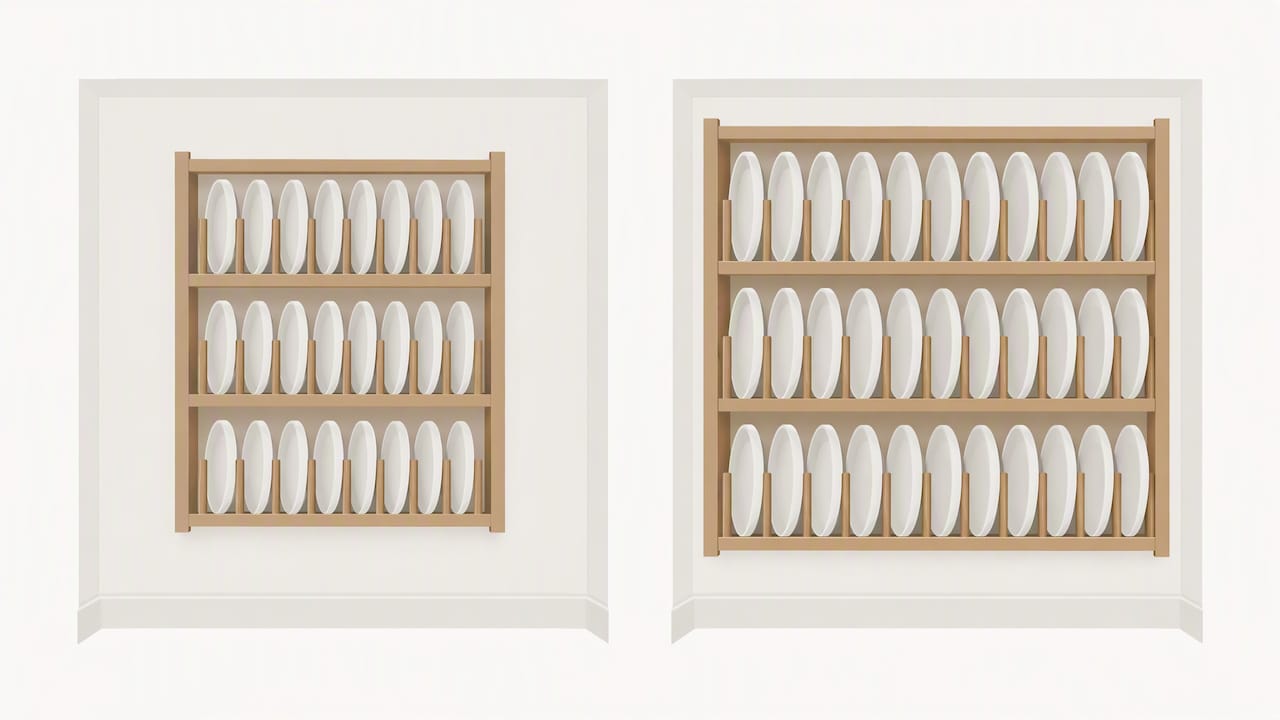
Off-the-shelf racks assume a standard wall and a standard plate. Plenty of homes do not have either. An unusually wide or narrow wall, trim that a stock rack would have to notch around, heavier stoneware or oversized platters, or a finish that needs to match existing cabinetry are all situations where a built piece outperforms a boxed one.
We approach every plate rack project with a personalized design consultation, working in pallet wood or solid wood depending on the look you want. If your wall or your plates do not fit a catalog listing, the next step is simple: measure the space, photograph the plates you want to display, and request a design consult.
— Wood
How Wood Made Illinois helps with custom plate racks and built-in displays
We build plate racks and display shelving to suit your wall and finish preferences.
- Custom shelving and built-ins sized to your exact wall width and plate collection.
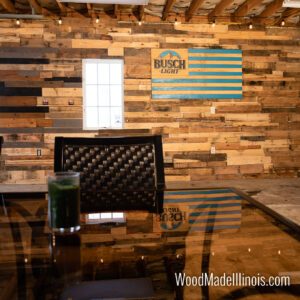
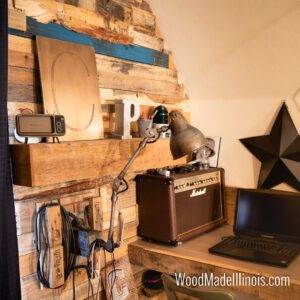
- Pallet wood accents for a rustic or reclaimed look, starting at $500.
- Design consultations to plan material, finish, and mounting before any drilling starts.
In a consult, we measure your wall and plates, walk through material and finish options, and discuss a suitable mounting approach. For readers who also want their closets or storage areas organized to match, One Day Doors & Closets builds custom closet systems that pair well with a coordinated home storage plan. Ready to get started? Request your design consultation and tell us about your wall.
FAQ
What can I use to hang plates on the wall?
Options range from dedicated plate hangers with spring-loaded grips to multi-slot wooden racks, floating picture ledges, and metal wall brackets built for a single plate. The right choice depends on whether you want plates fixed in place or easy to swap out, and on your plate’s weight and shape.
Is hanging plates on the wall out of style?
Plate walls have moved in and out of trend cycles for decades, and the current look favors mixed sizes, patterns, and ledge displays over the matched, formal grids once common. A well-spaced, intentionally composed arrangement reads as current regardless of the plates’ age or origin.
How to layout a plate wall?
Start with a template such as a single row, symmetrical grid, staggered cluster, or a mix of ledges and leaning plates, then center the arrangement around 57 to 60 inches from the floor. Keep roughly 2 inches between plates and mock up the layout with paper cutouts before committing to hardware.
How to hang plates on a wall without drilling?
Removable adhesive hooks rated for the plate’s weight can work for lightweight decorative plates on a short-term basis, but they are not a reliable option for a permanent or heavy display. For anything beyond a temporary arrangement, anchoring into a stud remains the safer, longer-lasting approach.
What size slots do I need for different plate sizes?
Each plate needs a slot sized to match, with enough extra width for the plate to slide out freely. Measuring your actual plates before buying a rack avoids a mismatch at installation.