Seasonal wood movement is the natural swelling and shrinking of solid wood across the grain as humidity rises and falls through the year. The working rule of thumb: expect approximately a small fraction of an inch of movement per foot of width on many flatsawn hardwoods over a typical year, according to shop heuristics based on shrinkage coefficients. Before any glue-up, measure the wood’s moisture content and build joinery that lets it move rather than fight it.
TL;DR:
- To minimize warping, choose species like black walnut or cherry, or opt for quartersawn cuts, which experience less width change through seasonal shifts.
- For a 12-inch wide, flatsawn white oak panel in a 6% moisture swing, expect about 0.26 inches of total movement, guiding gap and slot sizing.
- Proper joinery that allows for expansion, such as floating panels or slotted mortises, is essential to prevent cracking and warping over seasons.
- Maintaining indoor humidity between 35% and 55% reduces movement, and finishing slows but cannot fully prevent moisture-related dimensional changes.
Table of Contents
- How wood exchanges moisture with the air around it
- Why boards move differently across their width, thickness, and length
- Picking species and cuts that move less
- Calculating how much a board will actually move
- Building joinery that lets wood move instead of fighting it
- What finishes and climate control can realistically do
- Diagnosing cupping, cracking, and stuck doors
- How Wood Made Illinois manages movement on real projects
- Shop-tested rules that matter most
- FAQ
- Sources
How wood exchanges moisture with the air around it
Wood is hygroscopic: it absorbs and releases moisture until it matches the surrounding air, a balance point called equilibrium moisture content, or EMC. As relative humidity climbs in summer, EMC climbs with it, and the wood swells; as indoor air dries out in winter, EMC drops and the wood shrinks. Above that point, wood holds extra water without changing size; below it, every percentage point lost or gained translates directly into dimensional change, as detailed in the Forest Products Laboratory’s moisture relations chapter.
Two different clocks are running here. Daily humidity swings barely penetrate a board’s surface layers and rarely show up as visible movement. Seasonal shifts are the ones that matter in a shop, because they give moisture weeks or months to work all the way through a piece.
Exterior work has to track a wider, more exposed range tied to local weather rather than a thermostat.
- EMC rises and falls with relative humidity and temperature, not with the calendar date itself.
- Fiber saturation point marks where dimensional change begins, around 30% moisture content.
- Short-term humidity spikes rarely cause lasting movement; sustained seasonal shifts do.
- Interior work should be built near the moisture content your HVAC system actually produces.
Average wood movement runs roughly 0.24% to 0.26% per 1% change in moisture content for many common species, which is the number every shrinkage calculation starts from.
Why boards move differently across their width, thickness, and length
Wood does not move evenly in every direction, and that asymmetry explains most of the warping and cracking woodworkers fight. Movement across the grain is where the action is, and it splits into two further categories: radial, measured across the growth rings, and tangential, measured along them. Tangential movement is consistently the larger of the two, typically about twice the radial figure for a given species.
That 2:1 relationship, often called the T/R ratio, is why flatsawn boards cup and quartersawn boards stay flatter: a flatsawn board’s wide face runs roughly parallel to the growth rings, so it experiences the larger tangential movement across its width, while a quartersawn board’s face runs closer to perpendicular, putting the smaller radial movement across the width instead.
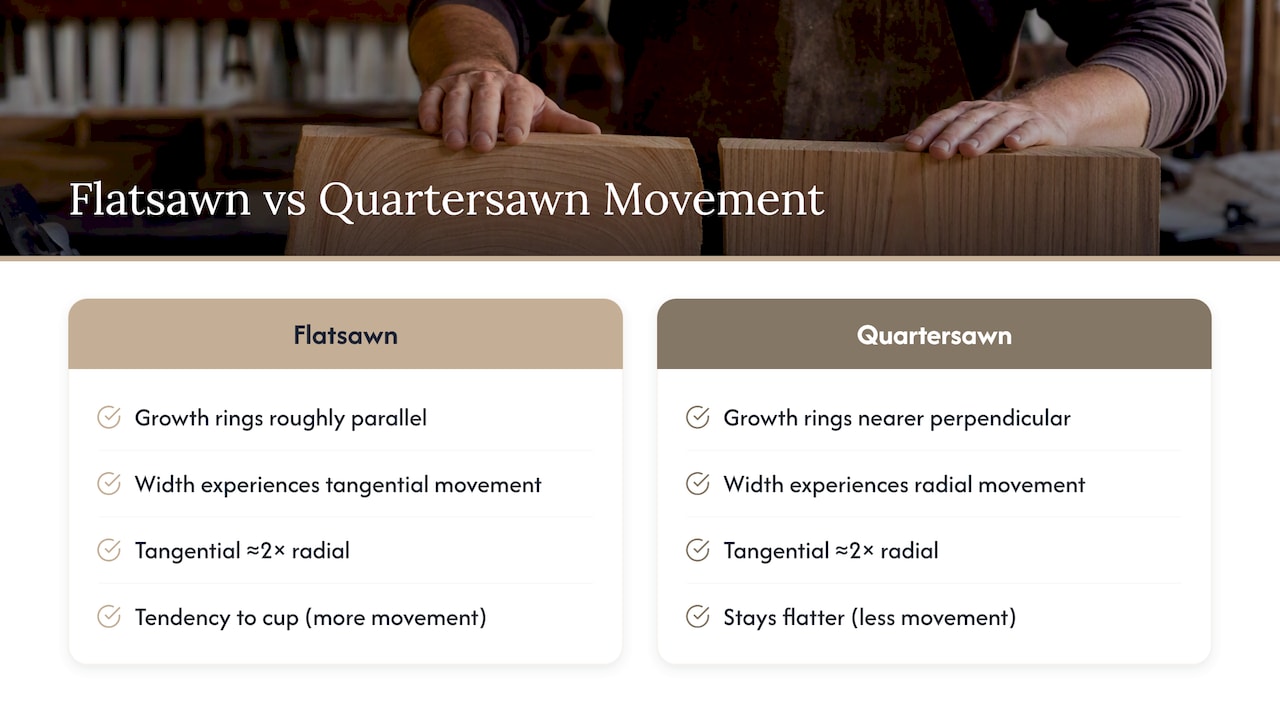
For a tabletop or panel, this means width matters more than thickness, and the orientation of the growth rings in the board you choose has more influence on long-term flatness than almost any finishing choice.
Picking species and cuts that move less
Not every species moves the same amount, and the numbers matter when you are choosing stock for a tabletop that has to survive ten Midwest winters.
- White oak moves more than most domestic hardwoods, with a tangential coefficient around 0.00365 and radial around 0.00180 per 1% moisture change, per shop-published shrinkage data.
- Hard maple and red oak sit in a similar range to white oak, making them reliable but not especially calm choices for wide panels.
- Black walnut and cherry tend to move less than oak, which is part of why they’re favored for stable panel work.
- Mahogany is among the more dimensionally stable common furniture woods, a reason it shows up so often in traditional casework.
Cut matters as much as species. A flatsawn board of any species shows more visible width change and more cupping tendency than the same species cut quartersawn or riftsawn, because quartersawn stock keeps the smaller radial movement running across the face. When a project calls for a wide, flat panel that has to stay flat through Illinois winters and summers, choosing a calmer species or paying for quartersawn material is often cheaper in the long run than repairing a cupped top.
Calculating how much a board will actually move
The formula behind every movement estimate is straightforward: movement equals the shrinkage coefficient, multiplied by the board’s width, multiplied by the expected change in moisture content. This is the same calculation shop guides use to generate their rule-of-thumb figures.
- Find the species’ tangential or radial coefficient, depending on the cut, from published shrinkage tables.
- Multiply that coefficient by the board’s width in inches.
- Multiply the result by the expected swing in moisture content between your driest and wettest season.
- Add a small safety margin, since real-world humidity swings rarely match tables exactly.
Here’s a worked example using flatsawn white oak. Using the tangential coefficient of 0.00365: 0.00365 times 12 times 6 equals about 0.26 inches of total seasonal movement, close to the quarter inch per foot heuristic quoted earlier.
A 6 point moisture content swing on a 12 inch flatsawn oak panel produces a small fraction of an inch of total movement, which is the number that should drive your slot and gap allowances.
Local humidity data, not a national average, should set your ΔMC estimate. When in doubt, round up rather than down.
Building joinery that lets wood move instead of fighting it
Good design doesn’t stop wood from moving, it gives the movement somewhere to go. Several joinery methods exist specifically to let a wide panel expand and contract without splitting itself or the frame around it.
- Breadboard ends pin the center of the joint solidly while slots at the outer edges let the tabletop slide beneath them as it moves.
- Floating panels inside a frame, the classic frame-and-panel approach, leave a gap at the panel’s edges so it can grow without pushing the frame apart.
- Sliding dovetails lock two parts together along their length while still permitting width-wise movement.
- Slotted mortises, elongated rather than tight-fitting, give a tenon room to shift seasonally.
- Z-clips attach tabletops to aprons without screws through solid wood, letting the top expand and contract freely while staying secured.
Sizing the allowance correctly is as important as choosing the right joint. A 36 inch wide tabletop in a seasonally humid climate might need roughly 3/8 inch of total travel designed into its slots or breadboard channels, based on the coefficient-times-width-times-ΔMC math from the previous section applied at that width.
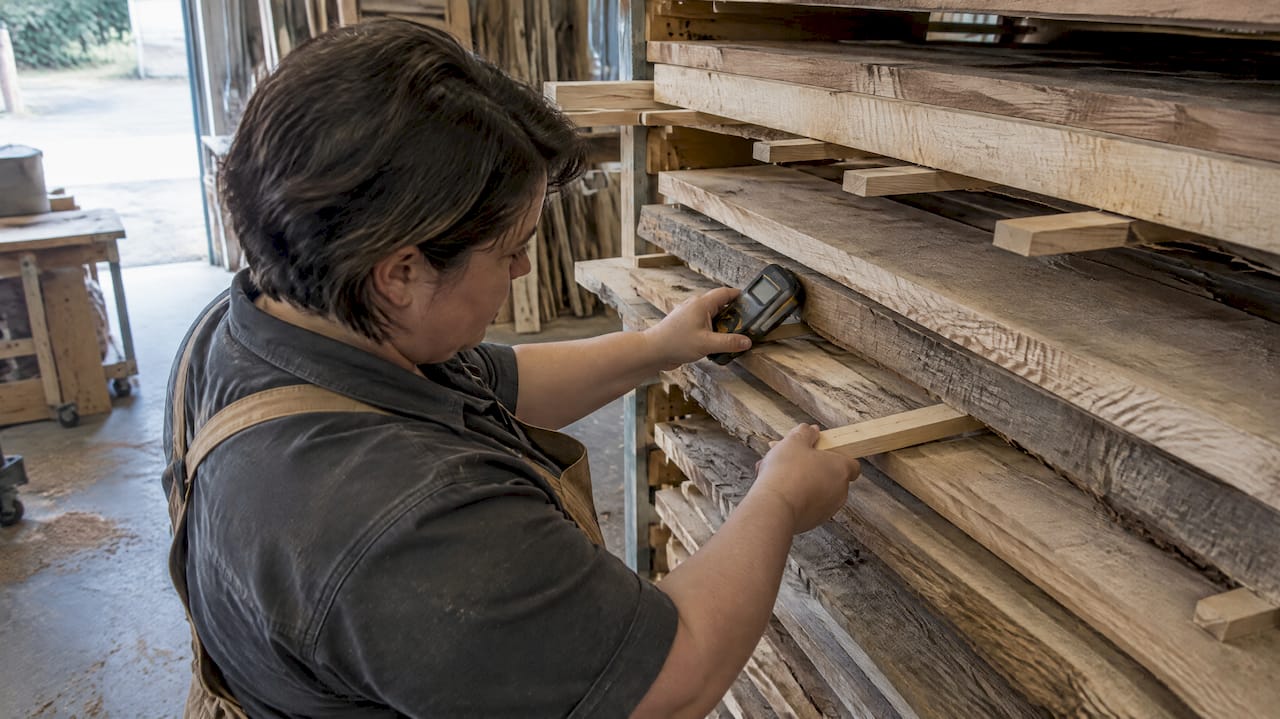
Before glue-up, acclimate the stock in your shop by stickering it with spacers between boards for airflow and checking moisture content with a pin or pinless meter. If the readings are still drifting, give it more time before you commit to final dimensions.
Pro Tip: Decide early which part of an assembly is fixed and which is allowed to float. Restraining a wide panel on all four edges removes its ability to move, and when humidity rises anyway, the cell walls can compress permanently, a condition called compression set that no amount of drying will reverse.
What finishes and climate control can realistically do
Finishes slow moisture exchange, they do not stop it. A film finish like a quality varnish or lacquer can meaningfully retard how fast a board absorbs or releases moisture, but no coating prevents the underlying dimensional change once equilibrium catches up. Design for movement first, and treat finish as a buffer, not a solution.
- Finish every face of a panel, not just the show side, to slow moisture gain and loss evenly on both faces.
- End-sealing exposed grain reduces the faster moisture movement that happens at board ends.
- Film finishes generally outperform oil finishes at slowing seasonal exchange, though neither stops it.
Indoor furniture holds up best between 35% and 55% relative humidity, a range widely used for stabilizing wood furniture in the home. A humidifier in dry winter months and a dehumidifier in damp summer stretches reduce the swing your furniture has to absorb. Checking RH with a simple hygrometer once a week through the shoulder seasons, spring and fall, catches problems before they show up as cracked glue lines.
Diagnosing cupping, cracking, and stuck doors
Most seasonal complaints trace back to one of a handful of causes, and matching the symptom to the cause saves a lot of wasted repair effort.
- Cupping across a tabletop usually means a flatsawn board reacted to uneven moisture between its top and bottom faces; light planing after full acclimation can correct minor cases.
- Cracking along the grain, especially near board ends, often signals the wood dried faster than its interior could keep pace, a sign the piece was built before full acclimation.
- A door or drawer sticking only in humid months points to swelling across the grain; a light shim adjustment or seasonal easing of the fit, rather than a permanent refit, is usually the right call.
- Cracked glue lines in a panel often mean the assembly restrained movement that had nowhere to go, the kind of restraint failure documented in wood stress literature.
Historic windows and repeated structural failures are where a professional eye matters most. If a wooden window keeps swelling shut every winter despite reasonable adjustments, or a stuck door or frame problem recurs year after year, the fix usually isn’t another shim, it’s a redesign of the joinery or hardware clearance.
How Wood Made Illinois manages movement on real projects
Every built-in, pallet wall, and window restoration project starts with the same question: how will this piece behave in January as well as July. That shapes the acclimation schedule, the joinery choices, and how we talk through timelines with clients before work begins.
- Lumber is stickered and moisture-checked in the shop before any cutting starts, following the same two-reading, one-week protocol described above.
- Window and trim installations use adjustable reveals and clearance rather than tight, permanent fits, so seasonal swelling doesn’t bind moving parts.
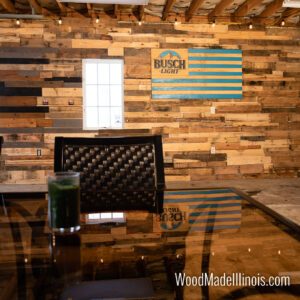
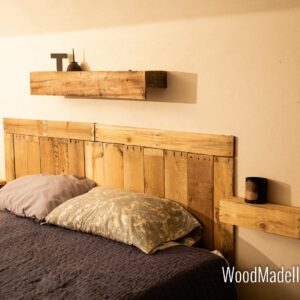
- Built-ins and pallet wood accent walls use floating panel techniques where the design allows, reducing the chance of split boards after the first full year in a home.
- Clients are told upfront which pieces may need a minor seasonal adjustment in year one, so a January door tweak doesn’t come as a surprise.
Shop-tested rules that matter most
The quarter inch per foot rule and a conservative moisture-content allowance have saved more callbacks for me than any clever joinery trick. Measure first, build second, and tell the client what to expect before winter arrives.
— Wood
FAQ
What wood can you no longer buy?
This varies by region and changes over time as harvesting restrictions, disease, and market demand shift which species are commercially available. Check with a local sawmill or supplier for current availability in your area rather than relying on a fixed list.
What time of year does wood swell?
Wood swells when relative humidity rises and stays elevated for weeks, which in most temperate climates means the humid summer months. The same moisture relations that drive EMC mean the wood is simply chasing the higher summer humidity before shrinking back as fall and winter air dries out.
What is the point of seasoning wood?
Seasoning dries wood down toward a stable moisture content so it can be worked and installed without unpredictable movement later. Furniture-grade wood is typically seasoned toward 6% to 10% moisture content, while firewood seasoning targets a much higher, less precise moisture range over a period of months.
Can you season wood in the winter?
Yes, air-drying and kiln-drying both continue through winter, though cold, dry air slows the process compared to a warm, well-ventilated summer stack. Common practice is air drying lumber to roughly 20% to 25% moisture content before finishing the job in a kiln, a schedule that works in any season with proper airflow and cover.
Sources
These are the sources behind the figures and recommendations above, useful for anyone who wants to check the numbers or dig deeper into the underlying research.