The most effective office breakroom storage combines vertical shelving, labeled containers, and a compact beverage zone, all overseen by one designated owner. Start with retail shelving and bins to test your layout. When foot traffic is heavy or the room has an awkward footprint, custom carpentry earns its cost in durability. Two changes to make this week: install a wall-mounted shelf above counter height, and assign one person to manage supplies.
TL;DR:
- Installing a wall-mounted shelf above counters and assigning a dedicated person for supplies reduces clutter and improves organization.
- Use clear, labeled containers and tiered racks in beverage stations to double capacity and keep small items accessible and tidy.
- Secure lockers or open baskets for personal items should be sized and positioned to prevent clutter and ensure easy access.
- Hidden storage like lift-up benches and toe-kick drawers can maximize small spaces without overwhelming the room visually.
- Consistent ownership and a routine restocking schedule are crucial to maintaining a functional, clutter-free breakroom environment.
Table of Contents
- 1. Open Shelving and Wall-Mounted Storage Ideas
- 2. Compact Beverage and Coffee Station Organization
- 3. Personal Storage: Lockers, Cubbies, and Assigned Baskets
- 4. Hidden and Under-Seat Storage Solutions to Maximize Small Rooms
- 5. Small-Part Organization: Baskets, Bins, Labels, and Dispensers
- 6. DIY and Low-Cost Storage Hacks for Tight Budgets
- 7. Materials, Durability, and Accessibility Considerations
- 8. Maintenance, Restocking, and Ownership Model That Keeps Storage Working
- 9. When to Hire Custom Carpentry for Breakroom Storage
- Author Perspective: Practical Priorities for Busy Office Managers
- How We Help With Custom Breakroom Storage and Built-Ins
- FAQ
- Sources
1. Open Shelving and Wall-Mounted Storage Ideas
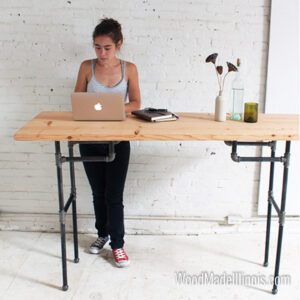
Floating shelves give you back counter space without the bulk of upper cabinets, and they work well for mugs, snacks, and paper goods that staff grab throughout the day. Industrial pipe shelving holds more weight and suits a breakroom with a warehouse or café aesthetic, while pegboard systems let you rearrange hooks and small shelves as needs change week to week. Rail systems with hooks work well for hanging items like reusable mugs or cleaning cloths near a sink.
Zone your walls by traffic. Put the items people reach for constantly, like mugs and snack baskets, in the “hot” area nearest the entry. Reserve shelving near the sink and prep counter for dishware, cleaning supplies, and items tied to food prep rather than quick grabs. Mount everyday shelves between 42 and 60 inches from the floor so most adults can reach without a step stool, and leave at least 15 inches of clearance below upper shelving to keep the counter usable.
Durability matters more in a shared kitchen than almost anywhere else in an office. Anchor heavier shelving into studs rather than drywall alone, and choose moisture-resistant fasteners near sinks or coffee stations where condensation and spills are routine. A custom shelving build can be designed around your exact wall studs and traffic flow rather than forcing a retail bracket system to fit.
Pair every shelf with containers that make upkeep simple:
- Clear stackable bins for snacks, sorted by type so staff can see contents at a glance.
- Labeled baskets for condiments, utensils, and cleaning supplies.
- A dedicated tray for mail or shared office supplies that otherwise pile up on counters.
Pro Tip: Mount one shelf slightly lower than the rest and reserve it for the items used most, like coffee filters or sweeteners, so people are not reaching overhead for daily basics.
2. Compact Beverage and Coffee Station Organization
A coffee station gets crowded fast when brewing, condiments, and trash share the same six square feet. Splitting the station into three zones, brewing, condiments, and disposal, stops the bottleneck that forms when three people try to use the same counter at 9 a.m.
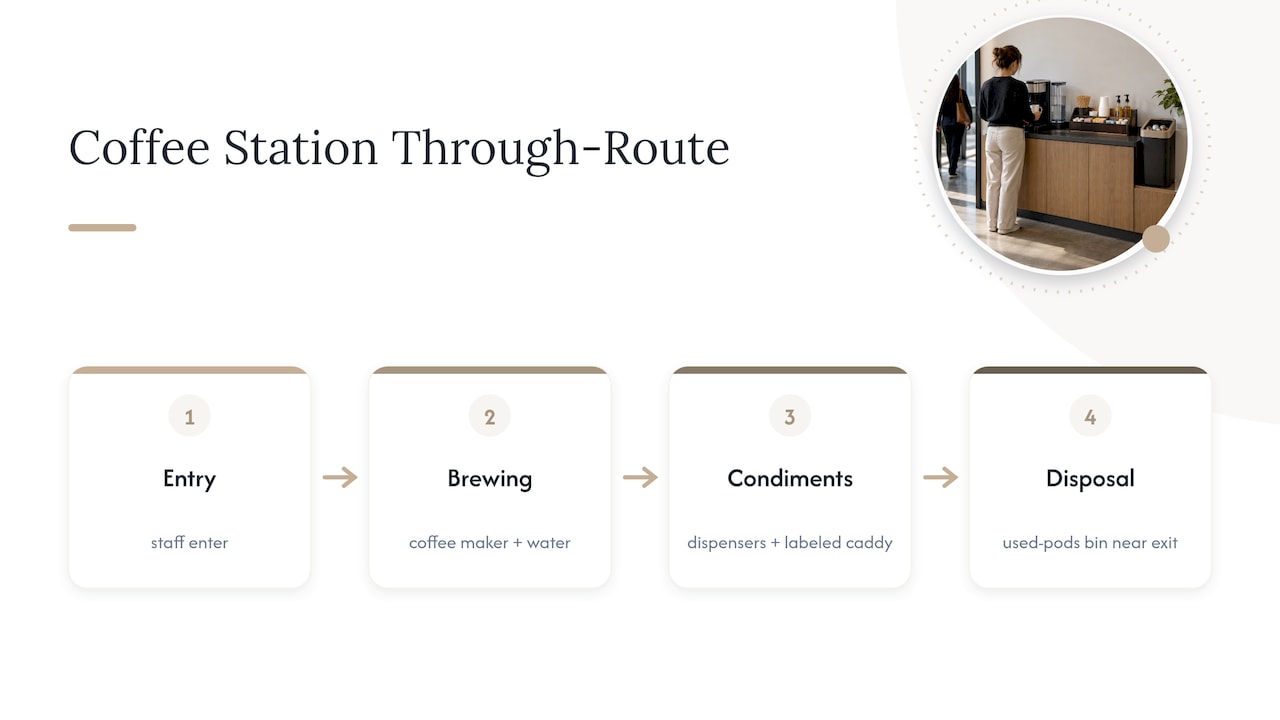
Tiered racks solve a lot of clutter by stacking mugs or pods vertically instead of spreading them across the counter. Dispensers for sugar, creamer, and stir sticks keep small items contained and visible, and a labeled condiment caddy means nobody is hunting through a drawer. Trays under coffee makers and kettles catch drips and make cleanup a thirty-second job instead of a scrub session.
Materials matter here more than in most of the breakroom. Laminate or sealed butcher block resists the daily splashing better than unfinished wood, and a kitchen renovation that swaps in a sealed counter around the coffee station pays off over years of steam and spills.
Placement affects flow as much as the organizers themselves. Put the coffee maker and water dispenser near the circulation path rather than in a corner, so people can grab a cup and keep moving instead of doubling back past each other. A through-route layout, where staff enter, serve themselves, and exit without reversing, keeps the morning rush from turning into a line.
A tidy coffee zone typically includes a tiered rack or shelf for mugs and pods, a labeled caddy for sugar, creamer, and stir sticks, and a small bin or tray dedicated to used pods and filters, positioned near the exit path.
3. Personal Storage: Lockers, Cubbies, and Assigned Baskets
Staff need somewhere to put a lunch, a coat, or a bag that is not the shared counter. Small lockers offer the most privacy and security, useful for offices where food theft or misplaced items have been a problem. Open cubbies cost less and are easier to clean, but they offer no security and tend to collect clutter if nobody is assigned to tidy them. Labeled baskets sit in between: cheap, easy to wipe down, and fine for low-risk items like water bottles or snacks, but not appropriate for anything valuable.
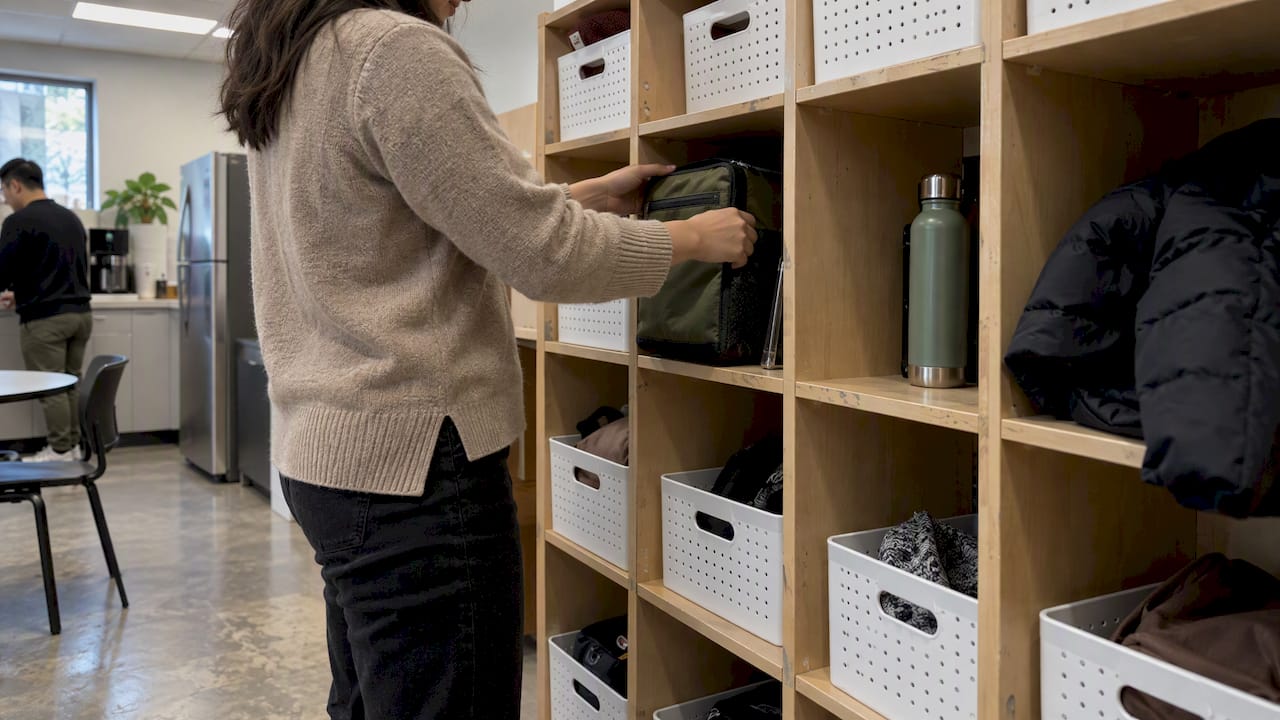
Size the opening to the job. A cubby meant for lunch bags should have enough depth for a standard insulated bag, and any enclosed space holding food containers needs ventilation gaps to avoid trapping odors or moisture. Coat storage needs more vertical clearance than food storage.
If you choose lockers, keep the mechanism simple. A basic keyed or combination lock works fine for daily use, and a clear policy, such as a 24-hour reclaim rule for unclaimed lunch items, prevents forgotten food from becoming a weekly cleanup chore.
Position lockers against a wall that does not interrupt the path to the sink or coffee station, preserving a clear walking lane. The Texas Department of Licensing and Regulation’s breakroom guidance notes that fixed storage elements and sinks can carry specific accessibility and clearance requirements, which is worth checking before anchoring lockers or cubbies to a wall near a sink.
A workable personal storage setup usually includes:
- Small lockers for valuables or food with security concerns.
- Open cubbies for coats and bags in low-theft environments.
- Labeled baskets as a low-cost middle option for shared or low-value items.
4. Hidden and Under-Seat Storage Solutions to Maximize Small Rooms
A small breakroom gains real capacity when storage disappears into the furniture instead of sitting on top of it. Bench seating with a lift-up lid can hold folding chairs, extra linens, or bulk paper goods without adding a single visible cabinet. Recessed cabinets built into an otherwise dead wall section do the same job for taller items.
Three retrofit options worth considering:
- Toe-kick drawers along the base of existing cabinetry, which use space that normally sits empty.
- Under-counter pull-outs for trash, recycling, or cleaning supplies, keeping bins out of sight but within reach.
- Slim rolling carts for bulk paper towels or napkins, which tuck into narrow gaps and roll out only when needed.
Hidden storage that gets opened daily needs a finish that holds up to constant use. Smooth, sealed surfaces on drawer slides and lift mechanisms prevent snagging, and rounded edges reduce pinch points on anything staff reach into without looking.
A rolling cart or a set of stackable bins is a reasonable DIY weekend project. A built-in bench with a hinged lid, or toe-kick drawers cut into existing cabinetry, is carpentry work best left to someone who can match the existing finish and ensure the hinge carries the load over years of daily use.
Pro Tip: If you are retrofitting toe-kick drawers yourself, measure twice before cutting into the base of existing cabinets, since plumbing or electrical lines sometimes run through that space.
5. Small-Part Organization: Baskets, Bins, Labels, and Dispensers
Loose utensils, napkins, and condiment packets are the fastest way to make an organized breakroom look chaotic again within a week. Matching containers by category solves most of it: a divided bin for utensils, a shallow tray for napkins, and a labeled basket for individual condiment packets.
Material choice depends on what is going inside. Plastic bins resist moisture better than cardboard or unsealed wood, which matters near a sink or coffee station where spills are routine. For labels, waterproof or laminated tags survive wiping down far longer than paper and tape. Color coding by team or by item type, for example, blue labels for shared supplies and green for a specific department, speeds up restocking because nobody has to read every label to find the right bin.
Mountable dispensers for cups, lids, and napkins free up counter space that loose stacks would otherwise occupy, and they cut down on the mess that comes from a toppled stack of napkins.
A practical guide to equipping a small break room recommends building restocking around visible par levels, a minimum quantity that triggers a reorder, rather than waiting for supplies to run out.
Useful small-part organization includes:
- Divided bins for utensils, sorted by type rather than dumped together.
- Waterproof labels or color-coded tags for shared versus departmental supplies.
- Wall-mounted dispensers for cups, lids, and napkins to clear counter clutter.
6. DIY and Low-Cost Storage Hacks for Tight Budgets
Not every breakroom problem needs a contractor. Several fixes take an afternoon and cost very little.
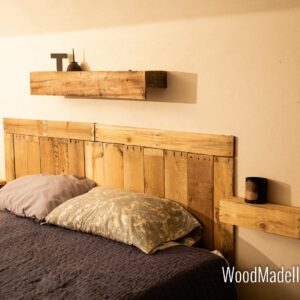
- Build a simple shelf from repurposed pallet wood, sanded and sealed, for a rustic look that costs mostly labor.
- Mount a pegboard panel for small tools, mugs, or cleaning supplies that need frequent rearranging.
- Repurpose a magazine holder as a vertical rack for lids or cutting boards.
- Use tension rods inside a cabinet to create a divider for trays or cutting boards stored on edge.
- Add adhesive hooks for lightweight items like dish towels or aprons where drilling is not an option.
- Hang an over-the-door rack on a pantry or supply closet door for extra bin storage.
- Roll in an inexpensive cart on casters for bulk paper goods that need to move between rooms.
These projects hold up best when finished properly. Sand rough pallet wood before use to avoid splinters, and seal any wood surface that will sit near a sink or coffee station so it does not absorb moisture and warp. Most of these hacks run under an hour each and cost little beyond the hardware, making them a reasonable way to test a layout before committing to anything permanent.
7. Materials, Durability, and Accessibility Considerations
The breakroom sees more daily wear than almost any other shared space in an office, so material choice determines how long a storage solution actually lasts. Sealed, moisture-resistant substrates and durable counter surfaces hold up around sinks, coffee makers, and microwaves far better than unfinished alternatives. Unsealed engineered wood is the common mistake: it looks fine on installation day and starts delaminating or swelling within months near a water source.
The tradeoff is usually cost versus lifespan. A sealed laminate or solid-surface counter costs more upfront than an unsealed panel, but it avoids the replacement cycle that comes with moisture damage in a high-use kitchenette.
Accessibility matters for wall-mounted storage, too. Product specifications for wall-mounted fire extinguisher cabinets illustrate a useful rule of thumb for any wall-mounted fixture: keep protrusions under the typical 4-inch limit referenced in accessibility guidance, and leave adequate approach clearance in front of the unit. A companion steel cabinet spec sheet shows similar mounting and protrusion constraints, useful reference points when planning any shelf or cabinet that juts into a walking path.
Material maintenance varies by choice:
- Sealed wood counters need resealing roughly once a year in high-moisture zones.
- Laminate surfaces need little beyond regular cleaning but cannot be refinished once damaged.
- Stainless or solid-surface counters cost more initially but rarely need replacement.
8. Maintenance, Restocking, and Ownership Model That Keeps Storage Working
Even the best shelving system falls apart within a month without someone responsible for keeping it stocked. Assigning a single breakroom owner, rather than leaving upkeep to “whoever notices,” is the single change that keeps supplies predictable.
A workable weekly routine looks like this:
- Restock items against a published par-level list posted near the supply closet.
- Wipe down counters, shelves, and the coffee station, paying attention to moisture-prone surfaces.
- Check expiration dates on condiments, creamers, and perishable snacks.
- Rotate stock so older items sit at the front of bins and shelves.
- Escalate missing or damaged items to facilities or management rather than letting gaps persist.
Simple metrics make it easy to tell whether the system is working: track the number of days between restocking complaints, or the percentage of par-level items in stock on any given day. Either number trending in the right direction means the ownership model is doing its job.
9. When to Hire Custom Carpentry for Breakroom Storage
Retail shelving and bins solve most breakroom clutter cheaply. A few signals point toward a custom build instead: repeated supply theft that only a lockable built-in solves, chronic counter congestion that no amount of rearranging fixes, an oddly shaped recess that no off-the-shelf unit fits, or a surface that needs to survive years of coffee spills without replacement.
A typical project with us starts with a consultation to walk the space and discuss pain points, followed by a design pass that accounts for traffic flow and existing plumbing or electrical, then installation. The carpentry process can benefit from experienced professionals and personalized design consultations rather than a fixed catalog of sizes.
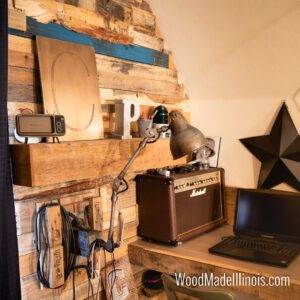
For counters near sinks or coffee stations, we typically recommend sealed, nonporous substrates that resist staining and moisture damage. Where budget and aesthetics align, pallet wood accents give a breakroom a distinct look without the cost of a full cabinetry overhaul.
Projects that tend to justify custom work include:
- A bench with hidden storage built to fit an irregular wall recess.
- Toe-kick drawers added to existing cabinetry without disrupting plumbing.
- A sealed counter replacement around a coffee station showing water damage.
Author Perspective: Practical Priorities for Busy Office Managers
If I had to boil this down to three moves, they would be simple ones. Put vertical storage first, since wall space is almost always underused while counters stay cluttered. Appoint one owner before buying a single bin, because no shelving system survives a committee-based restocking approach. And pilot with inexpensive containers before spending on anything custom. Retail bins and labels will expose exactly where your layout breaks down, and that information is worth more than guessing upfront. Once you know where the real bottleneck sits, whether that is a water-damaged counter or a dead corner nobody uses, sealed materials and a built-in solution become a sound investment rather than a guess.
— Wood
How We Help With Custom Breakroom Storage and Built-Ins
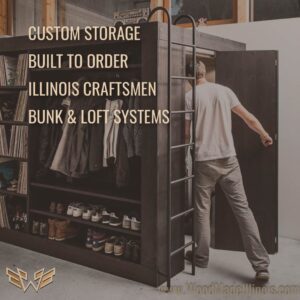
When retail shelving has done what it can and your breakroom still fights its layout, custom carpentry can be designed around the actual room instead of forcing a standard unit to fit. Custom carpentry can include shelving, built-in benches and cubbies, pallet wood accent walls, and countertop installs sized for coffee stations and prep areas that take daily abuse.
A consultation for custom carpentry typically covers design options for specific wall studs and traffic flow, a realistic timeline, and a cost estimate before any work begins. If your project leans toward a full counter and storage overhaul rather than a single shelf, our kitchen renovation service covers sinks, counters, and built-in storage together. For a smaller accent piece, our pallet wood wall options pair rustic style with a lower price point. Readers weighing simpler modular systems might also compare home organization system concepts for ideas before committing to a build.
Visit Woodmadeillinois to book a consultation and get a design and cost estimate for your breakroom.
FAQ
What are some creative ideas for an office breakroom?
Vertical shelving paired with a dedicated beverage zone and hidden bench storage covers most creative needs without eating floor space. Pegboard panels and pipe shelving add flexibility for teams that rearrange supplies often, while pallet wood accents give the room a distinct look at low cost.
What are some good storage ideas for my work office?
Wall-mounted shelves, labeled bins, and small lockers or cubbies for personal items cover the bulk of office storage needs. Pair those with a published par-level checklist so restocking stays predictable rather than reactive.
What are some creative hidden storage ideas?
Bench seating with a lift-up lid, toe-kick drawers built into existing cabinetry, and under-counter pull-outs all add storage without adding visible clutter. These work well for bulk supplies, folding chairs, or cleaning equipment that does not need daily visibility.
What are some DIY, cheap storage ideas?
Repurposed pallet wood shelving, pegboard organizers, tension-rod dividers, and adhesive hooks all cost little and take an hour or two to install. Sand and seal any wood surface before use, especially near a sink or coffee station, so it survives daily spills.
Sources
- Texas Department of Licensing and Regulation: Technical Memorandum TM2012-09 (break room illustration analysis)
- Academy Series – Aluminum Fire Extinguisher Cabinets – Product Data (JL Industries)
- Ideas for equipping a small break room (Katom learning center)