Restoring a wood window typically costs $300 to $1,200 per window for a standard unit, according to 2026 price ranges from Current Cost. Badly rotted sills, custom sash work or lead-safe procedures can push a single window to $2,000 or $3,000. Where your window lands depends on condition, size, access and what is in the paint. This guide walks through each factor so you can read a quote with confidence.
TL;DR
- Plan on $300 to $1,200 per window for standard wood windows. Full historic restoration or major structural repair can reach $2,000 to $3,000 or more per unit.
- Getting a stuck sash moving again is the entry point, at roughly $400 to $600. Glass-out stripping, repair and re-glazing costs more and lasts longer.
- Restoration usually costs less than quality replacement, especially when you add storm windows, and it keeps old-growth wood in your house.
- Lead paint, rotted sills and the number of windows in one batch are the three biggest swings in price.
- Ask every contractor for a per-window written scope, not a single lump number.
Table of Contents
- What wood window restoration costs in 2026
- What moves the price up or down
- A worked example: ten windows in an older Illinois house
- Restoration vs. replacement
- Perspective: how we think about restoration
- How to get an accurate quote
- Ways to keep the cost down
- Restoration help in Central Illinois
- FAQ
- Sources
What wood window restoration costs in 2026
Published figures vary because “restoration” means different things to different contractors. Here is how the main 2026 sources line up.
| Source | Typical range | What it describes |
|---|---|---|
| Current Cost, practical ranges | $300 to $1,200 per window | Standard units, with $2,000 to $3,000+ for extensive work |
| LatestCost | $300 to $1,200, average near $650 | Repairs, paint removal, reglazing and refinishing on a standard unit |
| Current Cost, historic windows | $350 to $3,000, average $1,200 | Sash repair, glazing, paint and minor frame work on a typical 6/6 sash |
The spread is wide, and that is honest. A double-hung window with sound wood and peeling paint is a different job from a window with a punky sill and a broken sash joint. Treat any national average as a starting point and expect your own quote to reflect the condition of your windows.
Three tiers of work
It helps to think in tiers, because most quotes fall into one of them.
- Basic refresh. Paint stripping, sanding, minor rot repair and repainting. Current Cost puts per-window basic restoration at about $150 to $900, averaging $375.
- Mechanical restoration. The sash is freed, cords or balances are addressed, and the window operates again. Industry commentary places this entry point at $400 to $600.
- Full restoration. Glass out, stripped to bare wood, joints re-glued, rot repaired, new glazing putty, new finish and weatherstripping. The same source describes complete sash restoration at roughly $350 to $1,200 per window, and historic-grade work can exceed that.
The cheapest tier is not always the cheapest outcome. A paint-over of a failing sash looks tidy for a season and then asks you to pay again.
What moves the price up or down
Condition of the wood
Surface wear is inexpensive to fix. Rot is not. The preferred repair is a dutchman: a rotted section is cut out and a new piece of matching wood is glued in. National Park Service preservation work favors this approach over heavy reliance on fillers, which tend to fail at structural joints. A dutchman costs more labor than filler, but it is the repair that holds.
The sill
Homeowners often focus on the sash, the part that slides. The sill is the more consequential part. A failing sill can send water into the wall cavity, and NPS technical guidance on deteriorated windows stresses that the frame matters as much as the movable parts. If your contractor flags a sill, take it seriously and ask for a photo. Repairing it early is far cheaper than repairing the wall behind it.
Think of paint and glazing as the skin of a house and the structure as its bones. Keep the skin sound and the bones stay dry.
Lead paint
If your house was built before 1978, the paint on the windows may contain lead. The EPA’s Renovation, Repair and Painting Rule requires that anyone paid to disturb painted surfaces in pre-1978 homes be certified and use lead-safe work practices. That adds containment, cleanup and training to the job, and it adds cost. It is also the single best reason not to hire an uncertified handyman for a bargain price. Ask for the contractor’s EPA lead-safe certification before you sign. Homeowners working on their own house are generally outside the rule, but dust is dust, and young children and pregnant women should stay out of the work area. If you are unsure about your home, ask your county health department or a certified lead inspector about testing.
Window size, type and access
A small double-hung window on the ground floor costs less than a tall arched window on a third story that needs scaffolding or a lift. Divided lites matter too: a window with twelve small panes has twelve glazing jobs. Storm sashes, leaded or stained glass, and unusual shapes each add time.
Batching and shop work
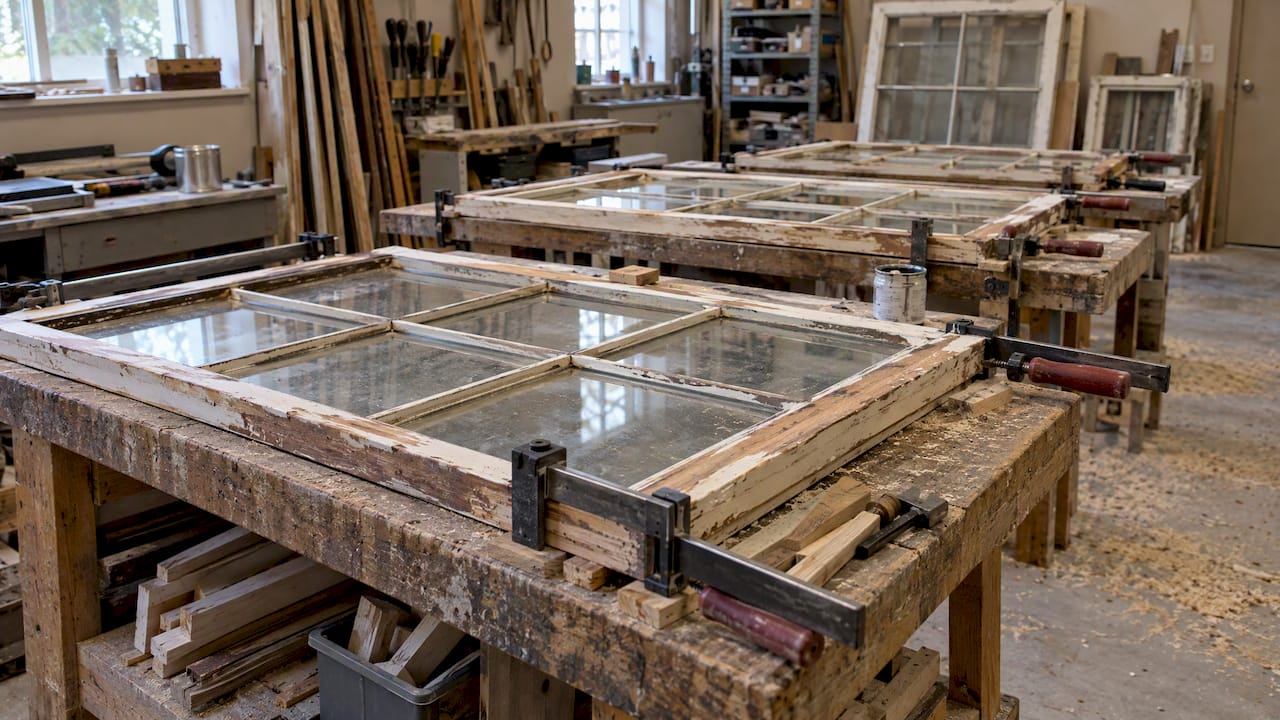
This is the factor most homeowners never hear about. Restoration is most efficient when sashes are removed from one side of the house, taken to a shop, and worked on together. Joints can be re-glued, clamped, cured and finished in a controlled space, and the per-window labor drops. Industry cost guides describe this batching advantage directly. A single window done on site as a one-off will usually cost more per unit than ten done together.
Location and season
Labor rates differ from state to state and city to city. In the Midwest, exterior painting and glazing also depend on weather, so spring through early fall is the busy window. Booking in late fall for winter shop work can sometimes put your sashes on the bench while the weather is too cold to paint outdoors. Ask what is realistic for your schedule.
A worked example: ten windows in an older Illinois house
Here is an illustrative budget, not a quote. Say you own a 1920s home with ten original double-hung windows. Six are in decent shape, three have failing glazing and peeling paint, and one has a soft sill.
- Six sound windows at a basic or mechanical tier: roughly $400 to $600 each, using the mechanical-restoration range above, or $2,400 to $3,600.
- Three windows needing full glass-out restoration: toward the middle of the $350 to $1,200 range, say $600 to $900 each, or $1,800 to $2,700.
- One window with sill repair: possibly $1,200 or more, since structural work sits at the top of the range.
That adds up to somewhere around $5,400 to $7,500 before lead-safe costs and storm windows. Compare that to replacing the same ten windows. A Bloomington and Normal contractor’s 2026 planning range for replacement is $800 to $2,500 per installed window, or $9,000 to $17,000 for ten, and higher for premium wood or full-frame work. The numbers will differ with your house, but the pattern is common: restoration tends to come in lower, and you keep original material.
Restoration vs. replacement
Price is only part of the decision. Consider these points.
| Factor | Restoration | Replacement |
|---|---|---|
| Typical cost per window | $300 to $1,200 | $500 to $1,300 and often more, installed (national average range) |
| Original old-growth wood | Kept | Lost |
| Appearance | Original profiles and glass | Often thicker frames, modern look |
| Energy performance | Improved with weatherstripping and storms | Strong when new, but varies by product |
| Disruption | Sashes out for days, openings boarded or covered | Usually quicker on site |
Note on that table: the replacement range reflects general national figures, and local numbers vary. The point is the comparison of kinds, not the exact dollars.
Energy savings are not the reason to replace
Many homeowners assume new windows are the route to lower bills. The U.S. Department of Energy’s Building America window guidance points out that air leakage can often be tackled with weatherstripping and caulking, and that well-fitted storm windows can bring comparable performance for far less money. A related DOE measure guideline on wood windows makes the same case: restoring originals and adding storms is frequently more cost-effective than full replacement. That guidance also tells you to check for lead paint and water intrusion first.
When replacement does make sense
Some windows are past saving: the frame is rotted through, the sash is structurally gone, or the opening has been altered. If your house is not historic and you want a particular performance rating, replacement can be the right call. A good contractor will tell you that rather than restore a window that will fail again.
Perspective: how we think about restoration
We build and repair wood for a living in Central Illinois, and we approach windows the way we approach any old wood: as something worth keeping when it can be kept. Old-growth sash was cut from tight-grained timber that modern stock rarely matches, and with a sound sill and a fresh coat of paint it can outlast the replacement you would buy to substitute for it.
Our honest advice on budgeting is simple. Start with the sill and the water path, because that is where hidden cost lives. Then decide whether you want windows that merely move or windows that are truly restored. Maintenance on a historic house is a marathon, not a sprint, and the cheapest quote is rarely the one that gets you to the finish line. With over 100 years of combined carpentry experience on our team, we would rather give you a clear per-window scope and a realistic number than a low figure that grows later.
— Wood
How to get an accurate quote
A useful quote is specific. Before anyone gives you a number, walk the house with them and make sure you cover these points.
- Count and list every window. Note floor, size, type and whether storm sashes exist.
- Ask what “restoration” includes. Does the price cover glass-out stripping, glazing putty, rot repair, weatherstripping, priming and two finish coats?
- Ask where the work happens. Shop-based work for the sashes and on-site work for frames and sills is a good sign.
- Confirm lead-safe practices for any pre-1978 home, including the contractor’s EPA certification.
- Get the sill and frame assessed separately from the sash.
- Ask about change orders. Rot found behind trim is common; agree in advance how it will be priced.
- Get at least two written quotes and compare scope line by line, not just totals.
If one quote is far below the others, check what it leaves out. Often the difference is skipped stripping, filler instead of wood repair or no lead precautions.
Ways to keep the cost down
- Do the whole elevation at once. Batching saves labor, as noted above.
- Prioritize. Restore the windows facing weather first, since south and west exposures take the most punishment, and schedule the rest in later phases.
- Add storm windows rather than replacing sashes for energy reasons.
- Fix small problems early. Re-glazing a loose pane is a fraction of the cost of repairing rotted wood.
- Maintain the paint. A well-kept finish is the cheapest insurance you can buy.
Restoration help in Central Illinois
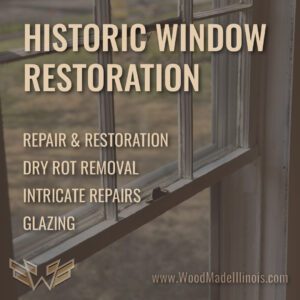
If your house is in the Peoria area, Wood Made Illinois handles custom carpentry, historic window restoration and small creative renovations for homes and small businesses, with design consultations to scope the work before you commit. You can see how we describe our wood window restoration and historic window repair work, then contact us for a per-window assessment. We do not publish a flat price for window restoration because the condition of each window decides the cost, and we would rather quote after we have seen yours.
FAQ
How much does it cost to restore an old wood window?
Most standard wood windows cost $300 to $1,200 to restore, with an average near $650 in LatestCost’s 2026 figures. Badly deteriorated or historic windows can run to $2,000 or $3,000. The condition of the sill and the presence of lead paint are the usual reasons a window lands at the high end.
Is it cheaper to repair wood windows than to replace them?
Usually, yes. Repair of minor problems often falls between $100 and $600, with a national average around $392, while installed replacement commonly starts above $500 and climbs from there. Restoration plus storm windows is often the better value.
Is lead paint a problem when restoring old windows?
It can be in homes built before 1978. Paid contractors working on these homes must follow the EPA’s lead-safe work rules, which adds some cost but protects your household. Ask for proof of certification, and talk to your county health department if you have young children and are unsure of your paint.
Why does the quote change from window to window?
Because each window has its own condition, size and access. A window with sound wood and a loose glazing putty is a light job. One with rot at the sill and a split sash joint requires wood repair, gluing and clamping, and extra finishing time.
Can I restore the windows myself to save money?
Homeowners can handle small tasks such as re-glazing a pane or adding weatherstripping. Stripping paint on a pre-1978 house, replacing rotted wood or removing heavy sashes is where mistakes get expensive and lead dust becomes a risk, so many owners hire a pro for those steps.
Sources
- Wood Window Restoration Cost: Practical Price Ranges for U.S. Homes 2026, Current Cost
- Historic Window Restoration Cost: Price Range and Key Drivers 2026, Current Cost
- Wood Window Restoration Cost: Typical Prices and Estimates 2026, LatestCost
- Building 22 Windows Restoration, U.S. National Park Service
- Reinforcing Deteriorated Windows, National Park Service technical note
- Lead Renovation, Repair and Painting Program, U.S. EPA
- Window Replacement, Rehabilitation and Repair Guide, U.S. Department of Energy
- Measure Guideline: Wood Window Repair, Rehabilitation, and Replacement, U.S. Department of Energy
- How Much Does Window Repair Cost?, This Old House
- What Replacement Windows Cost in Central Illinois, Knapp Exteriors