If a storm has torn siding off your detached garage or dropped a limb through your shed roof, your homeowners policy will often pay for the repair. The payout depends on three things: the “other structures” limit on your policy, your deductible, and how well you document the damage before anyone starts work. The repair itself matters just as much, because a claim only pays once, and the work has to be done by someone who can rebuild framing, trim, doors and roofing properly. In Central Illinois, that is the work we do at Wood Made Illinois through our storm damaged building repair service.
This guide walks you through what the policy covers, what to do in the first 48 hours, how the adjuster’s estimate is built, and what to do when the number is too low.
TL;DR
- Detached garages and sheds are usually covered as “other structures,” typically up to 10% of the amount insured on the house, but your own policy language decides.
- Wind, hail, falling trees and the weight of snow or ice are commonly covered. Flood, rot, rust, pests and neglected maintenance commonly are not, and business use can limit coverage.
- Photograph everything, cover openings to stop further damage, keep receipts, and hold off on permanent repairs until the insurer has seen the damage.
- Actual cash value subtracts depreciation. Replacement cost does not, though the insurer often holds back the depreciation until repairs are finished and documented.
- A written, line-by-line repair bid is your best tool when the adjuster’s estimate falls short.
Table of Contents
- Is a detached garage or shed covered at all?
- Which storm damage is covered, and what is not
- Deductibles, depreciation and what you actually receive
- The first 48 hours: protect, document, report
- How the adjuster builds the estimate
- When the estimate is too low or the claim is denied
- Getting the repair done right
- Our perspective
- Ready to start the repair
- FAQ
- Sources
Is a detached garage or shed covered at all?
Most standard homeowners policies sort your property into groups. The house itself is the dwelling. Detached garages, storage sheds and fences fall into a separate group called other structures. The Texas Department of Insurance classifies detached garages, sheds and fences as other structures, while an attached garage is treated as part of the dwelling.
That difference matters for the size of your payout. Other structures coverage is normally capped at a percentage of your dwelling coverage. The California Department of Insurance says this coverage is normally limited to 10% of the dwelling amount, and you can often buy more for an added premium. Texas regulators add a caution that applies everywhere: coverage depends on the individual policy, so 10% is a common figure, not a guarantee.
A quick example. If your house is insured for $300,000 under the dwelling coverage and your other structures limit is 10%, the most the policy would pay for all detached buildings combined is $30,000. That covers the garage, the shed and the fence together, so one bad storm that hits all three can use up the limit faster than you expect.
Two situations change the picture:
- Business use. A shed or garage used to run a business may not be covered under the home policy, according to the Texas Department of Insurance. If your shed has become a workshop or a home office that earns income, tell your agent and ask what applies.
- Attached versus detached. A garage attached to the house is usually part of the dwelling and sits under the larger limit. A breezeway connecting the two can blur that line, so read the declarations page or ask your agent how the policy treats yours.
Your declarations page is the one-to-two page summary at the front of your policy. It lists your coverages, limits and deductibles, and it is the first document to pull out.
Which storm damage is covered, and what is not
Coverage turns on the cause of the loss. Depending on the policy, covered causes commonly include wind, hail, falling objects, and the weight of snow or ice. In practice that means:
- A tree limb or whole tree that crushes a shed or garage roof.
- Hail that dents or punctures roofing and siding.
- Wind that lifts shingles, peels off siding or racks a garage door off its track.
- A heavy snow load that collapses a lightly framed roof.
The same source lists common exclusions: flood, earthquake, rot, rust, pests and damage that comes from deferred maintenance. Flood and earthquake generally need their own policies. If water came from the ground up rather than from rain through a storm-made opening, treat it as a separate question and ask your insurer which coverage applies.
Snow and ice deserve a second look. The Texas Department of Insurance notes that whether ice or snow damage to a fence or patio is covered depends on the policy, and some policies cover it only when the house itself collapses onto the structure. Illinois winters make this a practical concern, so read that wording before the first heavy snow.
One more Illinois-relevant detail: the Illinois Department of Insurance notes that some policies carry a special deductible for wind losses. Look for that on your declarations page, because it can be larger than your standard deductible.
Deductibles, depreciation and what you actually receive
The check you receive is the cost of the covered damage, minus the deductible, capped by your other structures limit. The Texas Department of Insurance explains that policy limits cap what the insurer pays, and the declarations page shows the limits and the deductible.
The second variable is how the policy values the loss:
| Valuation | What it pays | What to expect |
|---|---|---|
| Actual cash value | Repair or replacement cost minus depreciation | A smaller check, since an older roof or door is treated as worn |
| Replacement cost | Repair or replacement cost without depreciation, up to the limit | Often paid in two steps: the insurer initially withholds the depreciation until repairs are finished and documented |
The two-step payment is described in the Texas Department of Insurance guide, and the Maryland Insurance Administration describes the same split between actual cash value and replacement cost. The practical lesson: with replacement cost coverage, keep the final invoice and photos of the finished work, because those unlock the held-back amount.
Worked example
Say wind peels the siding and trim off one wall of a detached garage and lifts part of the roof, and the repair comes to $6,800. Your deductible is $1,000.
- On replacement cost coverage, the insurer might first pay the depreciated value less the deductible, then release the rest once you submit proof of completed repairs.
- On actual cash value, you receive the depreciated amount less $1,000 and the balance is yours to cover.
The numbers here are illustrative, not a quote. Your declarations page tells you which one you have.
Is it worth filing a small claim?
The Maryland Insurance Administration suggests comparing the likely repair cost with your deductible before filing a small claim, and warns that you may not see all the damage at first. A shed door that costs $400 to fix against a $1,000 deductible is not a claim. Damage to framing, roofing and trim that adds up past the deductible usually is. Get an on-site assessment before you decide, so the figure you compare is real. If you have questions about how a claim could affect your premium, your insurance agent is the person to ask.
The first 48 hours: protect, document, report
What you do right after the storm shapes the claim. Official guidance from several states agrees on the sequence.
- Make it safe. Stay out of any structure with a sagging roof, hanging limbs or downed power lines nearby. Garages often hold fuel, tools and electrical panels. Do not enter a damaged building until you are sure it is stable.
- Stop further damage. The Illinois Department of Insurance advises that you secure your property to prevent more damage or theft, for example by boarding broken windows and tarping a roof with holes. The California Department of Insurance explains why this matters: failing to prevent later damage may affect coverage for that later damage.
- Document everything before you touch it. Take photos and video of the structure and anything stored inside. The National Association of Insurance Commissioners (NAIC) recommends documenting damage to garages and tool sheds separately from damaged personal property, and keeping purchase receipts where you have them.
- Report the claim promptly. Call your insurer or agent. The Illinois guide says to report the claim as soon as possible, and most insurers also take claims online or by phone app.
- Save receipts for temporary measures. Tarps, plywood and labor for emergency covering are records worth keeping. The California Department of Insurance advises saving them and avoiding extensive permanent repairs until the adjuster has assessed the loss.
That last point is where homeowners most often go wrong: temporary protection is expected, permanent rebuilding before the insurer talks to you is not. Cover the opening, keep the damaged materials where you can, and wait for the adjuster before tearing out or rebuilding.
If the storm also pushed water into the structure and you need to clear out furniture, tools or keepsakes while the building dries, temporary storage after water damage gives your belongings a safe place while the repair is under way. Photograph the items before they move.
How the adjuster builds the estimate
The adjuster inspects the damage and writes the estimate the insurer’s payment is based on. According to the California Department of Insurance, the inspection should capture the degree of damage, the quality of materials and workmanship, and the measurements needed to calculate quantities.
You can help the visit go well:
- Walk the adjuster around the whole structure, not only the obvious damage. Ask them to look at the roof deck, the framing at wall corners, the garage door tracks and the trim.
- Point out older repairs and upgrades, such as new windows or a rebuilt door, so they show up in the estimate.
- Keep your own photo set and notes. Ask for the estimate in writing.
Hail and wind damage is often less obvious from the ground than from the roof. The Maryland Insurance Administration warns that homeowners may not see all damage initially, which is why a second look by a carpenter who works on roofs, siding and framing can pay off before you accept a figure.
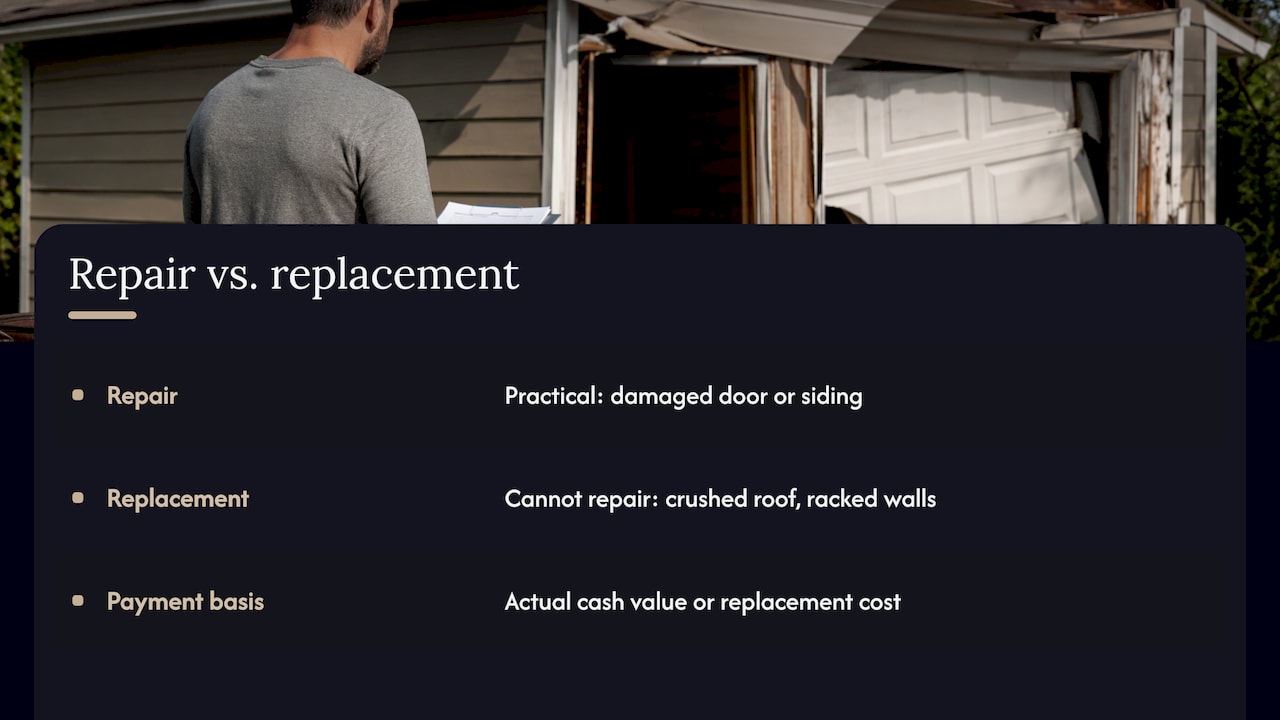
Repair or replace?
Insurers generally pay to repair damaged parts when repair is practical and move to replacement when a structure or component cannot be repaired. A shed with a crushed roof and racked walls is a different conversation from a garage with a damaged door and a section of siding. The adjuster’s scope will say which one applies, and your policy’s valuation (actual cash value or replacement cost) sets how it is paid. If the estimate treats a repairable structure as a total loss, or the reverse, ask the adjuster in writing what the estimate is based on.
When the estimate is too low or the claim is denied
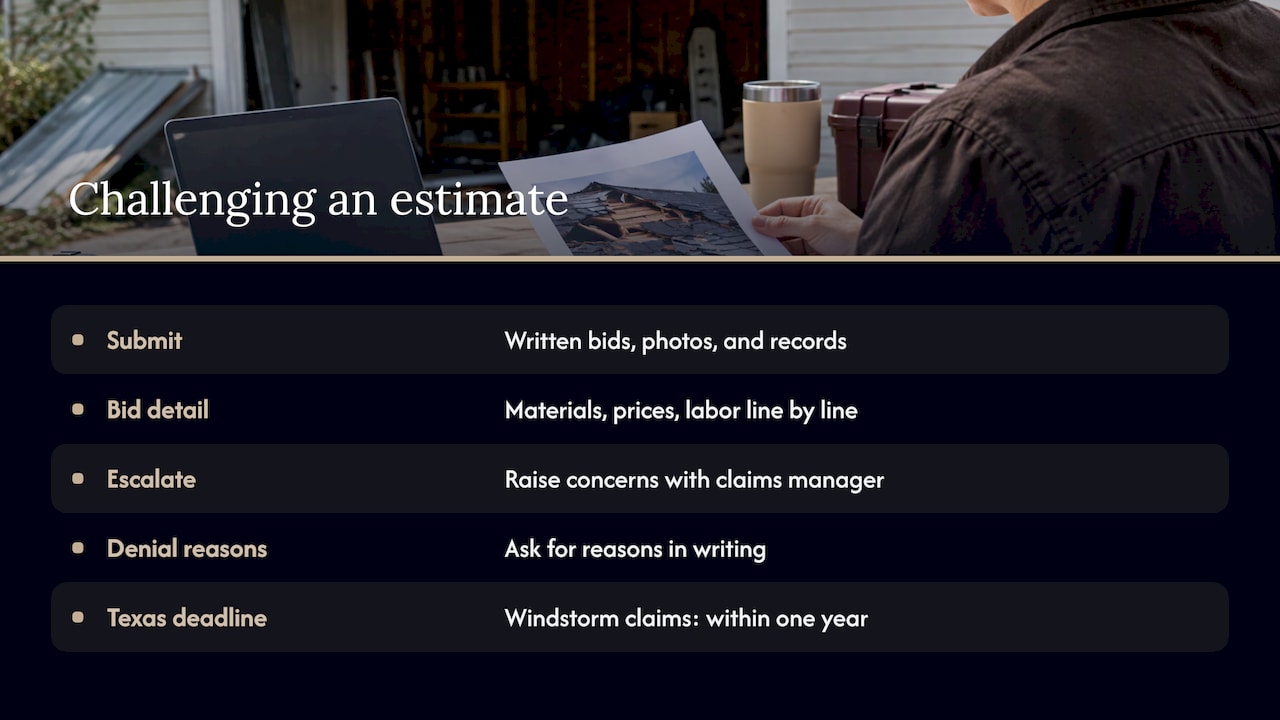
An adjuster’s first number is not always final. The California Department of Insurance advises homeowners to give the insurer written contractor bids, photos and records, raise concerns with the claims manager, and ask for denial reasons in writing.
The Maryland Insurance Administration says contractor bids are not required, but they help, and useful ones detail materials, prices and labor line by line. A bid that says “repair garage, $9,000” gives the insurer little to compare. A bid that lists the framing members, sheathing, roofing, siding, trim, door hardware and labor gives them something to match against their own scope.
Texas windstorm policy materials describe the same idea as a supplemental payment: you provide detailed estimates, photos or repair contracts to support a higher figure. Deadlines and procedures differ by policy and claim stage, so check your own policy and ask your insurer for its supplemental claim process. If a dispute cannot be resolved, the Illinois Department of Insurance, the state authority that regulates insurers, handles consumer complaints.
On timing, Texas offers one example of how strict deadlines can be: its windstorm association requires claims within one year of the damage. That is a Texas-specific rule, not a nationwide deadline. Your Illinois policy states its own time limits, so read the claims section and file early.
Getting the repair done right
The check settles the money. The repair settles whether the garage or shed stands up to the next storm. Storm damage to a detached building is rarely only cosmetic: wind loads work on connections, rafters and door openings, and a patch that ignores the framing behind the siding will fail again.
A few things separate a lasting repair from a quick one:
- Framing first. Racked walls and cracked rafters need to be made sound before any new trim or siding goes on.
- Weather envelope. Roof decking, flashing, siding and trim work as a system. Water that gets behind one failed piece travels.
- Doors and openings. Garage doors, man doors and windows are common casualties. Square, plumb, well-hung openings seal and operate properly.
- Matching and finish. Trim, siding profiles and paint should blend with the original structure.
This is carpentry, and it is what our team does. Wood Made Illinois serves homes and businesses in Central Illinois, and our team brings over 100 years of combined carpentry experience. Our storm damaged building repair service covers this kind of work, and our finish carpentry, door installation and siding and trim work sit alongside it. We also handle historic window restoration, which matters on older properties where outbuildings carry original details worth keeping.
We suggest bringing us in early, ideally right after you have documented the damage and before you accept the adjuster’s figure, so the scope you negotiate reflects what the structure needs.
Our perspective
A garage or shed is often the first thing a family builds out beyond the house, and it is the first thing a storm tests. We have spent careers learning how wood moves, how water finds a gap and how a joint holds or fails, and our team’s combined experience runs past a century.
Our view is simple. Treat the claim and the repair as one project. The insurer needs a clear record of what the storm did. The building needs a rebuild that addresses the framing, the weather envelope and the openings, not just the visible surface. When both are done with care, the payout and the work line up.
We also think a damaged outbuilding is a chance to do something useful with it. A rebuilt shed can gain shelving or a built-in workbench, and a repaired garage can gain better storage and a cleaner entry. Creative carpentry and built-in storage are part of what we do, and we like to leave an owner with a space that works harder than the one the storm took.
Wood
Ready to start the repair
If a storm has damaged your garage or shed in the Peoria area or elsewhere in Central Illinois, start by documenting the damage and reporting the claim. Then talk to us about the repair. We handle storm damaged building repair alongside carpentry, doors, trim and siding, so one team can look at the whole structure.

You can see our full range of services on the Wood Made Illinois site or browse our storm and emergency services page.
FAQ
Are sheds covered under homeowners insurance?
Usually yes. Sheds and detached garages typically fall under other structures coverage, commonly up to 10% of the dwelling amount. Your declarations page shows your actual limit, and a shed used for business may not be covered.
Will a storm claim make my insurance go up?
That depends on your insurer, your claims history and the rules in your state, so ask your agent before you file. A practical first step is to get a repair assessment and compare the likely cost with your deductible. If the repair is close to the deductible, filing may not pay off.
What should I do before repairing the damage?
Cover openings to prevent further damage, photograph and video everything, keep receipts, and report the claim. The Texas Department of Insurance advises against making permanent repairs before talking with your insurer. Temporary measures are expected, and permanent rebuilding comes after the adjuster has seen the loss.
What if the adjuster’s estimate is too low?
Send the insurer written, line-by-line repair bids along with your photos and records, and take your concerns to the claims manager. If you are denied, ask for the reasons in writing. These steps come from the California Department of Insurance’s claims guide.
Sources
- Texas Department of Insurance: Home insurance guide
- Texas Department of Insurance: Homeowners insurance and disaster claims FAQ
- California Department of Insurance: Homeowners and Renters guide
- California Department of Insurance: Residential Property Claims Guide
- Maryland Insurance Administration: Post-Disaster Claims
- NAIC: Post-Disaster Claims Guide
- Texas Windstorm Insurance Association dwelling policy
- Texas Windstorm Insurance Association policy notice on claim deadlines
- Amica: What is other structures coverage