Built-in beds include storage because they convert the largest piece of unused volume in any bedroom — the space beneath the mattress — into a purposeful organizational system that can replace a dresser, reduce floor clutter, and simplify daily routines. According to Chairish, integrating storage directly into the bed frame effectively eliminates the need for additional standalone dressers in many room layouts. That single design decision can reclaim meaningful square footage in a bedroom of any size.
The core reasons built-in storage belongs in a bed frame:
- Space optimization: Under-bed volume is otherwise wasted; a storage bed puts it to work without adding furniture footprint.
- Organization and accessibility: Drawers and lift compartments keep bedding, clothing, and linens within arm’s reach rather than scattered across closets.
- Furniture replacement: A well-built storage bed can stand in for a dresser or storage bench, reducing the number of pieces a room requires.
Retailers and designers have tracked rising consumer demand for built-in storage as urban living and lower-profile mattress systems free up under-bed clearance. The trend is not limited to small apartments; homeowners across Central Illinois and beyond are choosing storage beds because the design simply works harder than a standard frame.
Key Takeaways
Built-in beds include storage because they convert unused under-mattress volume into a permanent organizational system that replaces extra furniture, reduces floor clutter, and works harder than any loose bin or rolling cart.
| Point | Details |
|---|---|
| Primary reason for built-in storage | Integrated compartments replace standalone dressers and reclaim under-bed volume that standard frames waste. |
| Match storage type to access frequency | Use drawers for daily items; reserve lift-up compartments for seasonal bedding and luggage. |
| Hardware determines longevity | Load-rated gas pistons and full-extension ball-bearing drawer slides are the components most likely to fail if underspecified. |
| Measure before you buy or build | Confirm drawer swing clearance, lift headroom, mattress weight rating, and floor levelness before ordering or commissioning. |
| Woodmadeillinois for custom builds | Woodmadeillinois designs and installs custom storage beds in Central Illinois, specifying materials and hardware for long-term performance. |
Table of Contents
- What does “built-in bed storage” actually mean?
- Why built-in beds include storage: the functional benefits
- Honest trade-offs you should know before buying
- What should you actually store in a built-in bed?
- How to measure and choose the right storage bed for your room
- How materials and hardware determine how long your bed lasts
- Routine maintenance that keeps storage beds working for years
- When is a custom-built storage bed worth the investment?
- A carpenter’s perspective on what clients actually need
- Woodmadeillinois builds storage beds that work as hard as your room demands
- Sources
What does “built-in bed storage” actually mean?
Built-in storage in a bed frame means the storage compartments are structurally integrated into the frame itself, not added afterward with loose bins or rolling carts. The bed’s base, sides, or headboard serve as the cabinet structure. That is the key distinction from under-bed bins, which are separate pieces that slide in and out independently.
The five most common types:
- Side or foot drawers: Wooden or metal drawers built into the sides or foot of the platform base. Best for daily-use items like clothing or folded linens. Access is quick and requires only a few inches of clearance beside the bed.
- Lift-up / ottoman storage: A hydraulic gas-piston mechanism raises the entire mattress platform to reveal a large open compartment below. Excellent for bulky seasonal items; access is less frequent by design.
- Captain’s bed: A classic configuration with multiple drawers integrated into a continuous base. Comfort Pure notes that a well-built captain’s bed uses full-length drawer glides and a closed base to eliminate dust cavities, functioning like a dresser replacement.
- Platform compartments: Open or lidded niches built into the sides of a platform base, often used for books, remotes, or charging stations.
- Headboard / bookcase storage: Shelves, cubbies, or enclosed cabinets integrated into the headboard structure. Useful for nightstand items, reading material, and small electronics.
| Storage Type | Best For | Access Frequency | Typical Capacity |
|---|---|---|---|
| Side/foot drawers | Daily clothing, folded linens | Daily | Moderate |
| Lift-up / ottoman | Seasonal bedding, luggage | Occasional | High |
| Captain’s bed drawers | Clothing, linens, toys | Daily to weekly | High |
| Platform compartments | Books, remotes, small items | Daily | Low |
| Headboard / bookcase | Nightstand items, reading | Daily | Low to moderate |
Why built-in beds include storage: the functional benefits
The space-saving argument is straightforward, but the full picture is richer than square footage alone.
Space optimization is the most immediate gain. Beaudoin Beds points out that built-in storage maximizes otherwise-unused under-bed volume across sizes from twin to king, supporting a cleaner, modern aesthetic while freeing floor space for movement or other furniture. In a bedroom where every square foot counts, removing a dresser from the floor plan changes the feel of the entire room.
Organization and proximity matter more than most people expect. When storage lives inside the bed frame, the items you reach for most often — extra blankets, a second set of pillowcases, off-season clothing — are exactly where you need them. That proximity reduces the friction of putting things away, which is why storage beds tend to stay more organized than rooms relying on closet overflow.
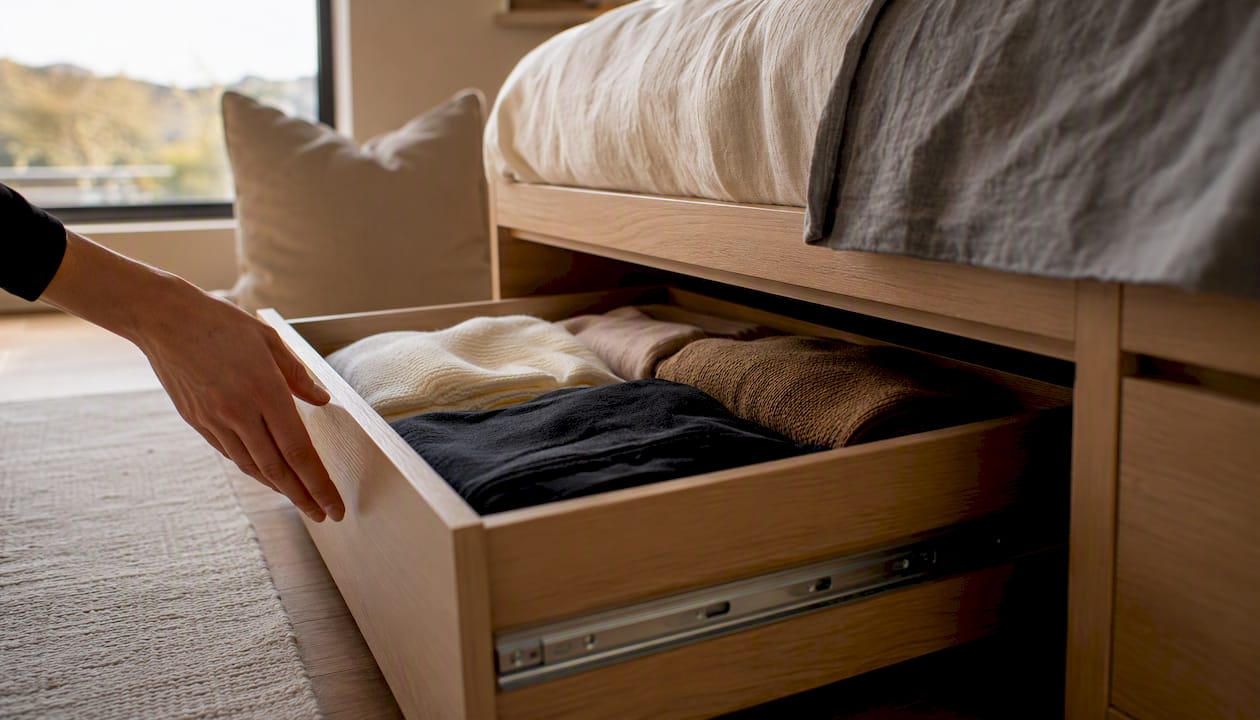
Aesthetic value follows from the cleaner lines a storage bed creates. Loose bins and rolling carts under a standard frame collect dust and create visual noise. Integrated drawers or a closed ottoman base present a finished, intentional look that reads as more expensive than it often is.
Ergonomic access varies by type. Drawers suit daily items because the motion is natural and low-effort. Lift-up platforms require more deliberate access — you raise the mattress, retrieve or store, then lower — which makes them better suited to seasonal items you touch a few times a year.
Pro Tip: Allocate drawer storage to items you use weekly or more often, and reserve lift-up compartments for seasonal bedding, luggage, and bulky items you access only a few times per year. Mixing the two types in one room gives you the best of both access patterns.
Remodelista notes that structured drawers and wheeled metal drawers offer premium durability and easier access compared with fabric bins, and editors recommend matching the access method to item frequency.
Honest trade-offs you should know before buying
Built-in storage beds are not the right answer for every situation. The trade-offs are real and worth understanding before you commit.
- Weight: A storage bed frame is substantially heavier than a standard platform, which complicates moving day and can stress older floors.
- Cost premium: Integrated storage adds to the price of any bed, whether ready-made or custom. The gap between a basic platform and a quality storage bed is meaningful.
- Mattress compatibility: Lift-up mechanisms have weight ratings. A heavy hybrid or latex mattress may exceed the piston rating on a budget ottoman bed, causing premature failure.
- Ventilation: Enclosed storage reduces airflow beneath the mattress. In humid climates, this can contribute to moisture buildup and mold if the compartments are not occasionally aired out.
- Repair and maintenance: Drawer slides wear, piston seals degrade, and hardware eventually needs replacement. A ready-made bed with proprietary hardware can be difficult to service.
In higher-humidity regions, the board choice inside a storage compartment matters as much as the hardware. Standard particleboard swells and delaminates when moisture accumulates in a sealed base. Moisture-resistant MDF or properly sealed plywood is the minimum standard for any storage bed used in a climate with seasonal humidity swings. Skipping this detail is one of the most common and costly mistakes in budget storage bed construction.
Resale flexibility is another consideration. A custom built-in storage bed is a permanent fixture; it does not move with you the way a freestanding dresser does. Megafurniture frames this clearly: custom carpentry is the right call when you plan to stay long-term, while ready-made wins when flexibility and speed matter more.
What should you actually store in a built-in bed?
The compartments work best when you match the item to the access type.
Good candidates for drawer storage:
- Folded clothing (T-shirts, sweaters, jeans)
- Extra pillowcases and sheet sets
- Towels and light blankets
- Books and magazines near a headboard unit
Good candidates for lift-up / ottoman storage:
- Seasonal comforters and duvets
- Off-season clothing in breathable bags
- Luggage and travel bags
- Extra pillows and decorative cushions
Items to avoid storing in any bed compartment:
- Anything requiring ventilation (leather goods, shoes without breathable bags)
- Valuables that should be in a locked safe
- Food items that attract pests
- Damp or wet items, even temporarily
Pro Tip: Use labeled, breathable fabric storage bags inside lift-up compartments. They keep items dust-free, make retrieval faster, and prevent the compartment from becoming a catch-all. For drawers, the KonMari vertical folding method lets you see every item at a glance without pulling the drawer fully open.
Pairing your storage bed with maximized bedroom closets creates a complete bedroom storage system where every category of item has a logical home.
How to measure and choose the right storage bed for your room
Getting the measurements right before you buy or commission a storage bed prevents the most common and expensive mistakes.
Step-by-step measurement checklist:
- Measure the room footprint and mark the bed’s intended position on a sketch. Note wall-to-wall distances on all sides.
- Measure doorway and stairway clearances to confirm the assembled frame can enter the room. Storage bed bases are often wider and heavier than standard frames.
- Confirm your mattress dimensions (twin, full, queen, king, California king) and note the mattress thickness. Lift-up mechanisms have maximum mattress weight ratings; verify the rating against your mattress weight before ordering.
- Measure drawer swing clearance: side-opening drawers need at least 24–30 inches of clear floor space beside the bed. Foot-opening drawers need clearance at the foot of the frame.
- For lift-up beds, measure ceiling height from the top of the mattress. The platform raises the mattress by roughly 18–24 inches when fully open; confirm you have enough headroom to access the compartment comfortably.
- Check floor levelness with a spirit level. An uneven floor causes drawers to drift open or stick and accelerates wear on slides.
- Measure adjacent furniture spacing to confirm the bed orientation works with nightstands, dressers, and traffic paths.
Additional checks:
- For headboard cabinet storage, measure the wall height behind the bed and confirm the headboard unit will clear any crown molding or ceiling slope.
- Note the direction of floor joists if you are concerned about concentrated weight from a heavy storage base.
- Ask a carpenter for an on-site measurement visit before commissioning a custom unit. A 30-minute site visit eliminates the guesswork that causes costly revisions later.
Pro Tip: Tape the bed’s footprint on the floor with painter’s tape before you order. Walk around it for a day. You will immediately see whether the drawer clearance is realistic or whether the layout needs to shift.
How materials and hardware determine how long your bed lasts
The frame and hardware are the skeleton of a storage bed. Get them right and the bed functions well for decades. Underspecify them and you are replacing pistons or drawer slides within a few years.
Material options:
- Solid wood: The most durable choice for the frame and drawer boxes. Resists humidity-driven swelling better than engineered panels and can be refinished. Higher cost and weight.
- Hardwood plywood: A strong, stable alternative to solid wood for large panels. Holds screws well and resists warping when properly sealed. The preferred choice for drawer bottoms and platform decking in custom builds.
- Moisture-resistant MDF or melamine board: Acceptable for interior compartment surfaces in dry climates; requires sealed edges to prevent swelling. Not recommended as the primary structural material.
- Standard particleboard: Common in budget ready-made beds. Swells readily in humidity, strips screws over time, and has a shorter service life. Avoid it for drawer boxes and base panels.
Hardware — the most critical decision:
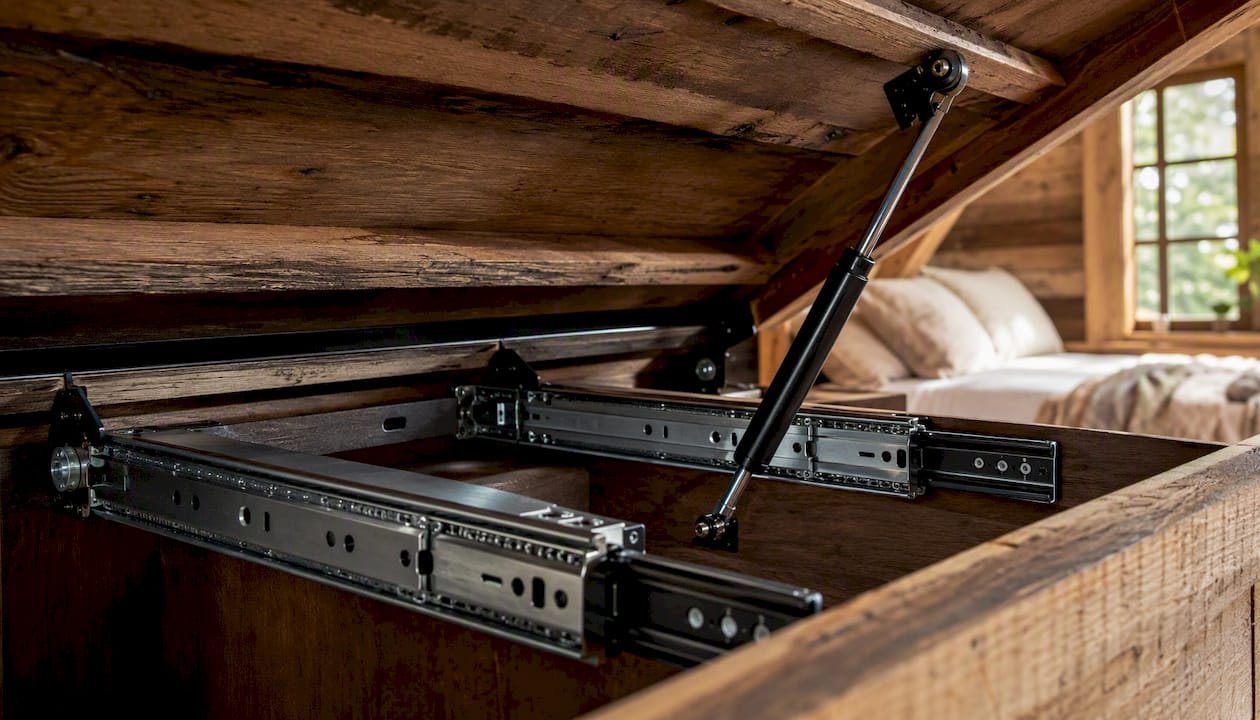
SelbyHardware identifies load-rated gas-lift pistons and heavy-duty drawer slides as the primary failure points in storage beds. Industrial-grade, sealed pistons rated for the actual mattress weight are the standard to insist on. For drawers, full-extension, ball-bearing slides rated for at least 75–100 lbs per pair outlast the economy alternatives by years. Drawer cabinet construction principles, including proper slide sizing and load ratings, apply directly to storage bed drawers.
| Material | Durability | Moisture Resistance | Best Use |
|---|---|---|---|
| Solid wood | Excellent | Good (sealed) | Frame, drawer boxes |
| Hardwood plywood | Very good | Good (sealed edges) | Panels, platform decking |
| Moisture-resistant MDF | Moderate | Good | Interior compartment surfaces |
| Standard particleboard | Poor | Poor | Avoid for structural use |
Joinery and support: A continuous base construction, as used in quality captain’s beds, eliminates the open void that collects dust and provides a more rigid platform for the mattress. Slat systems must be compatible with your mattress type; memory foam and latex mattresses require slats no more than 3 inches apart to prevent sagging.
Routine maintenance that keeps storage beds working for years
A storage bed is a mechanical system as much as a piece of furniture. Treating it like one extends its life considerably.
Quarterly checks:
- Tighten all visible fasteners, including bed rail bolts and drawer slide mounting screws. Vibration from daily use loosens them gradually.
- Test each drawer’s glide. A drawer that sticks or tilts forward usually has a loose slide or a mounting screw that has backed out.
- Inspect lift-up piston seals. A piston that no longer holds the platform open, or one that feels loose at the pivot point, needs replacement before it fails completely.
- Check the base panels for any signs of swelling or delamination, particularly at corners and edges.
Cleaning and storage hygiene:
- Vacuum lift compartments every three to four months. Dust and debris accumulate quickly in enclosed spaces.
- Use breathable fabric storage bags for linens and seasonal clothing. Plastic bags trap moisture and accelerate mildew.
- Wipe drawer interiors with a dry cloth seasonally. Avoid damp cleaning inside enclosed compartments.
- Air out lift compartments by leaving the platform raised for 30–60 minutes on dry days, especially after humid seasons.
When to call a professional: Piston replacement on a lift-up bed is a two-person job and requires matching the original gas-lift stroke and weight rating. Drawer slide replacement on a captain’s bed often requires partial disassembly of the base. Both are straightforward for an experienced carpenter but carry a real risk of damage if attempted without the right tools or knowledge.
When is a custom-built storage bed worth the investment?
Ready-made storage beds serve most standard rooms well. Custom carpentry earns its cost in specific situations, and knowing those situations prevents both overspending and under-building.
Custom is the right call when:
- The room has irregular geometry: angled walls, alcoves, sloped ceilings, or non-standard dimensions that a ready-made frame cannot accommodate.
- You want integrated headboard cabinetry, matching built-in nightstands, or a storage system that reads as a single architectural element rather than assembled furniture.
- The finish must match existing millwork, cabinetry, or flooring in the room.
- You plan to occupy the space long-term and want a permanent installation built to last 20 or more years.
- The mattress or structural load requirements exceed what standard ready-made hardware is rated for.
What custom adds beyond the frame:
- Tailored storage layout: drawer depth, compartment width, and lift-stroke length specified to your actual items.
- Higher-grade materials: sealed hardwood plywood, solid wood drawer boxes, and moisture-treated board for the base panels.
- Specified hardware: load-rated pistons and full-extension ball-bearing slides selected for the actual mattress weight and use frequency.
- Integrated solutions: custom shelving built into the headboard, matching side cabinets, or a platform that aligns with existing bedroom space-saving carpentry.
The single most common mistake in a custom storage bed commission is underspecifying the hardware. Clients focus on the wood species and the finish, which are visible, and accept whatever drawer slides and pistons the builder proposes. Insist on the hardware spec sheet before signing. A load-rated, sealed gas piston costs more than a budget alternative, but it is the component you will interact with every day for the next 15 years. The wood will outlast the hardware if you choose wrong.
Pro Tip: When comparing a custom quote to a ready-made alternative, calculate the total cost of the ready-made option including any additional furniture it does not replace. A custom storage bed that eliminates a dresser and a storage bench often costs less than the sum of those three pieces purchased separately.
How carpenters personalize standard designs for specific rooms is a useful reference when evaluating whether a custom scope is warranted for your project.
A carpenter’s perspective on what clients actually need
The most common request Woodmadeillinois receives for bedroom projects is not a specific bed style. It is a request to make a room feel larger without moving walls. Built-in storage beds are one of the most direct answers to that request, because they consolidate what would otherwise be three or four separate pieces of furniture into a single, fitted element.
What the team sees repeatedly in the field: clients who purchased a ready-made storage bed and are now dealing with drawer slides that have stripped their mounting holes in particleboard, or lift pistons that no longer hold the platform open. The frame looks fine from the outside, but the mechanical components were underspecified for daily use. With over 100 years of combined carpentry experience, the Woodmadeillinois team approaches every storage bed project by specifying the hardware first, then selecting the materials to support it, not the other way around.
Woodmadeillinois builds storage beds that work as hard as your room demands
Families and homeowners across Central Illinois who want a storage bed that fits their exact room, matches their existing millwork, and uses hardware rated for real daily use have a direct option: a custom build from Woodmadeillinois.
The team handles every stage, from an on-site measurement visit to hardware selection, material sourcing, and installation. Whether the project calls for a captain’s bed with full-extension drawer slides, a lift-up platform with load-rated pistons, or an integrated headboard cabinet system, Woodmadeillinois brings the same standard of construction to each one. Ready-made beds are a reasonable starting point for standard rooms, but when the geometry is irregular, the finish needs to match, or the investment needs to last decades, a custom build is the more durable answer. Reach out to the trusted local carpentry experts at Woodmadeillinois to schedule a consultation and see examples of past bedroom builds.
Sources
- The Complete Storage Bed Guide: Types, Benefits & Expert Tips – Chairish Blog
- 10 easy pieces: bed storage solutions – Remodelista
- Trend on the bubble: storage beds break out of the dorm – The Denver Post
- Captain’s Bed Benefits – Built-In Drawer Storage That Replaces a Dresser – Comfort Pure
- 7 Benefits of Having Storage Built Into Your Bed – Beaudoin Beds
- Built-In vs Ready-Made Bed With Storage: Which Makes Sense in a HDB – Megafurniture