Open shelving suits modern homes when it’s used with intention, not as a wholesale replacement for cabinetry. The reasons come down to three things: visual lightness in rooms that already lean toward open-plan living, faster daily access to the items you reach for most, and a chance to turn storage into curated display. The catch is that open shelving asks something of you in return.
- It needs regular editing, not just installation.
- Cooking zones need real ventilation, or grease becomes a maintenance headache.
- It works best as one element in a hybrid system, not the whole storage plan.
Key Takeaways
Open shelving suits modern homes best as a selective, well-maintained complement to closed cabinetry rather than a full replacement for it.
| Point | Details |
|---|---|
| Use it selectively | Reserve open shelving for coffee stations, range hood flanks, and display niches, not the whole storage wall. |
| Follow the 60 to 70% rule | Leave visible negative space so shelves read as styled rather than crammed. |
| Mount into studs with rated hardware | Anchor to studs and choose brackets rated for the load, with a safety margin built in. |
| Plan for upkeep | Weekly wipe-downs and good range hood ventilation keep dust and grease from taking over. |
| Build it with a pro | Woodmadeillinois designs and installs custom shelving matched to your home’s studs, load needs, and finish. |
Table of Contents
- Why Open Shelving Suits Modern Homes: The Design Logic
- Where Open Shelving Actually Belongs in Your Home
- How to Style Open Shelves Without Turning Them into Clutter
- Choosing Materials, Depth, and Safe Mounting
- The Honest Trade-Offs: Dust, Grease, and Upkeep
- A Quick Checklist for Mixing Open and Closed Storage
- What Years of Custom Builds Teach You About Shelving
- Get Custom Open Shelving Built and Installed Right
- Sources
Why Open Shelving Suits Modern Homes: The Design Logic
Designers keep coming back to open shelving for a simple reason: it changes how a room reads before it changes anything about how the room functions. Solid upper cabinets create a wall. Open shelving creates a gap the eye can travel through, which is exactly what modern, open-concept homes need when a kitchen bleeds into a living space and every surface is competing for visual attention.
That lightness has a practical twin. When mugs, everyday plates, and the olive oil bottle live on an open shelf instead of behind a door, you cut out the small repeated motion of opening and closing cabinets dozens of times a day. It sounds trivial until you notice how much of a cook’s rhythm is built around not having to think about where things are.
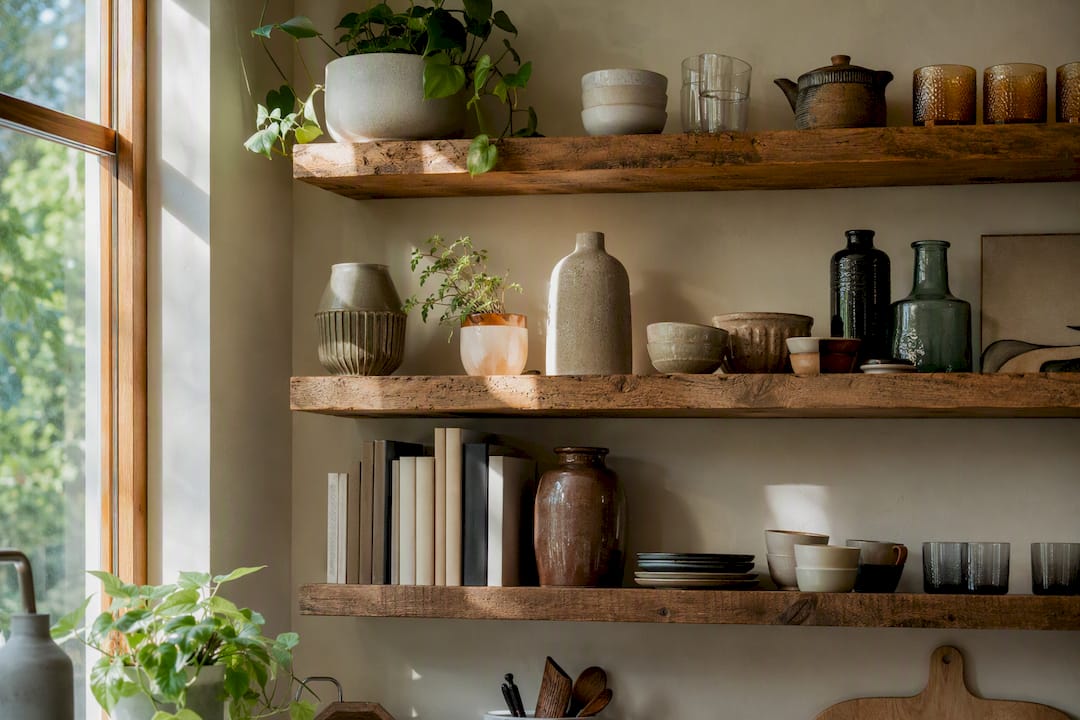
Shelves also do double duty as decor. A row of ceramics, a stack of cookbooks, a scattering of plants, none of that happens behind a cabinet door. Designers describe treating open shelving like curated art rather than storage, which flips the usual logic: your collection should shape the shelf, not the other way around.
The benefits concentrate in specific spots rather than spreading evenly across a home. Small kitchens, coffee stations, and the walls flanking a range hood are where open shelving earns its keep, because those are the zones where visual breathing room and grab-and-go access matter the most.
Where it works hardest:
- Small or galley kitchens that need to feel bigger than they are
- Coffee bars and beverage stations
- Niches beside a range hood or window
- Reading nooks and living room alcoves
Where Open Shelving Actually Belongs in Your Home
Open shelving isn’t a kitchen-only idea, but the kitchen is where it does its most visible work. Here’s where it tends to earn its place, room by room.
- Kitchen zones. A coffee station with cups and a French press on display, shelves flanking the range hood for everyday cookware, or a slim open pantry wall for staples in glass jars. These spots reward visibility.
- Bathrooms and powder rooms. Folded towels, a small tray of soaps, one or two curated toiletries. Open shelving here reads spa-like when it’s edited, cluttered when it’s not.
- Laundry rooms and mudrooms. Labeled bins and woven baskets on open shelves keep gear visible and grabbable on the way out the door, which matters more than pure aesthetics in these rooms and fit perfectly with home organization systems to streamline your space.
- Living rooms and alcoves. Built-in shelves for books, framed photos, and a few sculptural objects give a room personality without the bulk of a full media console.
Open shelving is the wrong call for a primary storage wall meant to hide everyday mess, and it’s a poor fit for households that don’t have the habit or the patience to keep things edited. If that’s you, closed cabinetry earns its cost there.
How to Style Open Shelves Without Turning Them into Clutter
The difference between a shelf that looks styled and one that looks abandoned usually comes down to restraint. Aim for 60 to 70% coverage and leave the rest as breathing room; designers who style shelves for a living consistently point to leaving 30 to 40% empty as the difference between a composed shelf and a crowded one. Rotate items seasonally so the shelf feels lived in rather than staged once and forgotten.
Composition rules that hold up in real rooms:
- Group items in odd numbers (three or five, rarely two or four)
- Mix heights: a tall vase next to a low stack of bowls reads better than a uniform row
- Repeat one material or color across a shelf run to tie it together visually
- Leave negative space at the ends, not just the middle
Backdrops carry more weight than people expect. A shelf mounted against bare drywall looks unfinished; the same shelf against tile, a painted accent wall, or wallpaper suddenly looks intentional. Integrated under-shelf lighting or a simple accent fixture adds warmth after dark and makes even a modest display feel finished.
Not everything belongs up there. Good candidates are items with shape and texture: ceramics, cookbooks, glassware, small plants, a cutting board leaned on its edge. Bad candidates are anything you use once a year, anything with a cord, and anything you’d be embarrassed to have a guest see up close.
Pro Tip: Photograph your shelf before you call it done, then look at the photo instead of the shelf itself. Cameras flatten a room the way a visitor’s eye does, and they’ll expose the gaps or clutter faster than staring at it in person.
Choosing Materials, Depth, and Safe Mounting
Material choice sets the tone before a single object goes on the shelf. Solid walnut or oak reads warm and traditional. Powder-coated steel brackets with a wood plank feel more industrial-modern. Glass shelving disappears visually, which works well in a small bathroom but shows every fingerprint in a busy kitchen.
Depth matters more than most homeowners assume. 10 to 12 inches handles dishes, mugs, and most display objects without looking bulky. Go deeper only when you genuinely need it, since a shelf that’s too deep for what sits on it just reads as empty space with a lip.
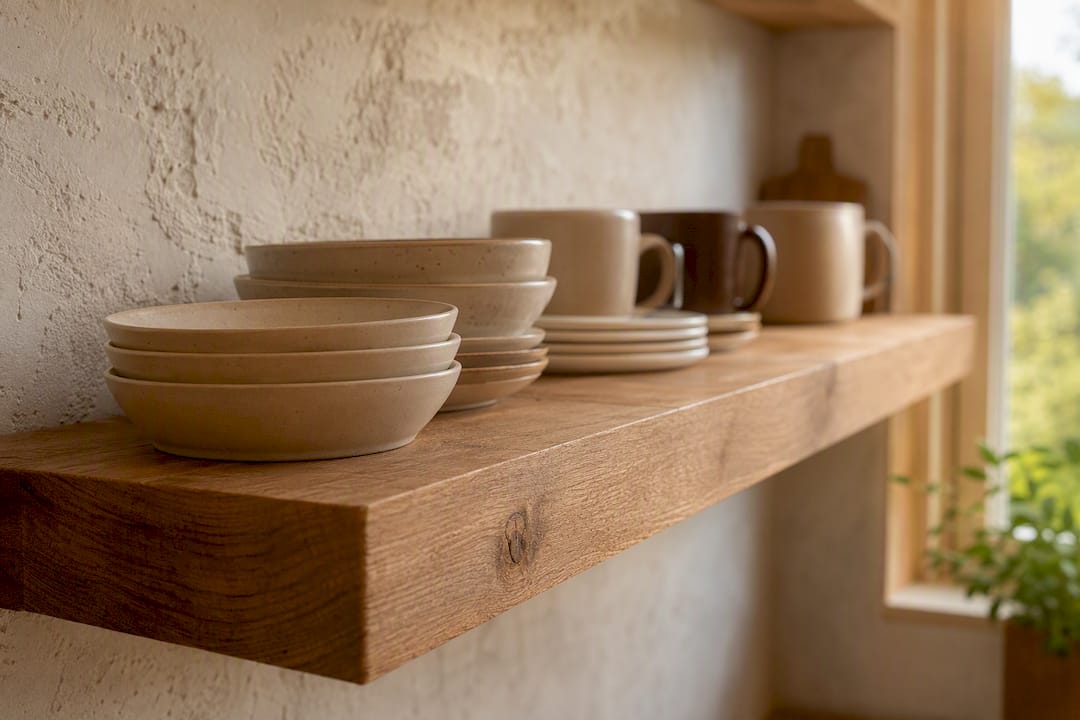
Shelf thickness changes the visual language too. Thin profiles around 12 millimeters look crisp and modern, while a thicker board near 1.5 inches can house integrated lighting and feels more substantial on the wall.
Mounting is where safety actually lives. Locate studs before you drill, and choose brackets rated for the load you expect. Anchoring to studs with load-rated hardware is the baseline; a hidden mount or floating bracket looks cleaner but still needs that structural backing to hold real weight over time.
Quick reference for going it alone vs. calling a pro:
- DIY-friendly: a single light shelf with basic brackets into studs
- Hire a pro: multi-shelf runs, heavy loads (cast iron, dense cookbook collections), floating or hidden-mount systems, or any install into plaster or masonry
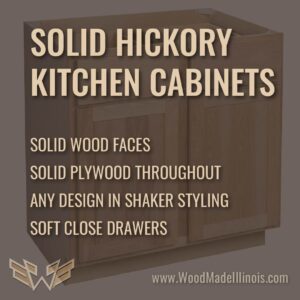
If you’re weighing shelving against a full cabinet run, browsing a solid oak kitchen build side by side with an open shelf mockup makes the material and cost trade-offs concrete fast.
The Honest Trade-Offs: Dust, Grease, and Upkeep
Open shelving trades a closed door for visibility, and visibility comes with maintenance. Dust settles on every surface whether or not you’re looking at it, and near a stove, airborne grease finds its way onto anything exposed. Open shelving genuinely requires more frequent cleaning than cabinetry, and a well-vented, exterior-ducted range hood does more to control that grease migration than any amount of wiping down after the fact.
A realistic upkeep rhythm:
- Weekly: quick wipe-down of frequently touched items
- Monthly: rotate or deep-clean rarely used pieces so nothing sits collecting dust for a season
- Ongoing: keep a vented hood running during and after cooking, not just while the burner’s on
For high-moisture or high-grease zones, stainless surfaces or tempered glass wipe clean faster than porous wood finishes. Pairing one open run with a closed cabinet nearby for pots, small appliances, and anything genuinely messy keeps the display honest without turning maintenance into a chore. Buyers touring a home tend to read well-kept open shelving as a sign of an attentive owner, and poorly maintained shelves as the opposite, so the upkeep isn’t just cosmetic. It shapes how the whole kitchen gets judged.
A Quick Checklist for Mixing Open and Closed Storage
Deciding how much open shelving to add comes down to a handful of honest questions about how you actually live, not how you’d like to live.
- Do you edit your stuff regularly? If clutter tends to pile up and stay, lean closed. If you’re naturally tidy, open shelving will look good more often than not.
- How often do you cook, and how well is the kitchen ventilated? Heavy daily cooking without a strong exhaust fan argues for keeping open shelves away from the stove or skipping them there entirely.
- What are your sightlines? A shelf visible from the dining table or entryway needs to look intentional at all times; one tucked in a side kitchen zone has more forgiving margin.
- What goes where? Daily-use dishware, glassware, and display pieces suit open shelves. Cookware, bulk pantry goods, and small appliances belong behind doors.
- What’s your budget and timeline? Open shelving typically costs less than a full run of upper cabinets and installs faster, which makes it a smart interim step if you’re renovating in phases rather than all at once.
Most kitchens that age well settle into a hybrid split: open shelving in one or two zones, closed cabinetry for the rest, which gives you the display benefit without asking the whole kitchen to stay perfectly curated all the time.
What Years of Custom Builds Teach You About Shelving
Working through custom installs across Central Illinois homes, a few patterns hold up project after project. Hidden mounts and French cleat systems consistently outperform simple L-brackets for anything heavier than light display items, since the cleat spreads weight across a wider run of studs rather than concentrating it on two or three points.
Material choice shows its consequences years later, not on install day. A well-finished hardwood shelf with tight joinery still looks sharp after years of daily use, while a poorly joined or under-finished piece starts showing gaps and wear within a season or two near a stove.
What tends to work across projects:
- French cleat mounting for anything holding real weight
- A durable finish that resists grease and moisture, not just one that looks good on day one
- Combining a few open runs with a closed cabinet nearby, rather than converting an entire wall
Pro Tip: If you’re only doing one thing right, spend the extra budget on the mounting hardware and joinery, not the shelf’s finish. A beautiful shelf that sags or pulls loose in a year costs more to fix than it saved going cheap.
A Carpenter’s View on Living with Open Shelves
The households that stick with open shelving long term tend to share one habit: they treat the shelf like a small, recurring chore instead of a one-time styling project. A weekly wipe and a monthly reshuffle keep it from ever looking tired. Starting with a single run, one niche or one coffee station, before committing a whole wall, is the lowest-risk way to find out whether you’re actually someone who enjoys keeping a shelf edited or someone who’d rather close a door on it.
Get Custom Open Shelving Built and Installed Right
Open shelving only delivers on its promise when the mounting is solid and the material holds up to daily use, and that’s exactly where Woodmadeillinois comes in for homeowners across Central Illinois. We build custom shelving, floating shelf systems, pipe-built shelving, and pallet wood accents tailored to your studs, your load needs, and your room’s sightlines, not a one-size-fits-all kit from a big-box store.
Hiring a pro matters most where safety and finish intersect: load-bearing brackets rated with a real margin, integrated lighting wired in cleanly, and a cohesive look that matches the rest of your cabinetry instead of looking bolted on. If you’re weighing open shelving against a fuller kitchen remodel, our kitchen cabinet service team can walk you through the hybrid split that fits your budget. Ready to see what fits your space? Request a consultation with our trusted local carpentry experts and get a plan built around how you actually cook, store, and live.
Sources
- Open shelving: designer tips (HouseBeautiful)
- Kitchen shelves: open shelving guide (ASHDECO)
- Open storage tips (HGTV)
- Open shelving vs cabinets (Artezia)