
Engineered hardwood typically needs a few days of acclimation, while solid hardwood often needs several days or longer depending on the gap between the wood’s moisture content and the room’s conditions. Calendar time alone never tells the real story: what decides readiness is a stable, matching moisture content (MC) across flooring and subfloor, confirmed with a meter rather than a guess, while the HVAC system holds normal living conditions throughout.
TL;DR:
- Acclimation should be based on matching moisture content between flooring and subfloor, confirmed with a moisture meter, not just time elapsed.
- Thicker, wider, or exotic hardwoods require longer acclimation periods due to slower moisture exchange, especially after long shipping or in winter conditions.
- Proper site preparation involves running HVAC at least 48 to 72 hours before delivery and maintaining stable temperature and humidity throughout installation.
- Regular moisture testing across multiple samples and monitoring room conditions are critical to determine when the wood has truly stabilized.
- Installing before reaching equilibrium often results in long-term issues like gapping, cupping, or buckling, which are best prevented with thorough testing and timing.
Table of Contents
- Recommended acclimation times and how to interpret them
- Site preparation: HVAC, normal living conditions, and timeline
- Measuring and testing: moisture content, RH, and EMC targets
- Step-by-step acclimation procedure for the jobsite
- Signs of inadequate acclimation and how to fix problems
- Practitioner tips from experienced carpenters
- Why acclimation matters to long-term floor performance
- How we help with moisture testing and acclimation-ready installation
- FAQ
- Sources
Recommended acclimation times and how to interpret them
The ranges carpenters and flooring installers work from are not arbitrary. Manufacturer guidance commonly calls for delivering engineered flooring a couple of days before installation, with solid wood held back several days, stored in the room where it will eventually live. Practical lumber acclimation data backs this up at a broader scale: thin stock can equilibrate in three to seven days, mid-thickness boards may need one to two weeks, and thick slabs can take considerably longer, though kiln-dried flooring stock generally moves faster than raw lumber because it starts closer to a stable moisture level.
Several variables stretch or shrink that window:
- Thickness and width: thicker, wider boards hold moisture longer and resist change, so they need more time to reach equilibrium.
- Species: dense exotics and tight-grained hardwoods absorb and release moisture more slowly than domestic species like red oak.
- Shipping history: a truckload that crossed several climate zones often arrives further from the jobsite’s equilibrium than one sourced locally.
- Season: winter heating dries indoor air sharply, which can pull installed wood tighter than flooring acclimated during a humid summer.
When any of these factors stack together, such as an exotic species delivered in January after a long haul, the smart move is to extend acclimation and retest rather than install on a fixed schedule. The Wood Handbook’s chapter on moisture relations explains why: wood’s equilibrium moisture content depends on both temperature and relative humidity, and sorption hysteresis means wood does not dry and re-wet the same way twice, so its prior storage conditions genuinely affect how long it takes to settle into a new room.
Site preparation: HVAC, normal living conditions, and timeline
Acclimation only works when the room itself behaves like a finished, occupied space. “Normal living conditions” generally means temperatures between about 60 and 80 degrees Fahrenheit and relative humidity between roughly 30 and 50 percent, the same range most manufacturers specify for ongoing occupancy, not just installation day. NWFA guidance on winter installation ties this directly to avoiding movement after the floor goes down.
To get there reliably:
- Run the HVAC system before delivery. Industry guidance generally calls for at least 48 to 72 hours of conditioned air before flooring arrives, and some NWFA installation materials recommend up to five days when the home has sat vacant or unconditioned.
- Use temporary conditioning if permanent HVAC is not yet active. Portable heaters, dehumidifiers, or window units can hold a room in range on new construction where ductwork is not finished.
- Keep the system running through installation and beyond. Shutting off climate control the moment boards go down undoes the acclimation work.
Pro Tip: A thermostat set correctly on install day means little if the system was off for the two weeks before delivery; log temperature and humidity daily so you have proof the room was stable, not just comfortable on the day you checked.
Fixed day counts are a starting point, never the finish line. A room that swings from 25 percent to 55 percent relative humidity over a week has not acclimated anything, no matter how many days have passed.
Measuring and testing: moisture content, RH, and EMC targets
A tape measure and a calendar will not tell you whether a floor is ready; a moisture meter will. Pin meters measure electrical resistance between two probes and work well for spot checks, while pinless meters scan a wider area without marking the wood, which makes them useful for sampling many boards quickly across a delivered lot.
- Sample broadly: check multiple boxes and multiple boards within each box, not just the top layer, since a pallet can include wood from different drying runs.
- Compare flooring MC to subfloor MC: the goal is a close match, not just an acceptable number in isolation.
- Watch the spread, not just the average: a tight range across samples matters as much as hitting a target number.
- Test concrete subfloors separately: calcium chloride tests or in-situ RH probes catch slab moisture that a surface check would miss entirely.
Experienced installers treat lot variance as a pass or fail signal. The NWFA installation guidelines describe sampling multiple boxes and rejecting shipments when the spread across boards exceeds manufacturer tolerances, even if the average reading looks fine.
Underlying all of this is equilibrium moisture content, or EMC: the point at which wood is neither gaining nor losing moisture because it has settled into balance with the surrounding air. The Wood Handbook frames EMC as a direct function of relative humidity and temperature, which is why a hygrometer reading tells you almost as much as the wood meter itself: get the air right, and the wood follows.
Step-by-step acclimation procedure for the jobsite
Acclimation is less a waiting game than a monitoring routine. Following a consistent sequence catches problems before they become installation defects.
- Inspect the delivery immediately. Check for shipping damage, then take initial MC readings across several boxes and record them with the date, so you have a baseline to compare against later.
- Cross-stack with stickers. Lay boards in alternating layers separated by thin wood spacers, leaving one to two inches of airflow between layers so every piece contacts conditioned air evenly.
- Store in the installation room, not a garage or basement. A detached garage or an unconditioned basement rarely matches the temperature and humidity of the living space where the floor will actually sit.
- Monitor daily. Record both the wood’s MC and the room’s RH and temperature at the same time each day; look for readings to flatten out, generally over 24 to 48 hours of minimal change, before calling the lot stable.
- Compare against the subfloor. Readiness means the flooring and the subfloor are close in moisture content, not just that the flooring hit a number in isolation.
- Act when readings will not settle. If MC keeps drifting after several days, check for a hidden moisture source such as a leak or high subfloor RH, extend the acclimation period, or contact the manufacturer for lot-specific guidance before installing.
Pro Tip: Keep a simple daily log with room RH, room temperature, and average plank MC in three columns; a flat line across two consecutive days is a far more reliable “ready” signal than any fixed number of days on a calendar.
This sequence matters more on jobs with tight schedules, where the temptation to install on day three regardless of readings is strongest. A floor installed a day late because the numbers were not flat yet costs far less than one that is torn out for cupping six months later.
Signs of inadequate acclimation and how to fix problems
Wood that was installed before reaching equilibrium tends to announce itself within one heating season. The pattern usually points to a specific cause:
- Gapping: boards shrink and separate when the home’s air gets drier than it was at installation, often from winter heating; minor seasonal gaps are normal, but wide persistent ones suggest the wood was too wet when installed.
- Cupping: edges rise above the center when the bottom of a board holds more moisture than the top, frequently from a damp subfloor that was never properly tested.
- Crowning: the opposite of cupping, with the center higher than the edges, often from installing before excess moisture from a recent sanding or finishing step fully left the wood.
- Buckling: boards lift from the subfloor entirely, a severe reaction usually tied to standing water or a major moisture event rather than ordinary acclimation shortfalls.
Small seasonal gaps and mild cupping are expected wood behavior, not defects, according to NWFA’s problem-prevention guidance. Large or permanent changes, by contrast, usually point to a moisture management failure at installation and call for a professional evaluation rather than a quick fix.
Practitioner tips from experienced carpenters
Carpenters who install flooring regularly treat the first hour on a jobsite as a screening process, not a formality. A quick pass through several boxes with a meter flags a non-uniform lot before it becomes a callback.
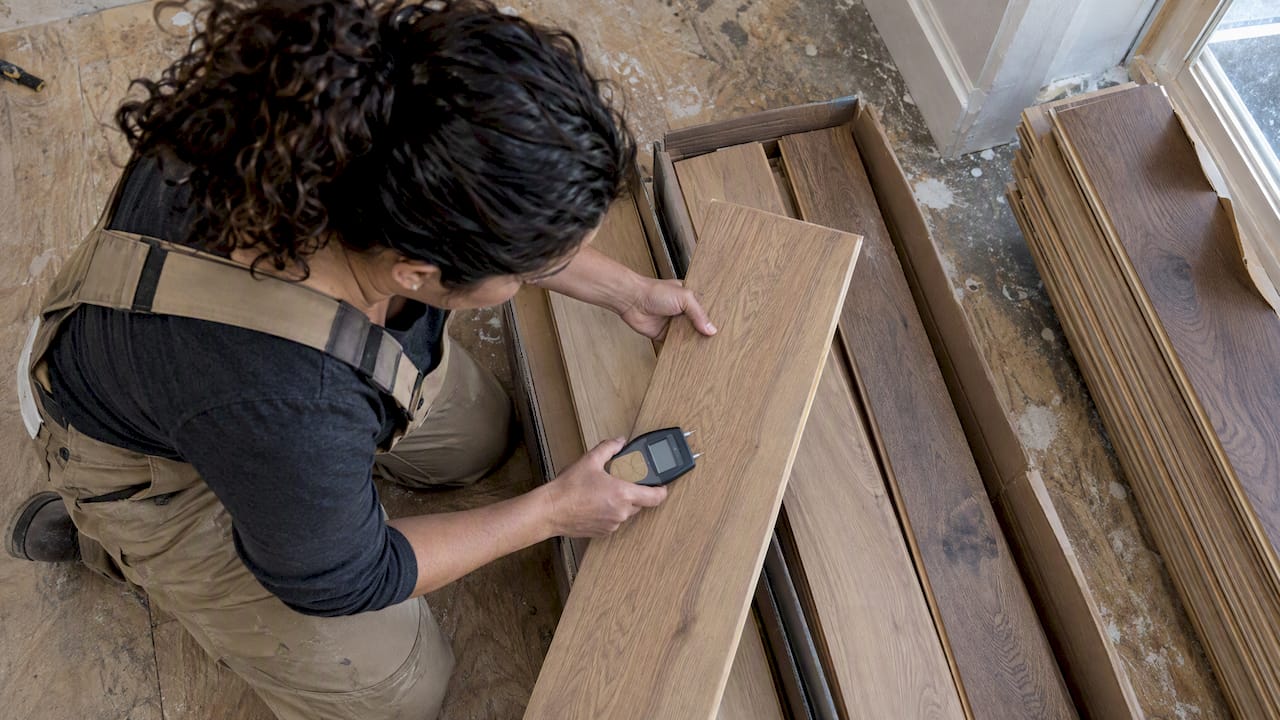
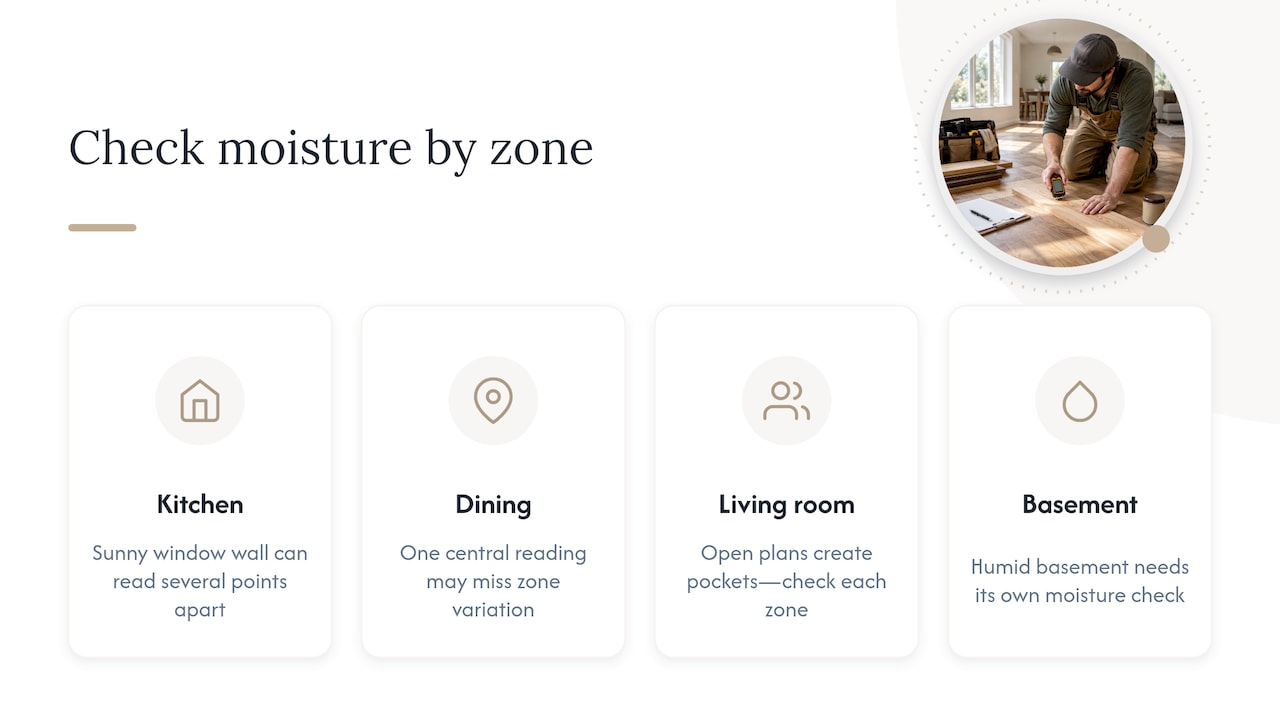
The general tolerance seasoned installers work within is tight: a wide spread across boards in the same shipment is treated as a reason to hold the job, not install around it. Older houses and open floor plans complicate things further, since original joinery and uneven insulation can create humidity pockets that a single hygrometer reading near the thermostat will miss entirely. A humid basement beneath an otherwise dry main floor deserves its own moisture check rather than an assumption that the upstairs reading applies throughout.
Pro Tip: In open floor plans spanning a kitchen, dining area, and living room, take readings in each zone rather than one central spot; a sunny window wall or an adjacent laundry area can run several points apart from the rest of the space.
Why acclimation matters to long-term floor performance
Treating acclimation as a formality rather than a measurement discipline is the single most avoidable mistake we see lead to callbacks. A floor that looks perfect on install day can still fail months later if the numbers were never actually flat. Our approach starts with testing, not scheduling. Test the wood. Test the room. Then install.
— Wood
How we help with moisture testing and acclimation-ready installation
We handle hardwood flooring installation for homes across Central Illinois, and that work starts with a real moisture check, not a calendar estimate. We can assess your site’s conditions, test flooring and subfloor moisture before a single board goes down, and flag problems while they are still cheap to fix.

If a previous installation already shows gapping or cupping, our hardwood floor repair services address those issues directly. Reach out through our site to schedule a pre-install assessment for your project.
FAQ
What happens if you don’t let wood flooring acclimate?
Flooring installed before it reaches equilibrium with the room tends to shrink, swell, or distort once the indoor humidity shifts with the seasons. The result is often gapping, cupping, or buckling, problems that trace back to moisture content mismatches rather than installation technique.
How long should wood floors acclimate before installation?
Engineered hardwood typically needs about 48 to 72 hours, while solid hardwood often needs three to seven days or more depending on species, thickness, and how far the delivered moisture content sits from the room’s level. The real test is a stable, matching moisture reading between flooring and subfloor, not a fixed number of days.
Will hardwood acclimate in the box?
Hardwood acclimates far more slowly inside sealed packaging, since the boxing itself blocks the airflow needed for moisture exchange with the room. Cross-stacking the boards with spacers after unboxing exposes more wood surface to the conditioned air and speeds the process considerably.
Is 24 hours long enough to acclimate laminate flooring?
Laminate and engineered products generally need longer than 24 hours, with most manufacturer guidance pointing toward at least 48 hours in the installation space. Confirming the room has held normal living conditions, generally 60 to 80 degrees Fahrenheit and 30 to 50 percent relative humidity, matters as much as the hour count itself.
Sources
- NWFA installation guidelines
- Wood Handbook, Chapter 04: Moisture Relations and Physical Properties of Wood