Expect a range of material costs for 50 square feet with free, heat-treated pallets at the low end, higher costs for reclaimed planks, and even more for prefinished or peel-and-stick panels. Hiring a pro typically pushes total cost higher depending on wall condition and scope. The single biggest swing factor isn’t the wood itself. It’s whether your labor is free or billed.
TL;DR:
- Reclaimed wood for 50 square feet typically costs between $200 and $500, while prefinished or peel-and-stick panels range from $250 to $600.
- DIY installation usually takes one to two weekends for a small wall, but labor costs rise significantly when hiring professionals for complex conditions, with fixed-price quotes recommended.
- Additional costs such as electrical box extenders, fasteners, sealants, and delivery can add 10% to 20% to the project’s total budget, especially if overlooked.
- Pallet availability and regional labor rates heavily influence overall costs, with urban areas often facing higher prices and longer sourcing times.
- Maintaining a pallet wall involves periodic resealing or sanding and replacing cracked boards, generally costing less over time than drywall repairs or repainting.
Table of Contents
- What Does a Pallet Wall Cost Per Square Foot?
- Free Pallets vs. Reclaimed Boards vs. Prefinished Panels
- DIY Installation vs. Hiring a Carpenter: Time and Cost
- Hidden Costs That Blow Up a Pallet Wall Budget
- Tools and Prep Steps for a DIY Pallet Wall
- How to Cut Pallet Wall Cost Without Cutting Corners
- Realistic Timeline for a Pallet Wall Project
- When Hiring Wood Made Illinois Makes Financial Sense
- What Homeowners Consistently Underestimate About Regional Costs
- What Pallet Walls Cost to Maintain Over Time
- What Nobody Tells You Before Your First Pallet Wall
- Get a Budget-Conscious Quote From Wood Made Illinois
- Sources
What Does a Pallet Wall Cost Per Square Foot?
Material choice drives the range far more than the wall’s size. A homeowner sourcing free pallets pays almost nothing for wood but trades that savings for hours of disassembly, denailing, and sanding. Someone buying prefinished panels skips that labor but pays retail prices from the first board.
Here’s how the numbers shake out for two common project sizes, based on pricing patterns from DIY pallet wall projects:
A small accent wall behind a bed headboard (50 sq ft) using free pallets can land under $50 if you already own a saw and nail gun. A 200 sq ft living room feature wall using reclaimed boards, plus contractor installation, commonly runs several times higher once labor is added on top of material costs.
Free Pallets vs. Reclaimed Boards vs. Prefinished Panels
Every material route sits on a sliding scale between cash outlay and sweat equity. Free pallets cost nothing to acquire but demand real prep time: pulling boards apart without splitting them, pulling nails, and sanding rough surfaces smooth. Before you use any salvaged pallet indoors, check for a stamped “HT” marking. That’s the accepted shorthand confirming the wood was heat-treated rather than chemically fumigated, and a pallet without that stamp should be treated as unsuitable for interior use.
Purchased materials remove the guesswork:
- Reclaimed planks sold by the bundle typically run $200 to $500 for 50 square feet, already cut to consistent widths.
- Peel-and-stick and faux pallet panels sit at $250 to $600 for the same coverage, with retail listings on sites like Amazon showing fairly consistent per-square-foot pricing.
- Shipping and delivery fees can add 10% to 20% to bundled orders, especially outside metro areas.
Availability also varies. Pallets are often free from warehouses or classified listings, but supply isn’t guaranteed on any given week.
DIY Installation vs. Hiring a Carpenter: Time and Cost
DIY installation wins on cash outlay but costs you weekends. A realistic timeline for a 50 square foot wall, based on project walkthroughs like the one on Instructables, runs one to two weekends depending on how much disassembly and sanding the boards need.
Hiring a carpenter shifts the math. Installed pricing climbs when a wall has obstacles: outlets, uneven drywall, or corners that need custom trim work. Here’s what separates a comparable quote from a vague one:
- Ask whether the quote includes materials or labor only.
- Confirm the wall’s condition was inspected in person, not estimated from photos alone.
- Get the finish (stain, sealant, trim) spelled out as included or extra.
- Ask about cleanup and disposal of scrap wood.
- Request a written timeline, not just a total price.
Uneven walls and electrical work are the two most common reasons a bid comes in higher than expected.
Hidden Costs That Blow Up a Pallet Wall Budget
The line items that catch DIYers off guard rarely show up in the “wood cost” number at all. Electrical box extenders are the most overlooked: adding board thickness to a wall pushes outlets and switches back into the wall cavity, and extension brackets are needed to bring them flush again. Budget for one per outlet or switch on the wall.
Other costs to plan for:
- Fasteners (finish nails, construction adhesive) typically add $15 to $40 per project.
- Sandpaper, wood filler, and sealant or polyurethane often run another $20 to $50.
- Delivery fees or pallet disassembly tools if you don’t already own a pry bar or reciprocating saw.
- A waste buffer of roughly 10% extra material for cuts and mismatched boards.
Pro Tip: Price out electrical box extenders before you buy a single board. It’s a $5 to $15 item per outlet, but skipping it means a switch plate that won’t sit flush once your wall gains an inch of thickness.
Tools and Prep Steps for a DIY Pallet Wall
Most first-time DIYers already own half the tool list. A miter saw or basic skill saw handles cuts; a nail gun speeds up attachment, though a hammer and finish nails work fine for a smaller wall. You’ll also want a sander, a caulk gun for adhesive, and a level or chalk line for layout.
Renting a nail gun for a weekend often costs less than buying one outright if this is a one-time project. The workflow itself stays simple:
- Prep boards (denail, sand, sort by color and width).
- Lay out the pattern on the floor before anything touches the wall.
- Attach boards working from the bottom up.
- Trim edges and outlet cutouts last.
- Finish with stain, sealant, or leave raw depending on the look.
How to Cut Pallet Wall Cost Without Cutting Corners
Free pallets make sense when you have time to spare and can verify the HT stamp on every board. Reclaimed or prefinished options make more sense when your weekends are limited or your walls need a more consistent look.
A few design choices stretch a tight budget further:
- Build a partial accent panel instead of covering a full wall.
- Frame a narrower strip behind a headboard or television rather than floor to ceiling.
- Use slightly narrower board widths, which use less wood per square foot of coverage.
Pro Tip: A thin coat of matte sealant, sanded only on the faces that get touched, looks nearly identical to a fully sanded and heavily coated wall. Save the extra sanding hours for boards at eye level.
Realistic Timeline for a Pallet Wall Project
Sourcing free pallets can take longer than buying, since supply depends on what’s available that week from warehouses or online listings. Once you have material, plan on a few hours of disassembly and sanding per 10 to 15 boards.
Installation itself moves fast, often a single afternoon for 50 square feet, following this step-by-step guide for office accent wall installation. Finish work is the wildcard: stain needs to dry between coats, and sealant typically needs 24 hours of cure time before the wall can be touched or bumped. Building in a buffer weekend for finish cure avoids rushing the last step.
When Hiring Wood Made Illinois Makes Financial Sense
Complex obstacles change the math fast: outlet relocations, uneven century-old plaster, or a wall that needs to double as a built-in. Wood Made Illinois brings over 100 years of combined carpentry experience to those calls, with fixed-fee quotes that account for the wall’s actual condition rather than a guess. A useful comparison checks scope, included materials, timeline, and cleanup side by side.
What Homeowners Consistently Underestimate About Regional Costs
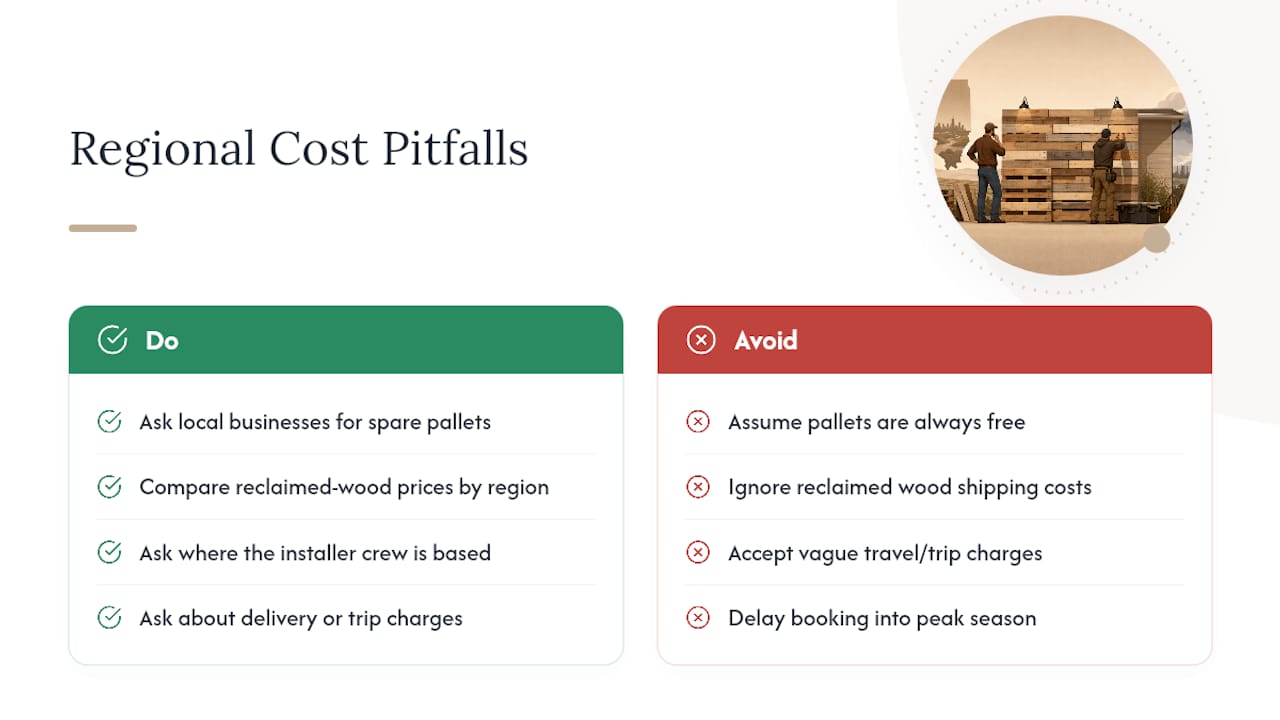
Pallet availability and labor rates shift by region more than most cost guides admit. In areas with active shipping, warehousing, or agricultural distribution, free pallets are genuinely easy to find, sometimes just by asking a local business to set a few aside. In dense urban markets or regions without much industrial activity, “free” pallets can mean driving 30 minutes each way or paying a small pickup fee that erodes the savings.
Lumber yard and reclaimed wood pricing also varies by regional supply. Areas near timber production or reclaimed wood brokers tend to see lower per-board-foot prices than regions where reclaimed material has to be shipped in from elsewhere. That gap can shift a 50 square foot reclaimed-plank project by $50 to $100 without anything about the project itself changing.
Labor rates follow a similar pattern. A contractor-installed wall in a smaller Central Illinois community typically costs less than the same scope of work quoted in a major metro area, simply because overhead and demand differ. If you’re comparing quotes from multiple installers, ask where their crew is based, not just where they’ll travel to. Installers absorbing a long drive sometimes fold that into the estimate as a delivery or trip charge, which is worth asking about directly rather than discovering on the final invoice.
Seasonal demand matters too. Home renovation contractors in most U.S. regions see a spring and early-summer surge, and pricing can flex slightly with that demand curve. Booking a fall or winter install, when schedules loosen up, sometimes opens room to negotiate on timeline if not always on price.
What Pallet Walls Cost to Maintain Over Time
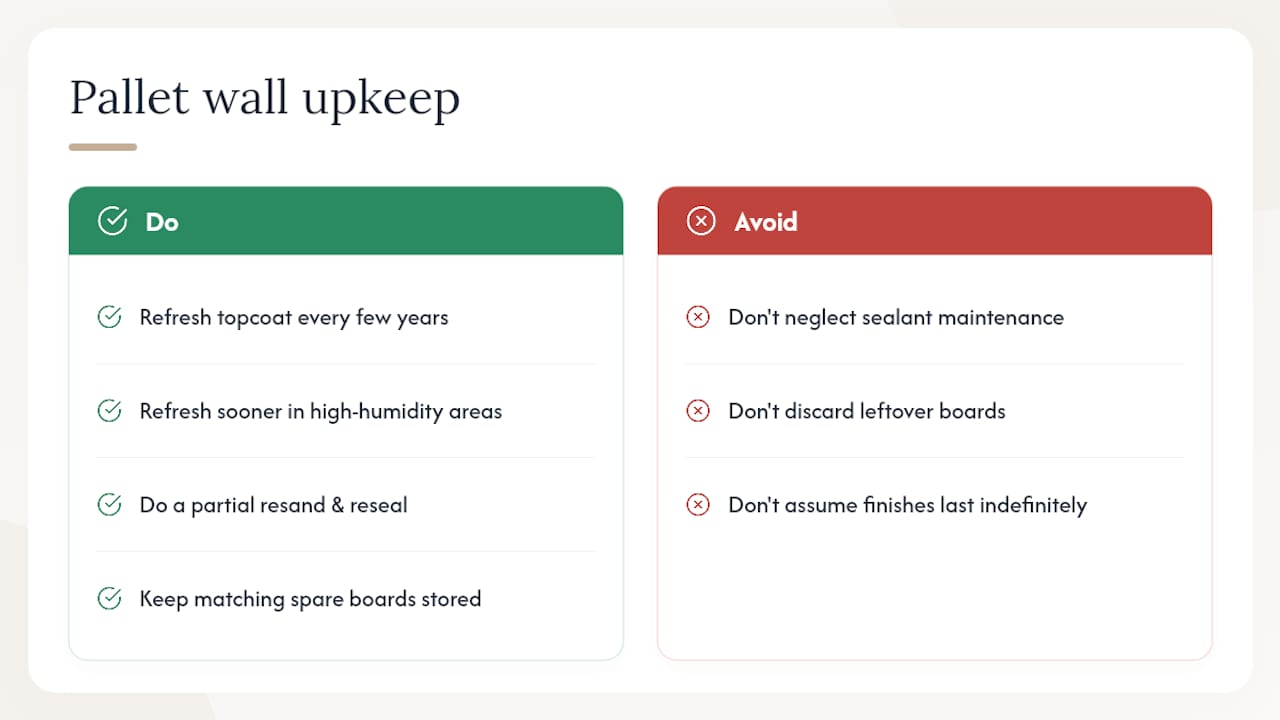
A pallet wall’s ongoing cost is usually low, but it isn’t zero, and that’s worth planning for beyond the install itself. Raw or lightly sealed wood can show more wear in high-traffic hallways or near kitchens, where grease and moisture in the air settle onto exposed grain faster than on a painted wall.
Sealant and stain don’t last forever. Expect to refresh a topcoat every few years in high-humidity rooms, or longer in a dry, low-traffic space like a home office or bedroom accent wall. A partial resand and reseal on a 50 square foot wall typically costs far less than the original install, since it’s a maintenance pass rather than new construction.
Board replacement is the other long-term line item. Pallet wood, especially reclaimed pieces with existing wear, occasionally cracks or splits along old nail holes as a house settles or humidity swings seasonally. Keeping a few matching spare boards from the original project, set aside in a garage or basement, saves you from having to source a color and grain match years later. That’s a detail few first-time DIYers think about until they’re standing in front of a damaged board with nothing to replace it.
Compared to drywall repair or repainting an accent wall, pallet wood maintenance tends to be cheaper and less disruptive; small sections can be patched without redoing the whole surface.
What Nobody Tells You Before Your First Pallet Wall
The budget surprise that catches almost everyone isn’t the wood. Build those into your number from day one, not as an afterthought. Done right, a pallet wall still looks like a professional installation on a fraction of the price.
— Wood
Get a Budget-Conscious Quote From Wood Made Illinois
If the math above tells you a DIY weekend isn’t realistic for your schedule or your wall’s condition, Wood Made Illinois offers a faster path to the same result without the trial-and-error costs of a first-timer’s install. Our team handles everything from a small accent feature to a full pallet wood wall installation, with fixed-fee quotes built around your wall’s actual condition rather than a generic estimate.
To get an accurate quote, have three things ready: your wall’s dimensions, a few clear photos, and your preferred finish (raw, stained, or sealed). We’ll flag any hidden costs, like electrical adjustments or uneven surfaces, before work starts, not after. Browse custom carpentry project ideas for inspiration, then reach out through our trusted local carpentry experts page to schedule a consultation.
Sources
- Pallet Wall : 9 Steps (with Pictures) – Instructables
- How to safely use pallet wood — Earth911
- Electrical box extension brackets — EECO Online
- DIY Pallet Wall – Catz in the Kitchen