The main types of custom closet organizers are wire shelving, freestanding furniture kits, modular panel systems, and fully custom built-ins. If you want the lowest cost and don’t mind a utilitarian look, choose wire. If you want furniture-grade style with room to grow later, choose modular. If your closet has odd angles, sloped ceilings, or you’re outfitting a primary suite you’ll use daily for a decade, a fully custom build earns its price.
- Rental or kid’s room: wire shelving. Cheap, ventilated, done in an afternoon.
- Growing family or budget remodel: modular panel systems. Furniture look, adjustable as needs shift.
- Primary closet or awkward geometry: custom built-ins. Exact fit, best finish, no wasted inches.
Key Takeaways
Matching closet organizer type to your budget, permanence needs, and wardrobe habits matters more than chasing the priciest or most feature-packed system available.
| Point | Details |
|---|---|
| Match type to permanence | Wire and kits suit renters; modular and custom suit long-term homeowners. |
| Budget bands vary widely | Costs run from under $100 for wire kits to $1,500+ for fully custom builds. |
| Components solve specific problems | Match shoe walls, double-hang rods, and drawers to your actual clutter, not trends. |
| Measure before you shop | Width, depth, ceiling height, and door clearance prevent costly returns. |
| Custom pays off for awkward spaces | Woodmadeillinois builds site-specific fits for sloped ceilings, primary closets, and high-use family storage. |
Table of Contents
- Types of Custom Closet Organizers Explained
- Which Components and Accessories Actually Matter?
- Materials and Finishes: What Holds Up and What Looks Good
- How Do You Choose the Right Closet Organizer Type?
- What Do Installation and Costs Actually Look Like?
- How to Measure Your Closet Before You Buy Anything
- When a Custom Carpenter Is Worth the Investment
- What This Editorial Says About Picking a System
- Get a Closet Built for the Space You Actually Have
- Where to Read More and What Tools to Try
- Frequently Asked Questions
- Sources
Types of Custom Closet Organizers Explained
Every closet system on the market falls into one of a few structural families, and understanding the differences saves you from buying the wrong one twice. Industry guides generally sort them into wire, freestanding furniture or kits, and permanently mounted custom cabinetry, with modular panel systems sitting between furniture and full built-ins.
Wire shelving is the system most people grew up with. Vinyl-coated steel wire mounts to the wall on a track, and you can usually finish a reach-in closet in an afternoon. The upside is airflow (nothing traps humidity like a solid wood shelf can) and the low barrier to entry. The downside shows up fast: wire sags under heavy sweaters, doesn’t support a flat surface for folded items well, and looks like a rental unit no matter how you dress it up.
Freestanding furniture and kit systems sit in the middle of the price ladder. Think pre-built dressers, cube organizers, and boxed kits from home improvement stores. You can move them when you move out, swap pieces as your wardrobe changes, and assemble most of them yourself in a weekend. Budget bands for this tier commonly run $100 to $600, according to closet system cost breakdowns, though premium modular towers can climb higher.
Modular panel systems use a track-and-panel approach, laminate or wood-look panels that hang on a rail so you can reposition shelves, drawers, and rods without retooling the whole closet. This is the upgrade path for homeowners who want a built-in look without committing to permanent carpentry. Premium modular setups often land between $600 and $1,500.
Fully custom built-ins are measured, cut, and installed for one specific closet and nowhere else. Nothing is repositioned later because nothing needs to be. This is where you land when your closet has a sloped ceiling, an awkward jog around a chimney chase, or when it’s the primary closet in a home you plan to stay in. Custom work typically starts at a higher price point and increases with square footage and finish level.
| System type | Cost | Appearance | Adjustability | Install complexity |
|---|---|---|---|---|
| Wire shelving | Lowest | Utilitarian | Low | DIY, under an hour per section |
| Freestanding/kits | Low to mid | Casual furniture | Moderate | DIY assembly |
| Modular panel | Mid to high | Furniture grade | High | DIY or pro install |
| Fully custom built-in | Highest | Cabinetry grade | Fixed by design | Pro carpentry required |
Walk-in closets tend to reward the higher end of that table. A walk-in footprint has room for drawer towers, shoe walls, and even a center island, so modular and custom systems get to show off what wire and basic kits can’t do.
Which Components and Accessories Actually Matter?
The system type gets most of the attention, but the components inside it determine whether the closet actually works for how you dress every morning. Here’s what shows up across most closet builds:
- Double-hang rods double your hanging capacity for shirts, folded pants, and skirts.
- Long-hang sections handle dresses, robes, and coats that can’t be shortened.
- Adjustable shelving lets you resize cubbies as sweater season turns into t-shirt season.
- Shallow shelves (8 to 12 inches) are built for folded items and shoe pairs, not deep piles that avalanche.
- Drawers keep delicates, accessories, and anything you don’t want on open display.
- Pull-out trays work well for ties, belts, and jewelry that get lost in a drawer.
- Shoe racks or shoe walls angle footwear so you can see the whole pair at a glance.
- Valet rods give you a spot to hang tomorrow’s outfit without crowding the main rod.
- Built-in hampers hide laundry inside the system instead of piling it on the floor.
Not every organizer type supports every component equally. Wire systems handle rods and basic shelving fine but struggle with drawers since wire doesn’t have the structure for smooth glides. Modular panel systems bolt drawers, pull-outs, and valet rods directly to the track, so you get furniture-level function without full carpentry. Fully custom built-ins can integrate every one of these components exactly where you need them, including soft-close drawers sized to your actual sock count rather than a manufacturer’s standard module.
The real question isn’t which components exist. It’s which ones solve the storage problem you actually have. If shoes pile up by the door, a shoe wall fixes that. If sweaters get crushed on a single rod, double-hang and shallow shelving fix that. Match the accessory to the mess, not the other way around.
Materials and Finishes: What Holds Up and What Looks Good
Material choice affects both how the closet looks in five years and how much weight it can carry today. Solid wood offers the best appearance and the longest lifespan, but it costs more and needs periodic care to avoid warping in humid rooms. Plywood with a wood veneer gets you most of that look at a lower price, since the structural core is engineered rather than solid stock.
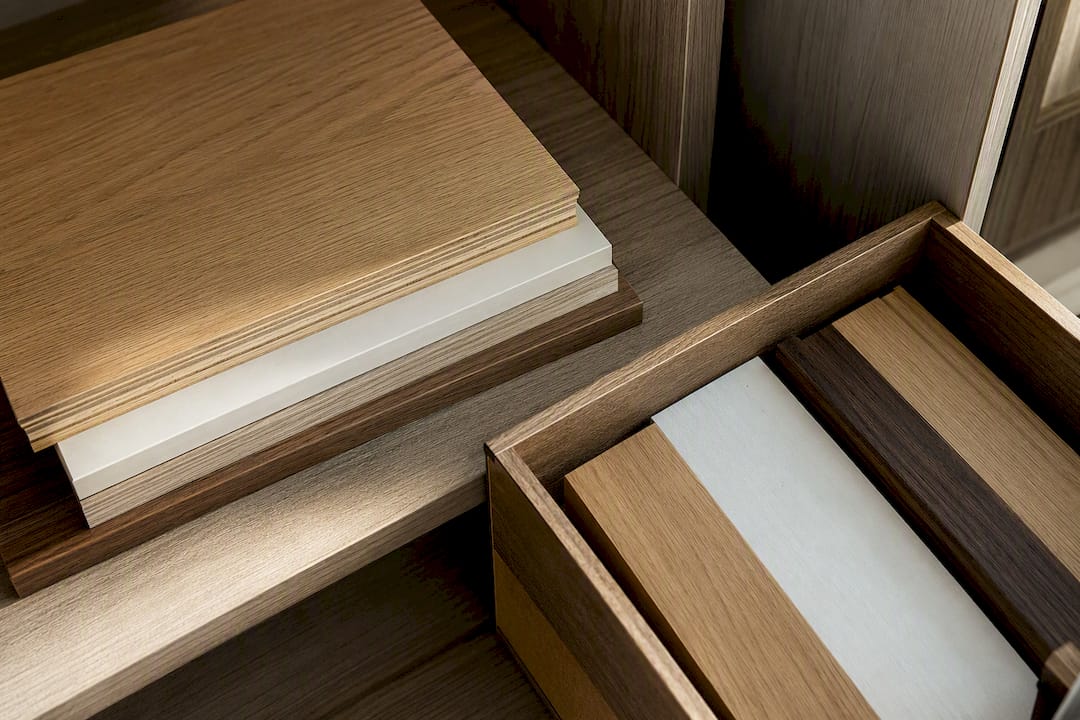
Melamine and laminate are the workhorse finishes in modular and semi-custom systems. They resist scratches and moisture better than raw wood, cost less, and come in dozens of colors, but they can chip at the edges over time and don’t take repairs as gracefully. Wire and metal remain the cheapest and most ventilated option, though they show wear at contact points and simply can’t support a flat folding surface the way a shelf can.
Hardware matters as much as the panel material. Soft-close drawer slides, solid drawer fronts, and painted wood versus laminate all shift the perceived quality of a system, even when the underlying structure is similar. For mudrooms, pantries, or laundry-adjacent linen closets, moisture resistance and load capacity for wet coats and heavy linens should outweigh appearance every time.
Pro Tip: If you’re outfitting a mudroom or a closet near an exterior door, prioritize moisture-resistant materials over matching your bedroom finish. A gorgeous walnut shelf that swells and sticks after one wet winter isn’t gorgeous for long.
How Do You Choose the Right Closet Organizer Type?
Picking a system comes down to five variables: the space type (reach-in, walk-in, or wardrobe), your budget, how permanent you want the solution to be, how much the finish matters to you, and whether you expect your storage needs to change.
Work through these questions before you commit to anything:
- How often do you actually use this closet, daily or seasonally?
- What’s your long-hang to short-hang ratio, mostly shirts and folded items, or coats and dresses?
- How many pairs of shoes need a home?
- Are you renting, or do you own and plan to stay put?
- Does the closet feed into a room you show off, like a primary suite?
- Is your wardrobe likely to grow (new baby, career change) in the next few years?
- What’s your real budget ceiling, including installation?
- Do you want to DIY it or hand it to a professional?
Watch for these red flags before you buy anything: sloped ceilings that make standard modular panels useless, obstructions like vents or outlets in the wrong spot, bifold or pocket doors that limit access to certain wall sections, and any closet where “we’ll just make it work” has already failed once. If you spot two or more of these, a designer or carpenter should walk the space before you order a kit online.
Choosing between an off-the-shelf closet organizer and a custom closet often comes down to this: an organizer adapts standard parts to your space, while a custom closet gets measured and built around your exact routine, at a higher price but with better long-term fit.
Pro Tip: Organizing expert Julie Morgenstern’s advice holds up well here: design for your organizing style, not for a magazine photo. Choose adjustable shelving and modular components so the closet can grow with you instead of becoming obsolete the moment your wardrobe changes.
What Do Installation and Costs Actually Look Like?
Budget expectations vary widely by system type, and knowing the bands ahead of time keeps quotes from feeling like a surprise. Consumer guides put basic wire kits under $100, freestanding or starter modular towers between $100 and $600, premium modular or semi-custom systems from $600 to $1,500, and fully custom installations at $1,500 and up.
| System type | Typical cost | Typical timeline |
|---|---|---|
| Wire kit | Under $100 | 1 to 2 hours, DIY |
| Freestanding/starter modular | $100 to $600 | Half a day, DIY |
| Premium modular | $600 to $1,500 | 1 day, DIY or pro |
| Fully custom built-in | $1,500+ | Days to a few weeks, pro carpentry |
Installation options track pretty closely with system type. Wire kits and basic freestanding pieces are DIY jobs, no special tools required beyond a drill and a level. Modular systems can go either way; some homeowners assemble them solo, others hire an installer for a cleaner result and to avoid drilling into the wrong stud. Fully custom built-ins require a carpenter from start to finish, since the panels are cut on-site or in a shop specifically for your closet’s dimensions.
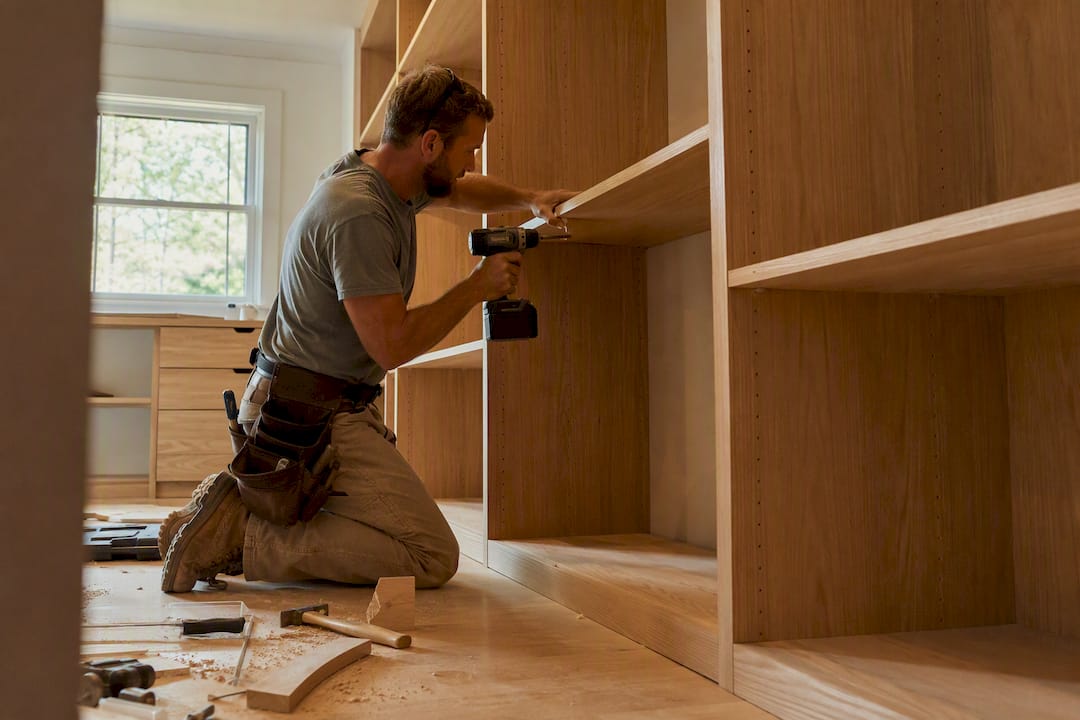
Timelines run longer than most homeowners expect once you factor in prep, actual install, and finishing work like paint or trim. Common add-ons that surprise people at quote time include upgraded hardware, closet lighting, and any drywall repair needed before the new system goes in.
How to Measure Your Closet Before You Buy Anything
Bad measurements are the single most common reason a closet order gets returned or a carpenter has to make a second trip. Get these numbers before you shop:
- Width of each wall the system will touch, measured at three points (top, middle, bottom) since walls are rarely perfectly straight.
- Depth from the back wall to where the door swings or track sits.
- Ceiling height, especially if it slopes, since that changes where upper shelving can go.
- Door swing and clearance, including whether it’s bifold, sliding, or a standard hinge.
- Baseboard height and any return walls that eat into usable width.
- Obstructions, like HVAC vents, outlets, or light switches that a shelf can’t cover.
For layout, reach-in closets generally work best with a double-hang section on one side and shelving stacks or short-hang on the other. Walk-ins support more elaborate combinations, including drawer towers and shoe walls, plus a center island if the room allows it. Keep at least a 36-inch clear walkway around any island so the closet stays functional and not just photogenic.
Sketch what you find, even roughly, and hand it to whoever you’re getting a quote from. A hand-drawn diagram with real numbers beats a verbal description every time.
When a Custom Carpenter Is Worth the Investment
Some closets don’t need a kit at all. They need someone who can measure the actual angles in the room and build to them.
- Exact-fit solutions for sloped ceilings, chimney chases, or oddly placed windows that no modular panel was designed to work around.
- Finish matching to existing trim, doors, or cabinetry elsewhere in the home.
- Integrated lighting and specialty hardware, like built-in outlets for a jewelry charging station or a pull-down valet.
- Long-term durability since site-built cabinetry typically outlasts stock modular panels under daily use.
Custom work pays off most in a primary closet you’ll use every single day, a high-traffic family closet that takes a beating, or any room where resale value matters and a half-finished wire shelf would hurt a buyer’s first impression. Reputable shops back this up with free design consultations and 3D planning tools that let you see the layout before a single board gets cut, along with clear installation warranties.
Pro Tip: Ask any shop you’re considering what happens if your measurements were slightly off after install. A warranty on workmanship, not just materials, tells you how confident they actually are.
What This Editorial Says About Picking a System
Most closet advice treats the decision like a shopping problem: compare features, pick the highest-rated kit, done. That misses the actual failure point, which isn’t the product, it’s the mismatch between a rigid system and a life that keeps changing. A wire shelf installed for a toddler’s closet in 2020 rarely still fits that same kid’s wardrobe by middle school.
The overlooked variable in most guides is permanence tolerance, how much you actually mind ripping something out later. Renters and short-term owners should stop chasing furniture-grade finishes they’ll abandon in three years. Homeowners settling into a primary suite for the long haul often underspend on custom work because the sticker price looks steep next to a $150 kit, without weighing what a decade of daily use against an ill-fitting shelf actually costs in frustration.
The honest advice: buy cheap when the closet is temporary, and buy once, correctly, when it isn’t. Skip the middle ground of a $700 modular system you’ll resent in two years because it almost fits.
Get a Closet Built for the Space You Actually Have
If you’ve read this far and realized your closet has a sloped ceiling, an awkward jog, or just deserves better than a wire shelf sagging under winter coats, Woodmadeillinois builds the fully custom option this guide keeps pointing back to, at a price and turnaround that fits Central Illinois budgets rather than a national showroom markup.
Every project starts with a design consultation where we measure the actual angles in your room instead of guessing from a catalog module, and we’ll walk you through finish and hardware choices that hold up in daily use, not just in a showroom. Homeowners dealing with mudroom chaos, an awkward primary closet, or a built-in that never got finished right the first time tend to see the biggest difference once the work is custom-fit. If your closet has been “making it work” for longer than you’d like to admit, reach out to Wood Made Illinois and get a real measurement and quote before you buy another kit that almost fits.
Where to Read More and What Tools to Try
For deeper cost comparisons, The Home Picker’s closet system breakdown covers budget bands in detail. For layout guidance by room type, Diplomat Closet Design’s system overview explains walk-in versus reach-in component options. Before ordering anything, use a free design consultation and 3D planning tool to catch measurement errors early, and check Woodmadeillinois’s custom shelving page for finish and hardware examples.
Frequently Asked Questions
What are the main types of custom closet organizers?
The four primary categories are wire shelving, freestanding furniture or kits, modular panel systems, and fully custom built-ins. Each trades off cost, permanence, and finish differently, so the right pick depends on your budget and how long you plan to stay in the home.
Is a modular closet system worth the extra cost over wire shelving?
For most homeowners planning to stay several years, yes. Modular systems support drawers and pull-outs that wire can’t handle well, and premium modular setups typically run $600 to $1,500 versus under $100 for basic wire kits, according to closet cost guides.
When should I hire a custom carpenter instead of buying a kit?
Hire a carpenter when your closet has sloped ceilings, unusual angles, or built-in obstructions that standard modular panels weren’t designed to fit, or when it’s a primary closet you’ll use daily for years.
How do I measure my closet before getting a quote?
Measure width at three points per wall, depth from the back wall to the door track, ceiling height (note any slope), door clearance, and mark any vents or outlets that could block shelving placement.
Do custom closet companies offer free design help?
Most reputable shops offer a free design consultation and often a 3D planning tool so you can see the layout before committing, which helps catch measurement issues before installation.
Sources
- How to Choose a Closet Organization System 2026: Wire vs Wood vs Modular – The Home Picker
- Custom Closet Organizer: Compare Options & Pick Better (2026)
- Top Closet Systems for Homes: Types & Benefits | Diplomat Closet Design
- Best closet systems guide with expert organizing perspectives | Better Homes & Gardens